Yonder Toward the Dardanelles

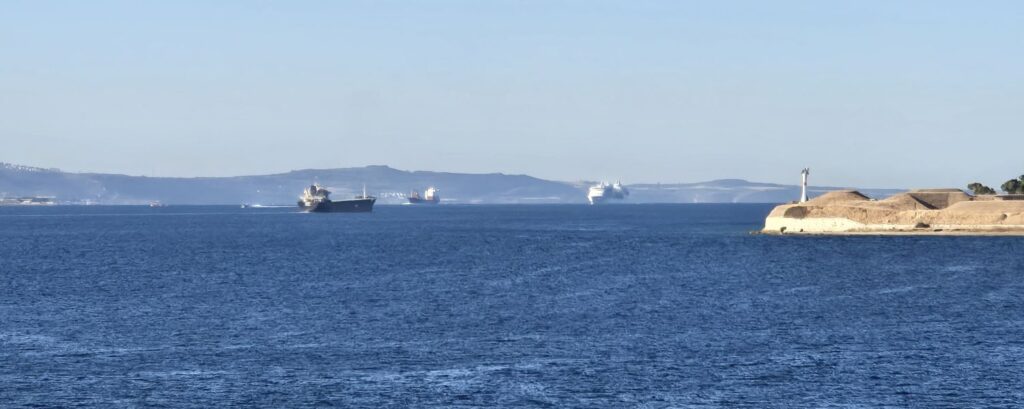
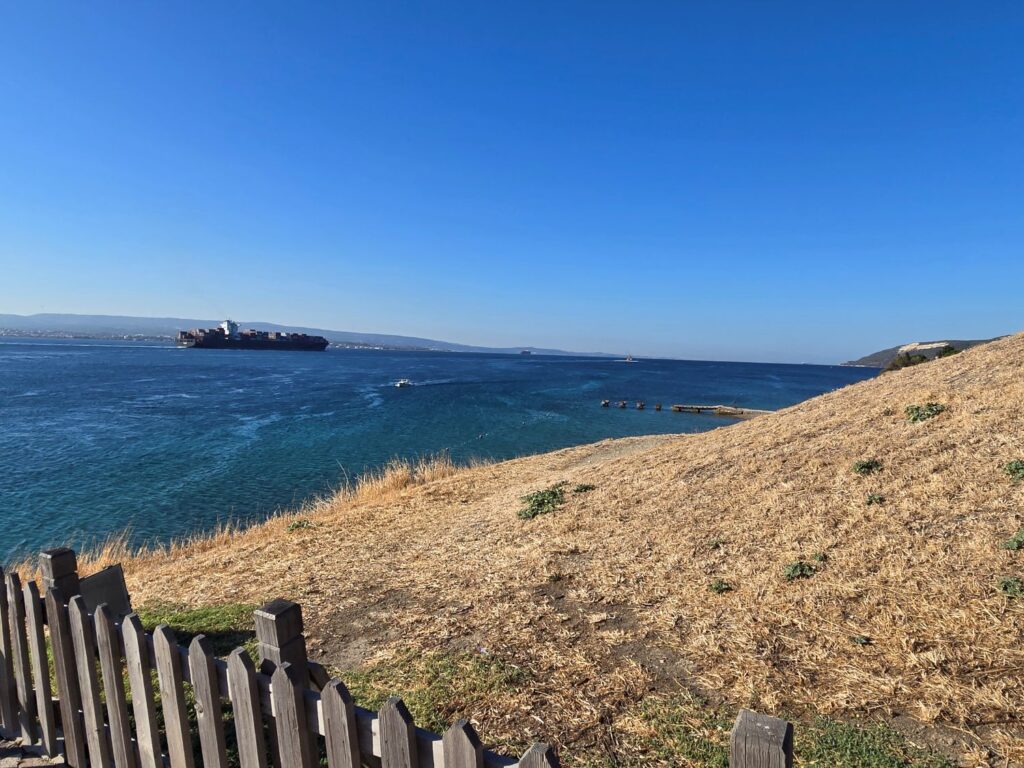
Shipping on the Dardanelles.
Dardanelles shipping on the current and at dock.
P. Ferguson image, September 2025.

Introduction

I stood on the deck of a troopship
At the Gate of the Dardanelles,
Midst the thunder of warships’ cannon
And the bursting of giant shells

G. Brownell, The Call from the Dardanelles
Published in The Referee, 6 October 1915

Suvla Bay.
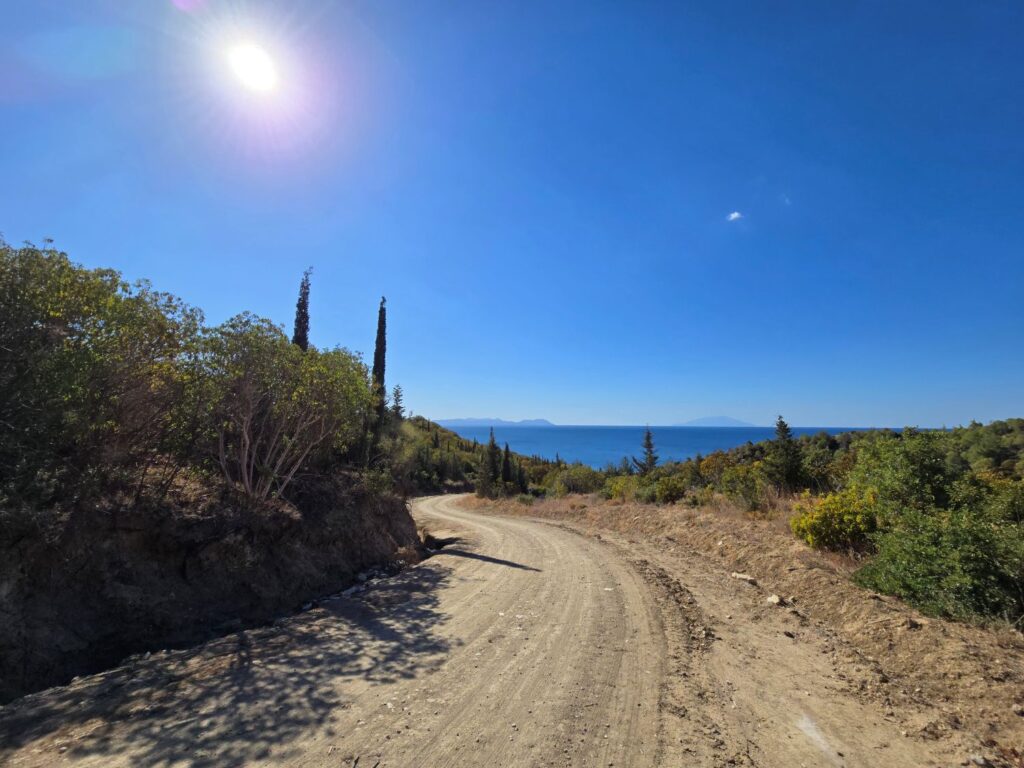
Suvla Bay where the Allies landed nightfall 6 August 1915.
P. Ferguson image, September 2025.

Day Six (20 September): Suvla

As time nears to our departure another ferry arrives and satirical discussion immediately ensues about the possibility of being rammed amidst various references to well-known but cliche film quotes. The ferry pivots on a dime or more likely a plastic lid floating on the water. The on/off procedures are perfection with those well versed in the ways of our local crossing. Efficiency, both in unloading and loading, some at the same time and when full – off to the other side once again. Atop our water transport I repeatedly rise to photograph the mercantile fleet making its way to the sea. I appreciate painted colour against the natural landscape and deep blue of the passage.

Dardanelles vessel heading north.
The deep blue. Dardanelles vessel heading towards the Sea of Marmara.
P. Ferguson image, September 2026.
The shades of the water’s deep blue harmonizes with the gentle ripples. Enough to make the contours assured of highlights and shadows. Reds and whites stand out against layers of centuries old merchant fleets. With the green but dry Gallipoli Peninsula in the background another freighter compass point moves along. I turn to thinking of Conrad’s Lord Jim and the Patna. Serendipitously how chance reminders (neural signals) allow us to connect random thoughts. Our crossing may be slow today as the floating commerce takes precedence, I take the opportunity writing reminders of neural signals to voyages upon the seas.

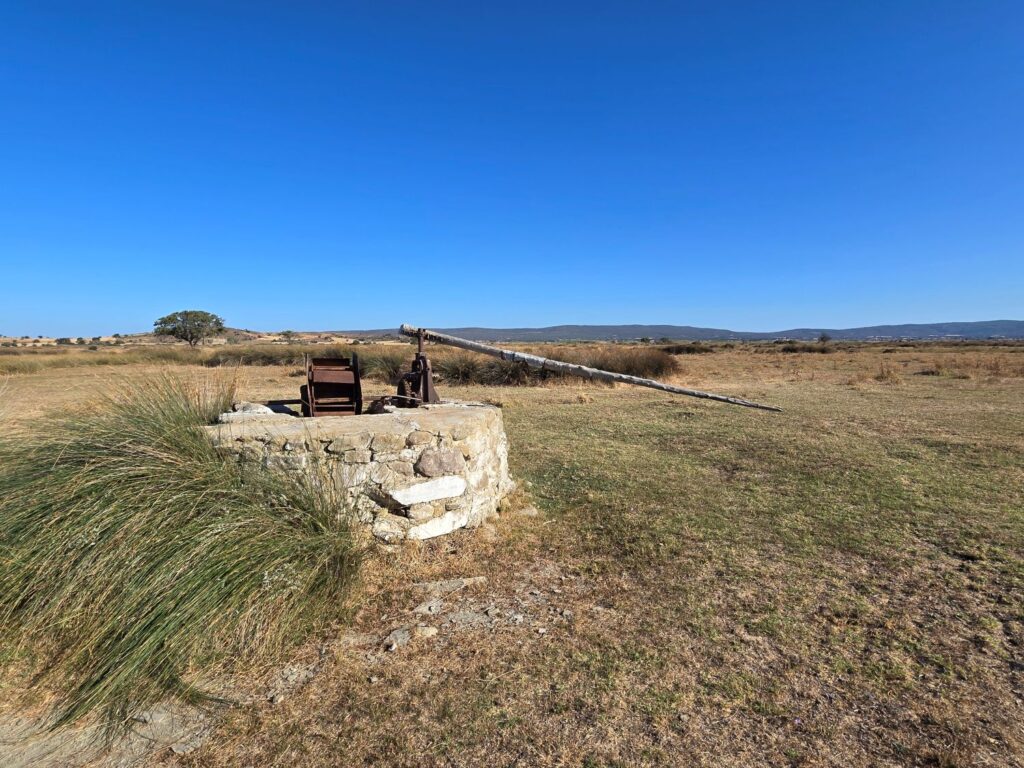
The well.
The well. Failure to provide a shout leads one traveler to drawing water.
P. Ferguson image, September 2025.

Upon the other side we learn of failure to pay for a round (in Australia and New Zealand – think ANZAC – a round is known as Shout/Shouting) has resulted in one of our adventurers assigned with the task of drawing water near Green Hill and Chocolate Hill. In close pursuit is a driver chasing our laborer in circles. Amidst the laughter one thinks of Arnold as Conan. Methinks there will be additional shouts in the evening.

The Lala Baba trail.
Upon this place we tread. Our trail up Lala Baba Hill.
P. Ferguson image, September 2025.

Today at Lala Baba Hill (200 feet high) we learn about the Yorkshire Regiment (6th Green Howards) who are largely coal miners from Durham. Instructed not to use ammunition in the 7 August 1915 attack the fight is with the bayonet and hand to hand combat. The element of surprise lost due to a flare. Three-quarters of the regiment becoming casualties. After two hours there are only fragments of the 6th remaining. Tough coal miners downed by continual hurt upon this place we tread. Amongst their losses Lieutenant Colonel Henry Edward Chapman killed whilst leading the attack to the summit (and here…here we stand). Chapman is buried at AZMAK Cemetery, Suvla.

War Graves headstone H.E. Chapman.
Lieutenant Colonel H.E. Chapman marker, AZMAK Cemetery.
P. Ferguson image, September 2025.

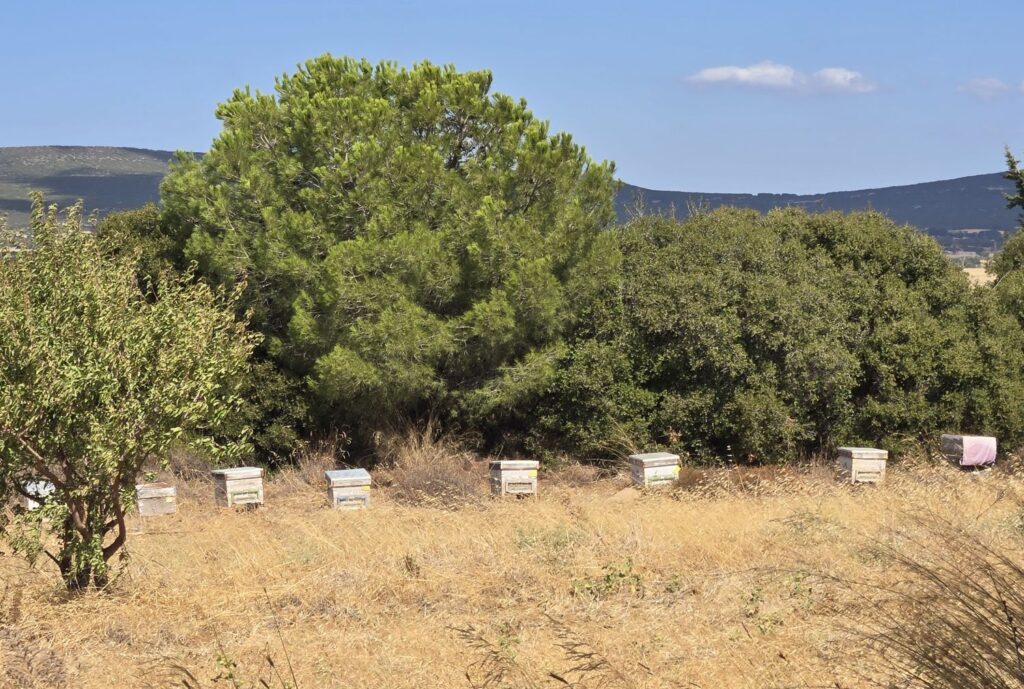
Our journey continues. At our next site I watch green feathered birds dart amongst the trees at Chocolate Hill. We meet with the property owner who takes us to a previously buried Turkish projectile, with fuse and shrapnel balls. After this viewing of rusted metal, attention is turned to the nectar of bees as jars of honey are purchased for travel to tables in the UK. Hives and high explosives – nectar and hurt from the same fields.

Honeybee hives.
Eat honey, my son, for it is good. (Proverbs).
P. Ferguson image, September 2025.

The day continues with the words of Homeland reminding us of the harshness that was once here. Sadly, I am unable to find this voice this day…perhaps it will be heard again to these ears? With thoughts of all this storied day we arrive at Hill 10 Cemetery where I photograph gravestones of Newfoundlanders and so too the Hook Brothers, Duncan and Robin, 9th Battalion Lancashire Fusiliers resting side by side. Their story was known to me…and now there in another, Henry Edward Chapman far, far away across the sea.

Imperial War Museum. Lives of the First World War. E.H. Chapman.

And now today (10 January 2026) with time at home in the comfort of an oversized chair I imagine my Dardanelles ships of colour making their way upon the dueling currents. I think of 1899-1900 Conrad but find another while in search of quotes about the Dardanelles…a 1860 passage not heard to me before…a new serendipitous chance reminder that will return time and time again.

Dardanelles
Théodore Aubanel
French Provençal poet

In the still hours when I sit dreaming
Often and often I voyage in seeming;
And sad is the heart I bear with me,
Far, far away across the sea
Yonder toward the Dardanelles
I follow the vessels disappearing,

Vessels of the Dardanelles.
Dardanelles merchant ships.
P. Ferguson image, September 2026.

From notes written 20 September 2025
—SNIP—

Alinteri Words of the Day

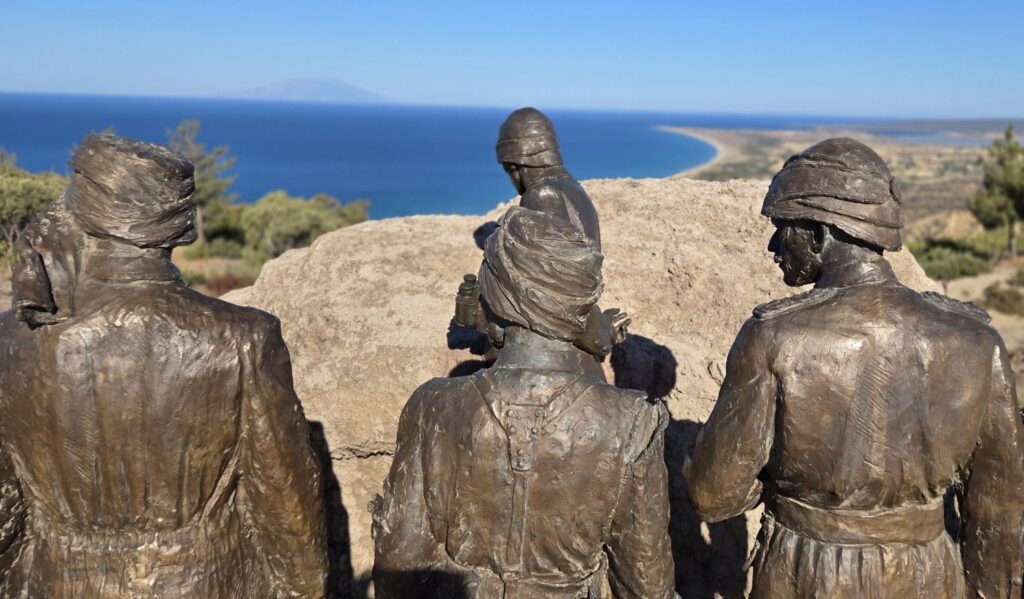
Soldiers in bronze
Soldiers in bronze watch from the high ground.
P Ferguson image, September 2025.

Day Five (19 September): ANZAC II

Minor issues this morning but enough to throw me off my mark. Hopefully catch up will round itself out shortly. It is enough that this creature of habit’s morning routine has had his trail disturbed. Once sorted I feel hurried but resolved. Soon I am at breakfast circling about the honey and bread, cereal, raisins and hot food. Afterwards we advance to the café nearest to our embarkation point. The morning, like the strait and self, has become calm…one must remember…minor issues.

Cars and passengers on the ferry.
Vehicles and passengers prepare to disembark for the Gallipoli Peninsula.
P. Ferguson image, September 2025.

Again our team climbs to the top of the ferry for our crossing to the Gallipoli Peninsula. Two trips a day, there and back again, and how I do enjoy the crossing in these open-seating boats. I have time to think, to start the new words of the day. My mobile is a constant tool – the Notes app receiving a workout each day as I gather thoughts wherever I can. These initial impressions will be added too. More writing, more rumination to follow.

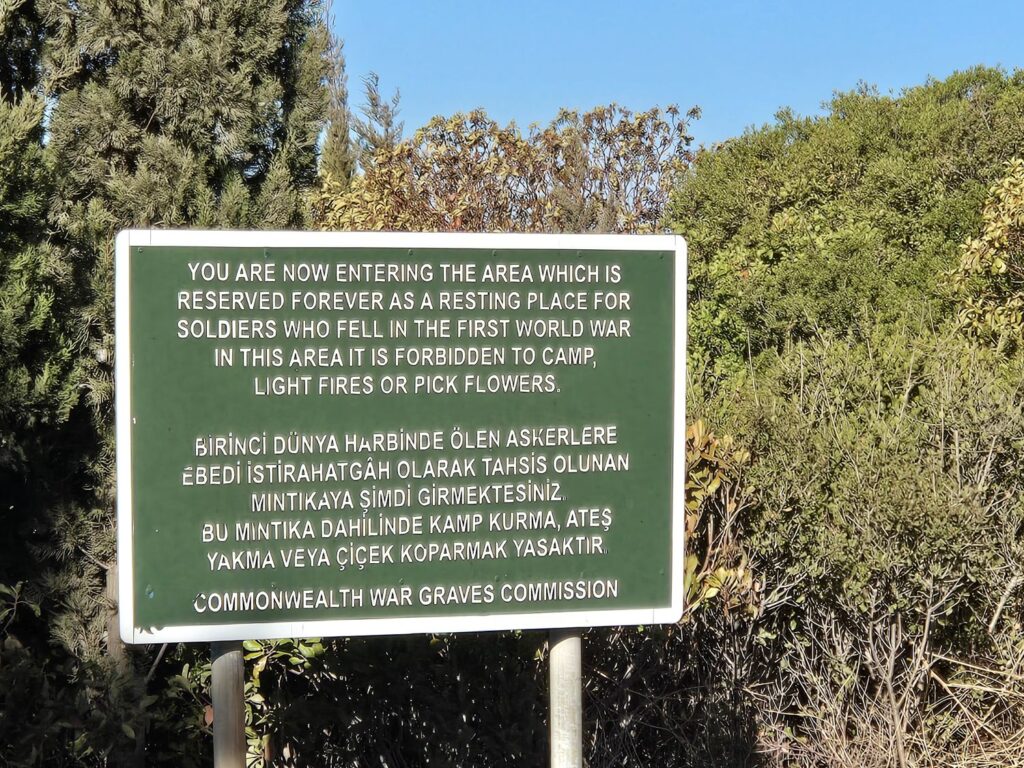
A reminder of where we enter...
A reminder to us all of this land …of what went before.
P. Ferguson image, September 2025.

I believed earlier this may be my last visit here, but I think not. Why do we come back to these places? There are daily challenges, I have challenges – at times with every step. But I return because of what went before. Knowing, feeling this ground, these surroundings, sun, water, earth and sky – the people whose experience was this ground and turning this to my experience for them…for others.

We see more people today visiting relatively open sites. The benefit of this style of operational history tour is we go up and we go down the roads and trails less traveled. I appreciate those who visit here whether from cruise ships, buses or on their own. They have at least shown interest. What connects these visitors to these grounds (?) – to walk these earlier steps, to feel this ground, to stumble to fall, to feel the heat, the salt, the challenge of the climb…

The rugged trail
The burnt and dried landscape of Gallipoli.
P. Ferguson image, September 2025.

It’s a four water bottle walk down a slope covered with debris and stone. Burnt branches litter the ground and in the near distance the sound of chainsaws and falling timber dry crackles its way to the earthen deck. Locals must wonder why we came this way as blackened hands wonder where to wash. The bosks* and holts** require fleet of foot and the free-spirited whip-like branches find their way across your person attempting to thwart your step, to challenge your balance, stinging when their twitch finds bare skin.

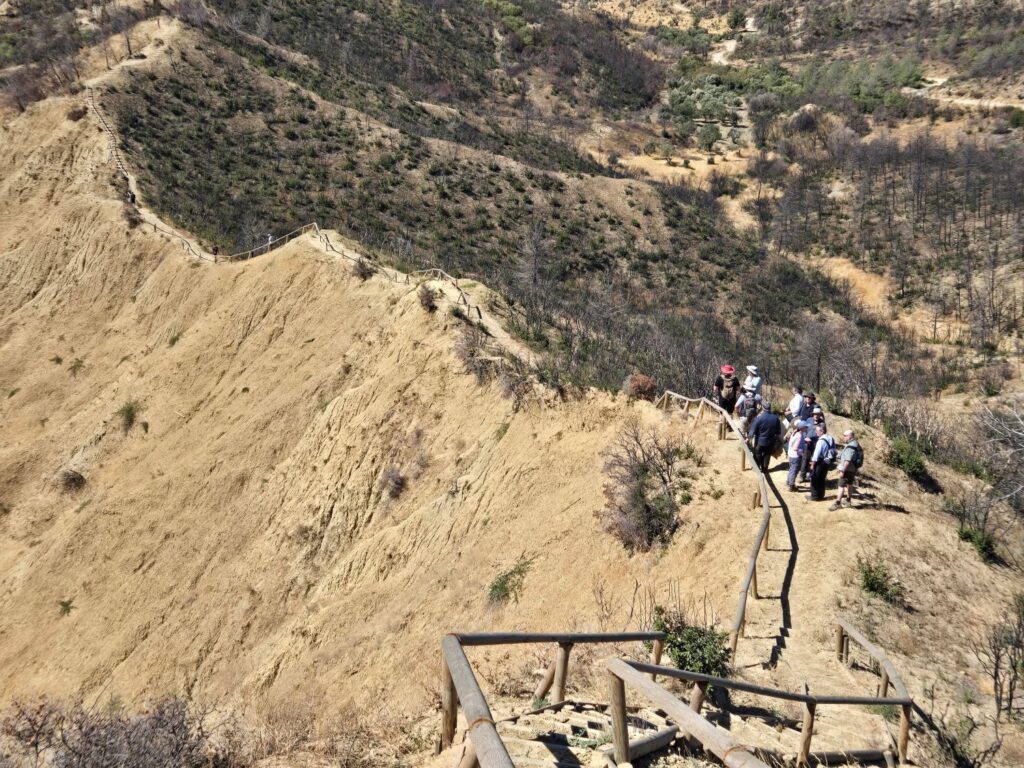
Rhododendron Ridge
Rhododendron Ridge.
P. Ferguson image, September 2025.

The climb down and up Rhododendron Ridge, part of the Sari Bair range is much kinder than 2012. The peaks here are 200 to 300 meters high or for us old school types 650 to 980 feet high. And to think soldiers climbed in between these trails and upwards whilst under fire! Aged steps of varying low and deep rises have been replaced with some kindness, albeit occasionally with a reach of the foot. Former railings made of branches have, as well, been replaced with a finer version of sturdy and do not wobble nearly as they did before. It is a grand walk to the water and an event that pushes me, like Gully Ravine to a return visit. With our journey’s end we board our bus to lunch at Hill 60 and stop at the Sphinx where we have time to become familiar with this landmark formation overlooking ANZAC.

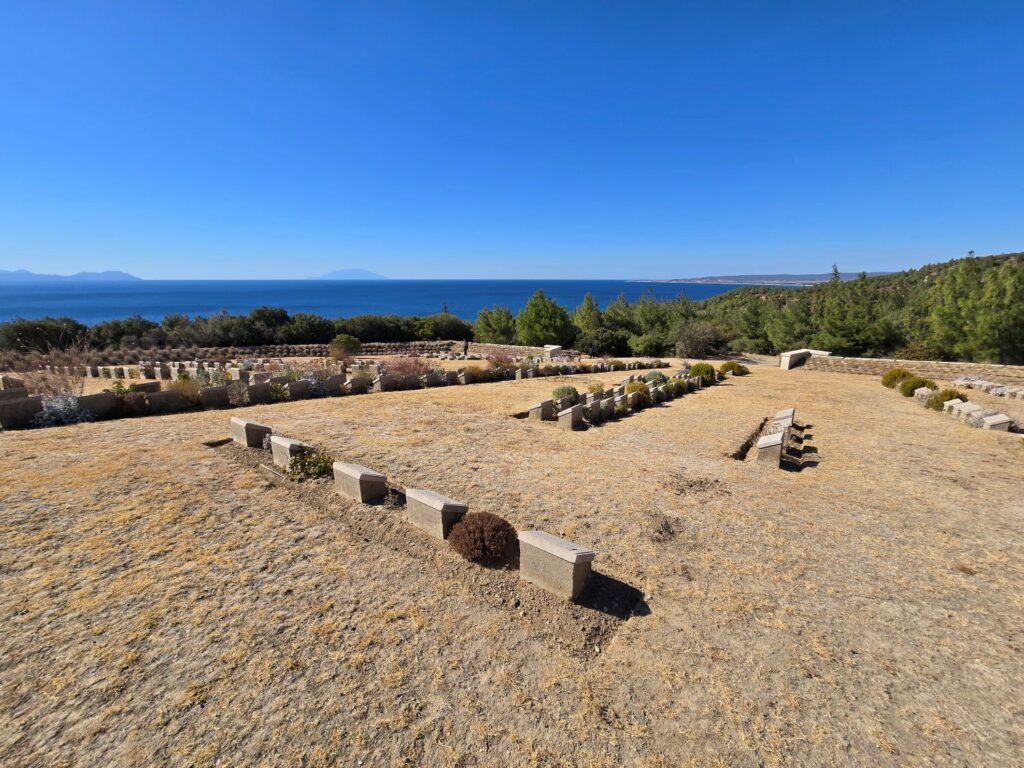
Shell Green Cemetery.
Shell Green Cemetery, cricket was played here. Howzat…Jaffa.
P. Ferguson image, September 2025.

Another walk follows uphill to Shell Green Cemetery where a diversionary cricket match was played on the green by the 1st Light Horse Brigade on the 17 December 1915. The tactical innings a ruse, a deception to conceal Allied preparations for the evacuation of the ANZAC and Suvla Bay sectors. With thoughts of batting and centuries (100 runs), bouncers and googlies I return whence I came down the graveled road, bringing an end to the historic portion of the day…and with each step I watch as the sun stipples across the water on the horizon.

Return from Shell Green Cemetery.
The return from Shell Green Cemetery.
P. Ferguson image, September 2025.

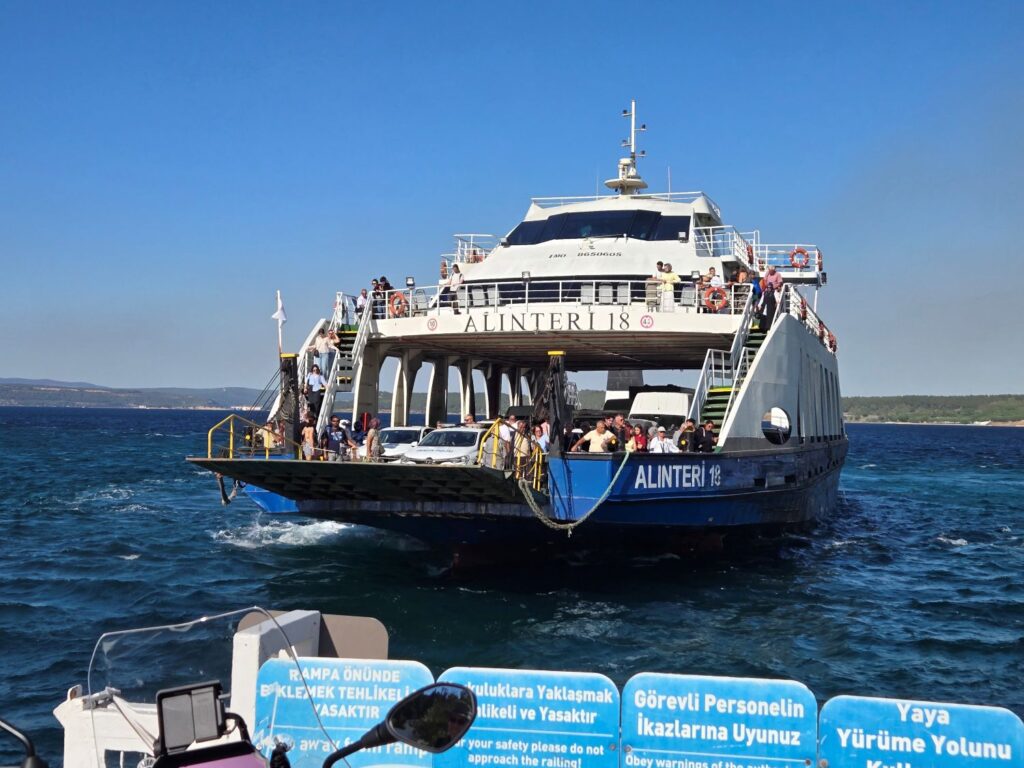
Our bus attempts to reach an early Çanakkale ferry, but our boat has just departed. No hurry, there is more time to watch from this bank. I watch side to side observing life moving within the winds of today. It is a fine contrast to the past events we experience with our wanderings here. As the Alinteri*** 18 docks, I return to the present requirements. It has been a fine day of great effort and achievement. People and cars disembark (and load) at the same time. The vessel waits until full – not to a set schedule (it would seem). Before we depart the nearby minaret provides its audible devotional to all. Heads turn towards the direction of the call to prayer heralded from the tower and as we depart, I wonder what those amongst hear within its yearning voice?

Our ferry the Alinteri.
Our return ferry the Alinteri 18 prepares to dock.
P. Ferguson image, September 2025.

* Bosk: thicket of bushes, a small wood.

** Holt: Old English. A small wood, wooded hill, grove of trees.

***Alinteri: Turkish meaning “sweat of the brow”. Hard work, labor or great effort. Used to emphasize that something was achieved through honest hard work.

From notes written 19 September 2025

—SNIP—

Can You Hear the Music

Introduction

Istanbul not Constantinople. We are barely off the ferry and onto the bus…the preliminaries beginning as I request 30 seconds notice before we join in this day’s, same as each day, bus-song. Great fun and now (having had 30 seconds) recorded for all time, a rousing choral group only too pleased to belt out the tune, ably led by the PHBT* logistics team. Though prior to this trip the song amused me it is now a standout, a memory for all time. The tune sets the tone for our day…brings the team together…all are smiling, whilst chattering about last evening’s wind tunnel refreshments. Our 50-minute drive to Gully Ravine continues.

Day Four (18 September): Helles 2

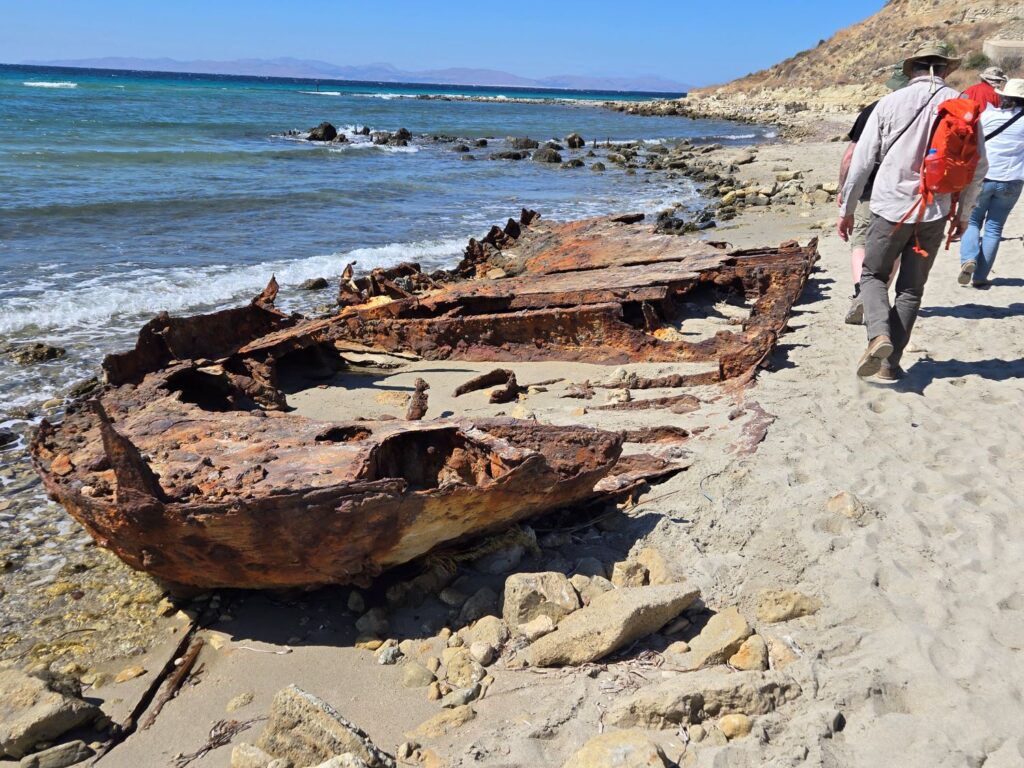
Lighter at Gully Beach,
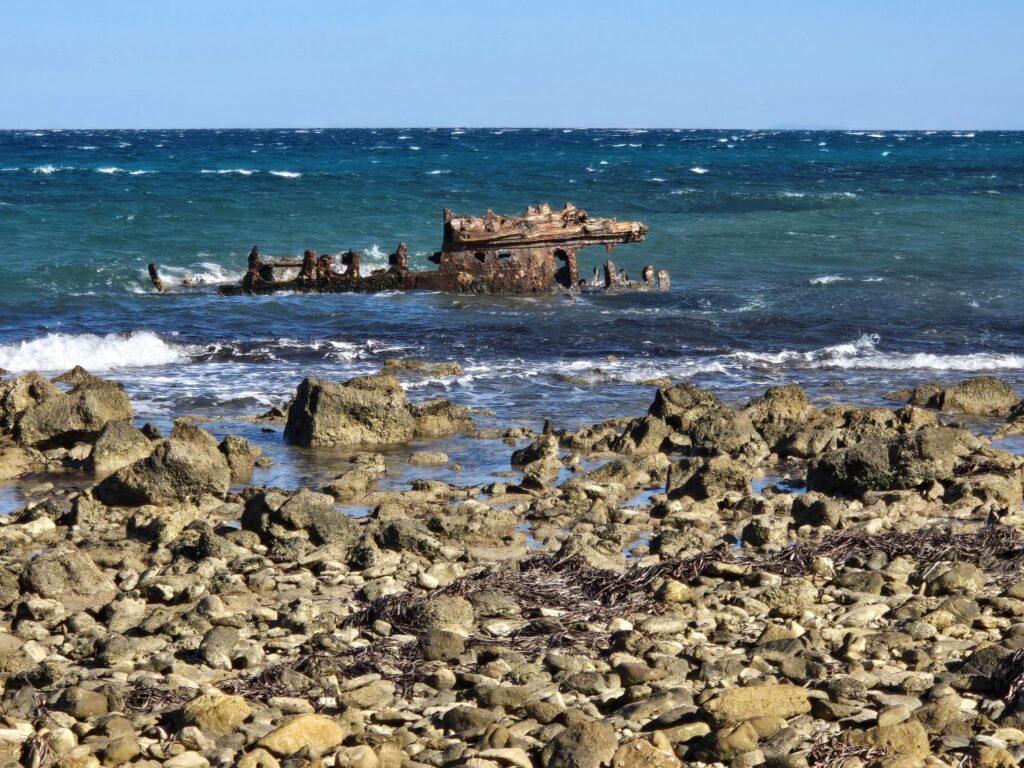
Shipwrecked lighter at Gully Beach.
P. Ferguson image, September 2025.

We stop at X beach and walk part way down the slope stopping before we are on the landing. It is a brief visit to learn what happened here but soon we move on to Gully Beach (Y2) where another vessel awaits us lying in state beached. Its metal skeleton becoming increasingly a relic of layered, shredded rust. One day the sea shall have the boat shard as the waves continue with their wake. Nearby the bones of men.

Water bottles.
Standing full and crumpled water bottles.
P. Ferguson image, September 2025.

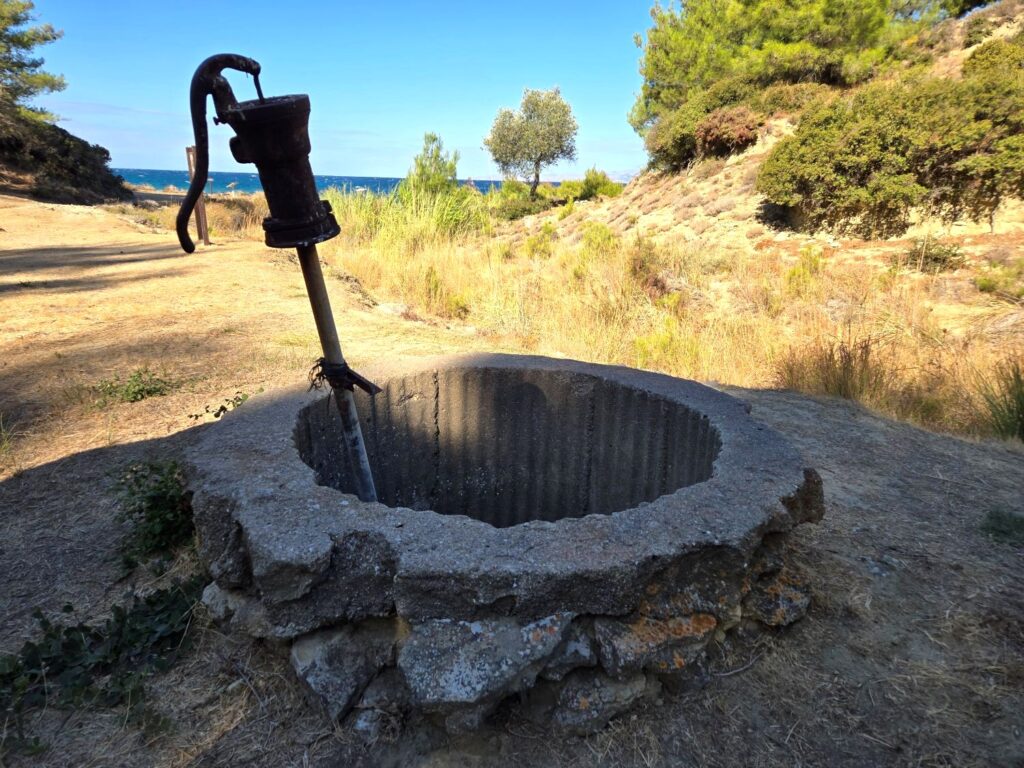
We walk towards a well…likely dug by Joseph Murray, Hood Battalion, Royal Naval Division. Though water lies within its walls we would not drink from it. Best to trust the hydration we carry. Aqua est Vita – Water is Life. A perfect reminder – remember to hydrate…our next walk is three bottles long…and our time here and for all days – the sound of crumpling bottles like the shuffling of cards. Some sounds stand out from the crowd, and this is one for the duration. We move on from the well, card metaphors continue.

Well near Gully Beach.
Water is life. The well near Gully Beach.
P. Ferguson image, September 2025.

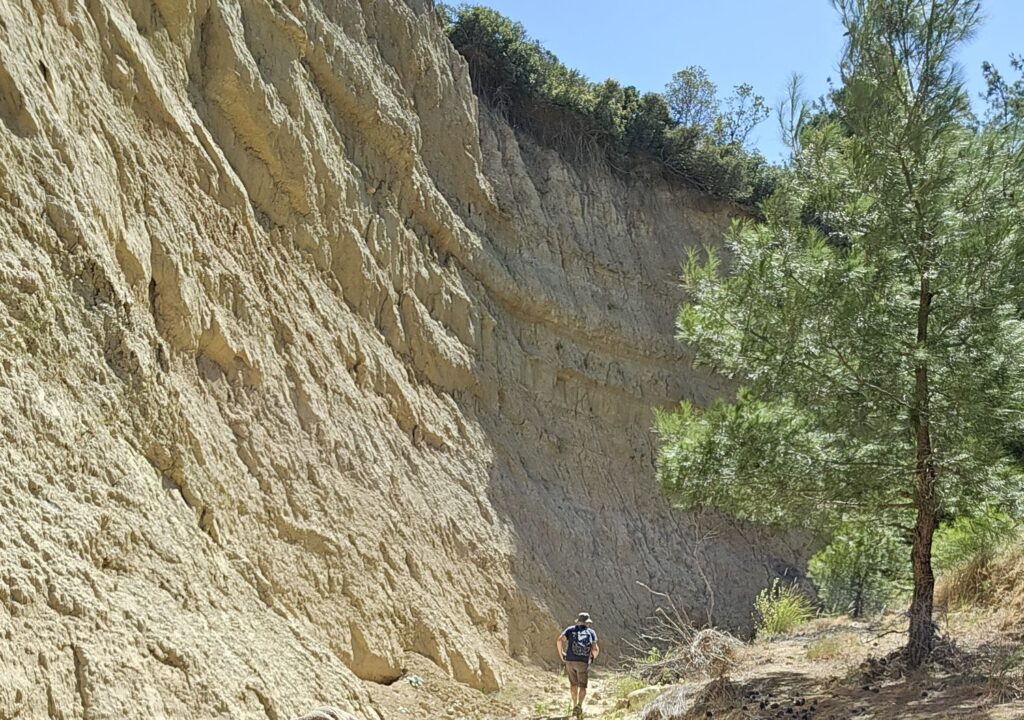
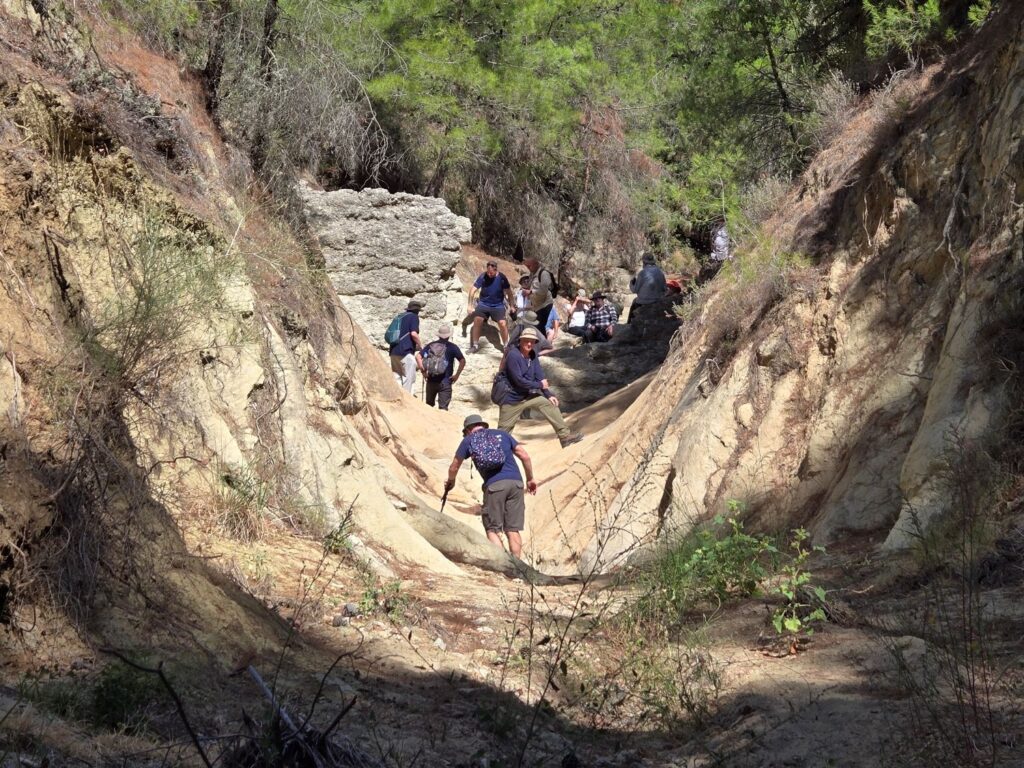
Our wander through the dry ravine goes especially well. In 2012 our group had challenges to navigate…I seem to recall sliding across boulders (or at the least very large rocks or was it compacted earth – probably both) in an attempt to move along the path of least resistance. There seemed to be more obstacles as the water in the ravine dictated our need to bob and weave. One was concerned about falling in – though not deep there would be far too much laughter for the remaining day and for the rest of the trip. Here in 2025, there are a few low-level challenges, and the natural rock wall requires two to help me over, but there is no water. I suspect the 2012 challenges remain – that was May…now in September it is far drier, not very green, and so too with wildfires having taken much in its path…we are able to see more.

Gully Ravine
Walking through a very dry Gully Ravine.
P. Ferguson image, September 2025.

Along the gully’s carved route I again stand and walk in amazement at this natural place that in 1915 saw medical posts within its contours including dressing stations and first aid posts. I imagine as I wander, what silent sounds rebound within these walls…their stories are being told again as we walk through this part of history. Hmmmm 1915…2025…110 years later. We will remember them.

Approaching the rock wall at Gully Ravine.
The team at the natural rock wall of Gully Ravine.
P. Ferguson image, September 2025.

At Nuri Yamut Memorial we sit outside its walls and receive our lunch, meatball sandwiches embedded with chips aka fries, along with bananas, drink and ice cream. While here in Gallipoli each day, time is of its own accord. It takes the time it takes to hike to places, there are always detours in our advance, new finds, new excursions, lunch occurs when we get there. Not as scheduled but always appreciated. As I walk along the wall after re-fueling the call to prayer begins its crest. Indeed most appropriate after all we have seen.

Redoubt Cemetery.
Redoubt Cemetery. West of Krithia.
P. Ferguson image, September 2025.

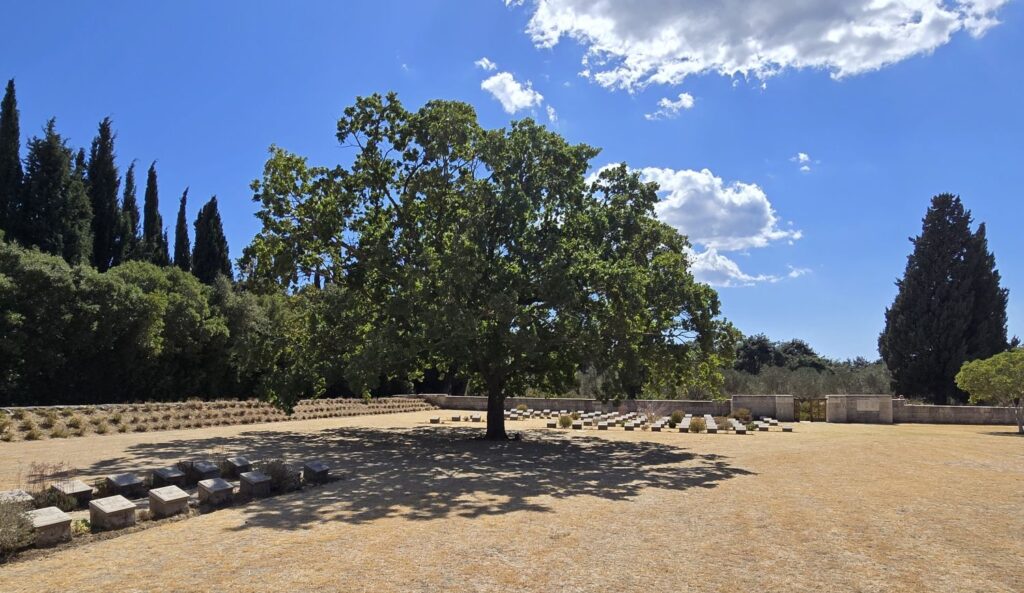
A visit to Redoubt Cemetery, near Krithia, occurs near to day’s end and brings us to a memorial tree planted in honour of 2nd Lieutenant Eric Duckworth, “B” Company, 6th Battalion, Lancashire Fusiliers, age 19. The tree is the only private memorial on the Gallipoli Peninsula having been planted by his parents James and Mary Duckworth of Dunsterville, Rochdale in 1922. Though Eric Duckworth was never found, he is commemorated on the Helles Memorial, the leafy oak stands with 2,027 Commonwealth servicemen burials and commemorations.

Eric Duckworth memorial treee.
Memorial oak tree planted in memory Eric Duckworth.
P. Ferguson image, September 2025.

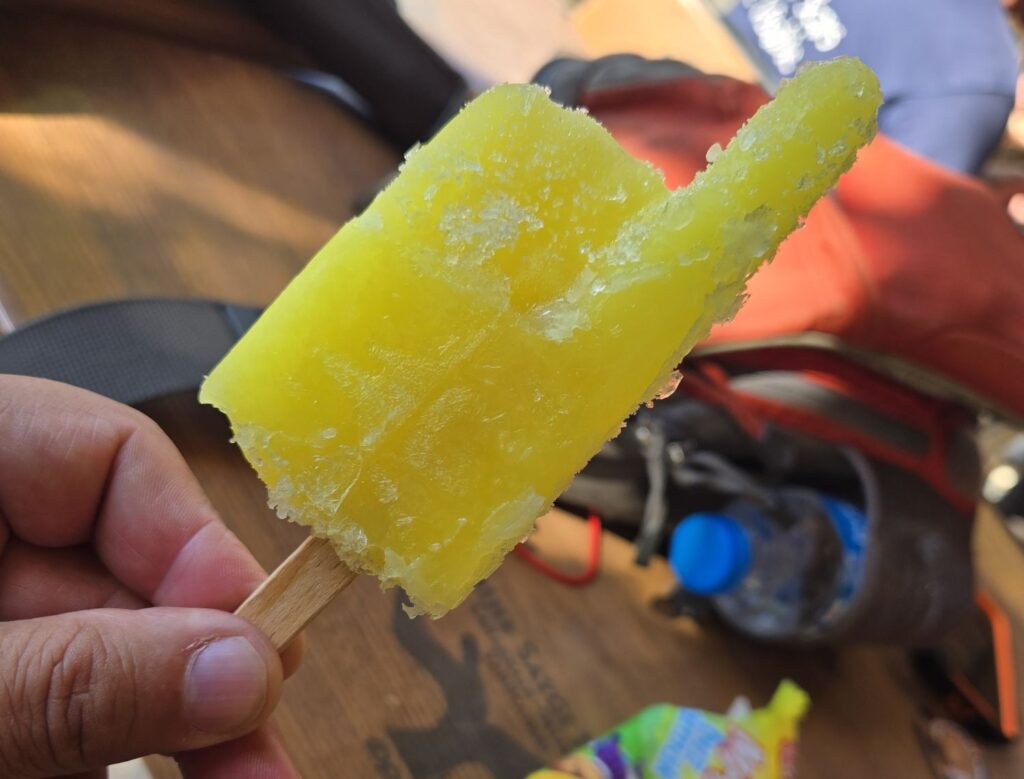
Reminders of loss continue as we add to our day of learning at Achi Baba a site of great devastation, costly and bloody, in these killing fields and gullies. There was an immense loss of life here, fragments of war are found along our travel lines and, at rest in the crux of a tree, the sting of a projectile lies extinguished but haunting. The trauma still remains in these grounds and waters… though we repeatedly remind ourselves to never let this carnage happen again, with our lives of experience, the knowledge of the days we have now… is it too much to contemplate the actions we continue…after our simple pleasures of lemon ices? Aqua Est Vita…Terra Musicam Habet Is Qui Audiunt (the earth has music for those who listen).

Lemon ice.
Lemon ice at Krithia. Time for contemplation. Can you hear the music?
P. Ferguson image, September 2025.

*PHBT (Peter Hart Battlefield Tours)

From notes written 18 September 2025

—SNIP—

Safe and Warm

Wantmore with candles
Wantmore on walkabout at the non-mice Bailey home.

Here In His Attic

Wantmore struggled a bit this past year. He was missing his o’den ones who had kept him safe and warm. The ones who brought him ice cream and crumbles, tastiness and shiny things. Still there were others about who brought him joy. But the year had also been hard with his non-mouse Bailey family having finally chosen to gift the Waterloo items to an important museum somewhere in London. Wantmore did not understand what London was…sounded big, scary for a mouseling. And so here in his attic, Wantmore was now alone in his alonenessness, a giant void that once was the trunk, his boot his home and filled with things…well…familiar things to him…gone.

Wantmore in a chair by his hearth.
Wantmore browses through his oneziss picture album at Christmastime.

Wantmore sat in his chair, a small hearth providing warmth with a table of goodness beside. Slowly he sipped at the hot chocolate and giggled as the melted green, yellow and pink marshmallow bits attached themselves to his whiskers. But he was also very careful as he sat turning pages in his oneziss mouse album. Some mouses were unknown to him but others he well remembered like Grampa Gravystone, formerly of the Auxiliary Mouse Service.

Wantmore and marshmallows.
Wantmore saved mini marshmallows through the year for his hot chocolate.

Gravystone (such a fine name) had lived and fire moused (oh my) in London (extra oh my) during the time of the Blitz. Tales of tails in gargantuan fires, falling debris, loud noises, frightened mouses and other creatures…including the non-mice. But Gravystone had survived these days and afterwards came to Kemmelberry. Wantmore looked to the wall where a frame of Gravystone and his shiny things resided. There was of course a portrait of Gravystone with his tin hat marked “AMS”, an AMS badge he wore in those trepidatious times and a green, orange and black riband with the Defender Medal. Gravystone always said that he was most proud of his service and so was Wantmore.

Gravystone AMS
Gravystone in an AMS vehicle races to a Blitz site.
Pixabay image by Hellio42.

Decidedly Wantmore decided he needed more crumbs, some fruitcake was about from the non-mouse Christmas last year and it was the dark kind…the best kind. Wantmore shaved some slivers for himself and some extra for any potential guests, this as it was known amongst the non-mice – Christmas Eve. Gently Wantmore poured more hotness into his mug…it was his best mug, one that Gravystone was given by Wantmore’s Gramma Tailtwitch before Gravystone and her were married. Tailtwitch worked in a canteen run by a local charity providing comforts to the Auxiliary Mouse Service and Raid Mouse Precautions. Tailtwitch would have received a Defender Medal too, but this was long ago misplaced. As Wantmore turned the page to his elden mouse wedding day portrait he smiled and was gracious for the year that he had had. Never mind this sadness stuff…I learned to play checkers this year he thought…and he was very good counting six wins for himself and six wins for his other self as there was only him.

Wantmore plays checkers
Wantmore playing checkers (to his understanding!)

Just as he pulled the checkerboard out for the final game of the season, great mouse clatter occurred as he was descended upon by all matter of oneziss mouses. There was much to chatter about and a few gifts to open insisted his mother mouse named for Tailtwitch but with a y added to note a difference in the grand mouse tree. All assembled around Wantmore’s tree as he pulled the ribbon…and within his paw fell a shiny medal…one with a green, orange and black ribbon. Wantmore held it with great surprise and there upon the medal’s edge…was a great mouse name Tailtwitch. Canteen Mouse Service. Much joy fell upon him as he chose that moment to align the two oneziss Defender Medals together complete with a certain wedding photo (both in uniform). And so, the mouses, safe and warm, chattered all night with crumbles and spices, drinks and giggling as marshmallows attached themselves to their whiskers.

Wantmore with his mouse oneziss.
Wantmore with his oneziss at the hearth.

Merry Christmas to one and all…mouse and non-mice!

All images, save for AMS Gravystone, by P. Ferguson, December 2025

Prickles and Ants That Bite!

Gallipoli ant nest.
Gallipoli ant nest in the sand.
P. Ferguson image, May 2012.

Introduction

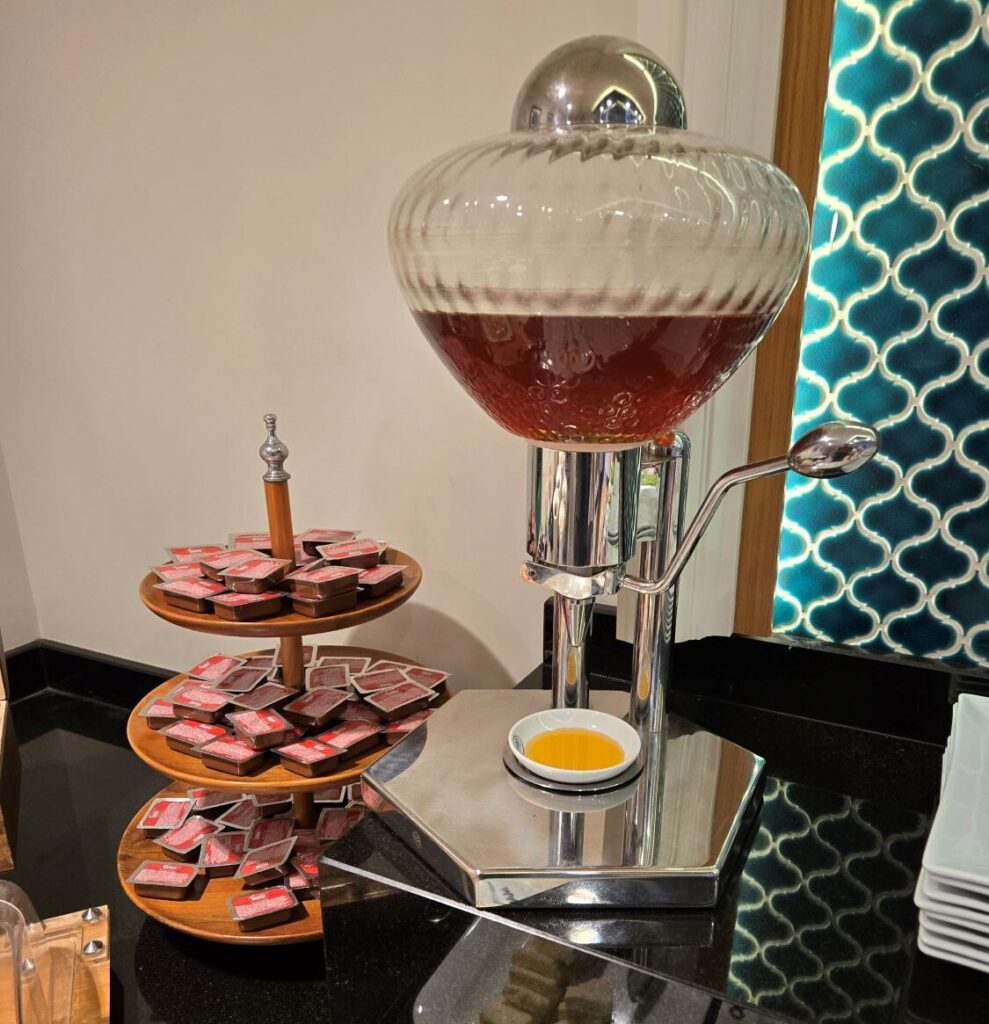
The day begins (for me) at breakfast with a honey urn (an inverted hive), coffee at the café and on the ferry discussions of classic rock bands we have seen. Today is Anzac 1. It will be time to climb again. Hold up legs…knees…the roll-on muscle lotion applied. I am good to go. The lotion will, perhaps, be lasting. Remember to hydrate and sunscreen…

Honey urn at the Port Artur Hotel.
Honey urn at Port Artur breakfast room.
P. Ferguson image, September 2025.

As our bus rolls on to our first objective – 21 of us in all – and most of us of an age…the song comes. Istanbul (Not Constantinople)…to be sung every day. Forever ingrained. Our daily tune becomes worthy of a quick search, and I am amused that the original was sung by the Canadian quartet…The Four Lads…good gosh the Canadians (and there are four of us this trip) are to blame for this ear worm released in August 1953!

Day Three (17 September): ANZAC 1

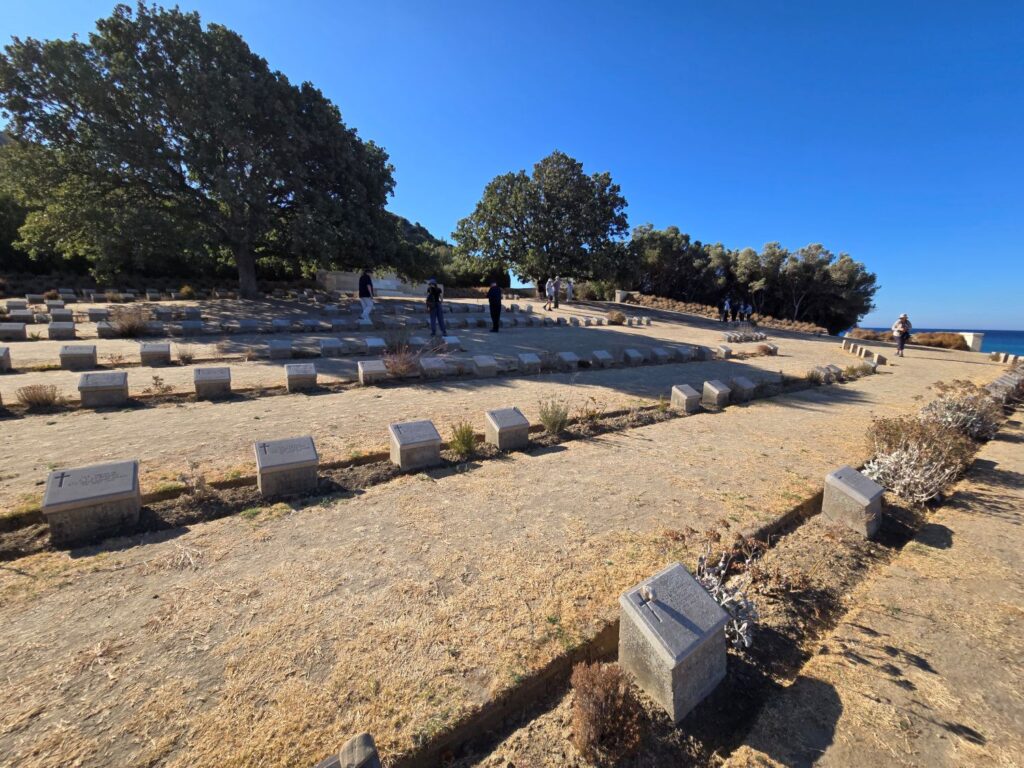
Ari Burnu Cemetery.
Commonwealth War Graves Commission markers at Ari Burnu Cemetery, ANZAC, Gallipoli.
P. Ferguson image, September 2025.

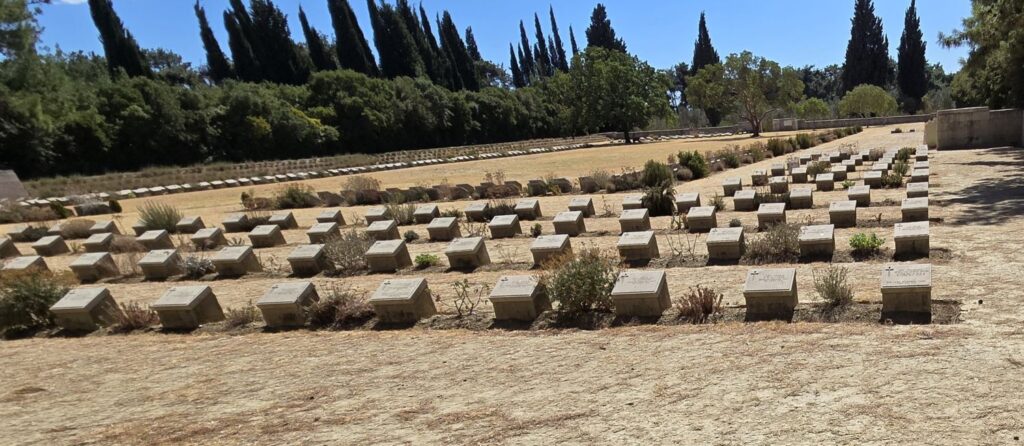
At Ari Burnu, near Suvla Bay, where the Australian and New Zealand Army Corps first landed 25 April 1915 we walk the rows of graves. Stones have been left atop several markers as evidence of other’s visits. Always I wonder what these visitor’s thoughts were…some perhaps relatives…others perhaps sentimental…the losses can be overwhelming. In the distance thunder…

Beach Cemetery, ANZAC, Gallipoli.
P. Ferguson image, September 2025.

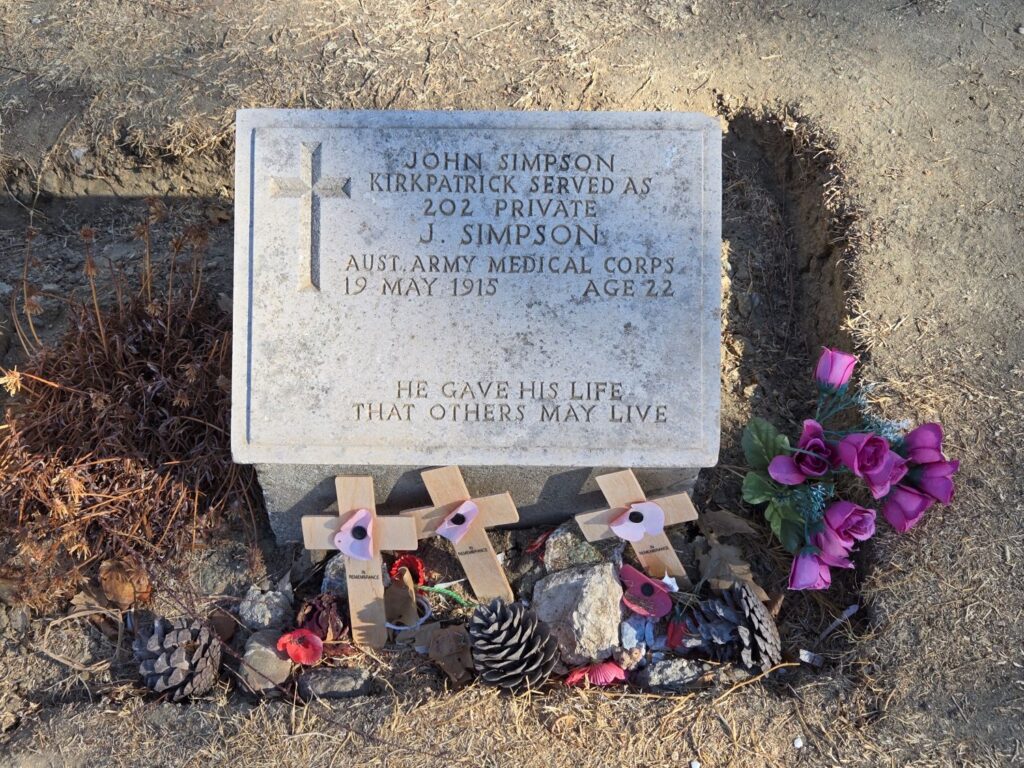
We proceed south to Beach Cemetery at Hell Spit also near to Suvla Bay. Here, similar to our visitors who leave behind stones at Ari Burnu, visitors leave poppy crosses, pinecones and stones at the grave of John Simpson Kirkpatrick AKA John Simpson, a stretcher bearer of the 3rd Australian Field Ambulance.

Grave of John Simpson Kirkpatrick.
Grave of John Simpson Kirkpatrick, Australian Army Medical Corps.
P. Ferguson image, September 2025.

Simpson used donkeys to transport the wounded to the beaches for evacuation. For almost a month, whilst under fire, Simpson continued in these actions until killed by machine gun fire 19 May 1915. His likeness together with his donkey appear on the Australian Anzac medallion and on statues at the Australian War Memorial and in England (Simpson was born in South Shields).

James Simpson Kirkpatrick.
Australian War Memorial, A02826.

We climb today towards Plugge’s Plateau. Some of it fierce, one poor soul falls a second time in as many days – there are more days of this, one hopes for no further falls – no injuries. I understand their strength to keep going. Having fallen myself in 2012 I know that one’s will – will help you through the course. Repeating to myself, as I did in 2012, There is no way I will let this hurt affect my trek.

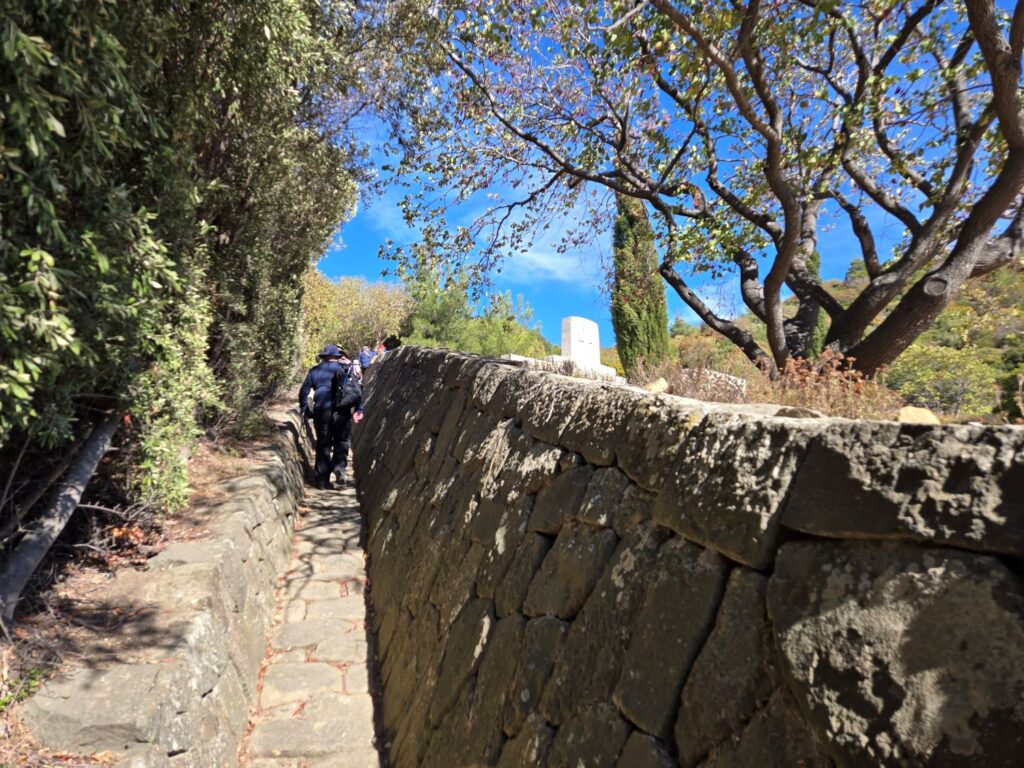
The hike alongside Shrapnel Valley Cemetery.
Climbing upwards alongside Shrapnel Valley Cemetery.
P. Ferguson image, September 2025.

Our walk to Plugge’s starts at Shrapnel Valley Cemetery as we hike upwards along the constructed path to the left and then on to the foot trail. We look down towards Queensland Point from McLagan’s Ridge, now renamed Walker’s Ridge. Further along the path a sign simply marked Walk This Way points towards my family walk destination…in memory of the Harper family, two Australian brothers I only recently wrote about (see And So We Will Walk, September 1, 2025).

Kangal at rest.
Our constant companion for much of the day. P. Ferguson image, September 2025.

At Plugge’s Plateau Cemetery, the smallest of the Commonwealth War Graves Commission’s cemeteries in Gallipoli, a Kangal joins our team on to the Sphinx and beyond. Atop the ridge I look towards the Sphinx and the Razor’s Edge, all cameras are out as everyone captures the towering landmark…our Kangal finds shade, lies down and rests. Our large dog friend knows this route well, moving ahead, stopping well in advance at all points of interest. His reward will come later with snacks and water from our group. Rover has done this before.

The Sphinx and the Razor's Edge.
Two Gallipoli landmarks, the Sphinx and the Razor’s Edge. P. Ferguson image, September 2025.

With the heights that we climb, we must also face steep downward journeys…and then climb again…this time to 4th Battalion Parade Ground Cemetery. At the end of the trail a sign…C.W.G.C. 4th Bn. Parade Ground Cemetery / Steep path 200m [metres]. I am near to my main walk today…reminders of previous writings of the Beard Family Walk (24 May 2024), Oh My Dear Boy (John Macnaugton’s Walk – 26 August 2024), and Mrs. Kate Palmer’s Walk (11 August 2018) come to mind. But at this time…to the brothers Harper…the Harper family walk. Both lads killed 7 August 1915.

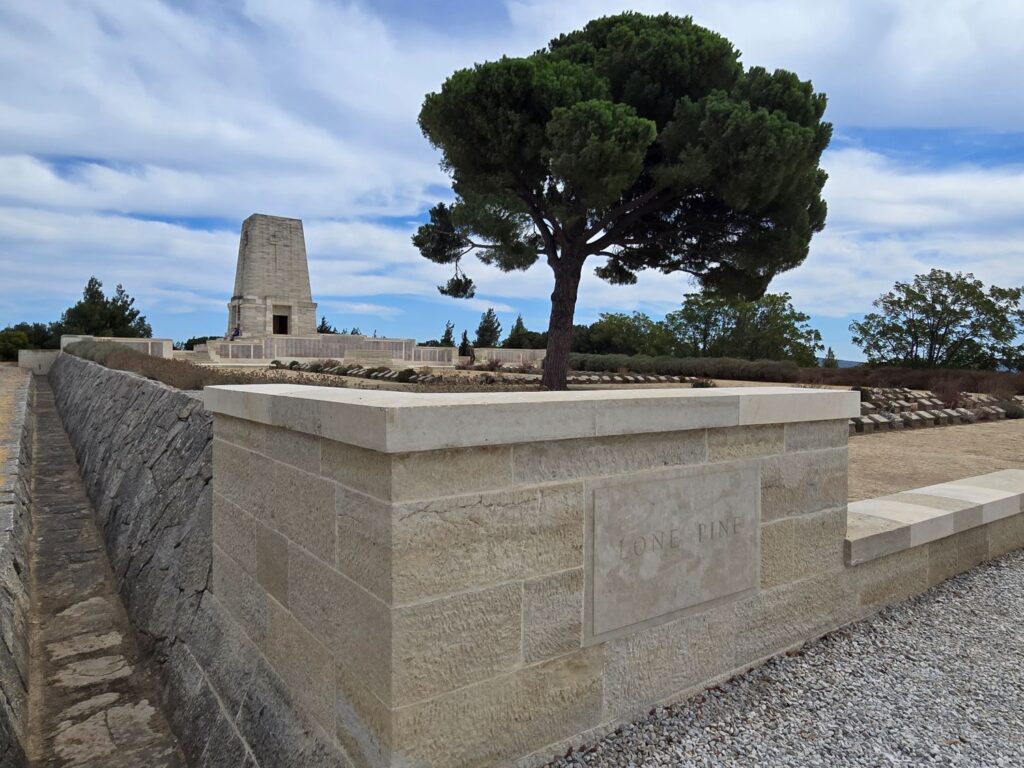
Lone Pine Cemetery and Memorial.
Lone Pine Cemetery and Memorial. P. Ferguson image, September 2025.

Now at Lone Pine Memorial and Cemetery I wonder if mother and father…Fanny and Charles Harper of Perth Australia have been here…or other family members. Only recently I had learned of the brother’s 1915 time influencing director Peter Weir. A story creating a story. How many others know more about Gallipoli thanks to Weir, thanks to Gresley Tatlock Harper (age 31) and Wilfred Lutkin Harper (age 25).

Gresley Tatlock Harper.
Gresley Tatlock Harper. Australian War Memorial, PO7183.001

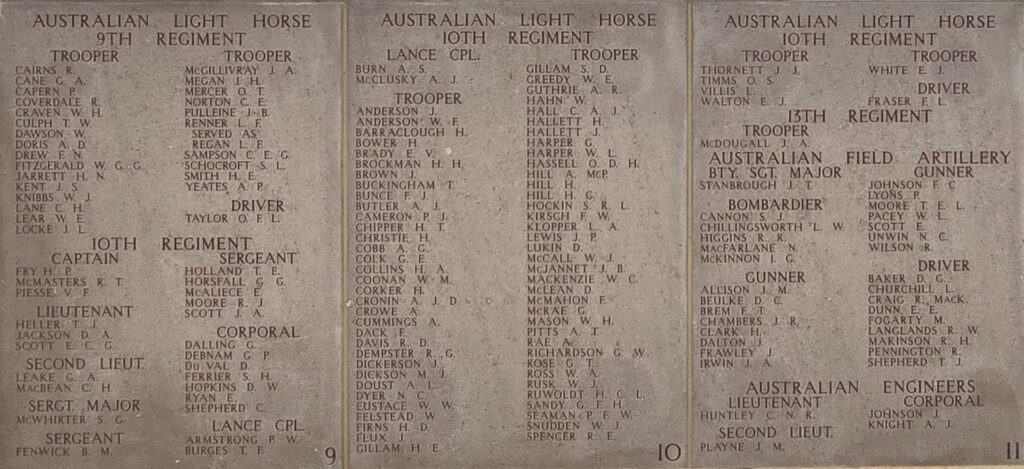
Upon arrival I take my time to find their names. There are visitors here and I have no wish to disturb them in their thoughts. Distant images first and then to the panel in the far left corner – nearest to the memorial – AUSTRALIAN LIGHT HORSE / 10TH REGIMENT – and there the Harpers are before me…along with so many others…of their regiment…of other regiments and I wonder…how many others know about Gallipoli also thanks to other family names…Fry, Anderson, Holland, Ruwoldt, Villis…?

Wilfred Lutkin Harper.
Wilfred Lutkin Harper. Australian War Memorial, PO7183.002

Always hard to leave my thoughts at Lone Pine…but there will be new thoughts…another day…we move out to the Anzac Mine Tunnels and Quinn’s Post. Here the tour’s oracle stands with a reading appropriate to our day before we leave for Bloody Angle and Dead Man’s Ridge. At long last I find some rosemary in thirst to photograph. We visit Walker’s Ridge Cemetery where one can see Suvla Bay in the distance.

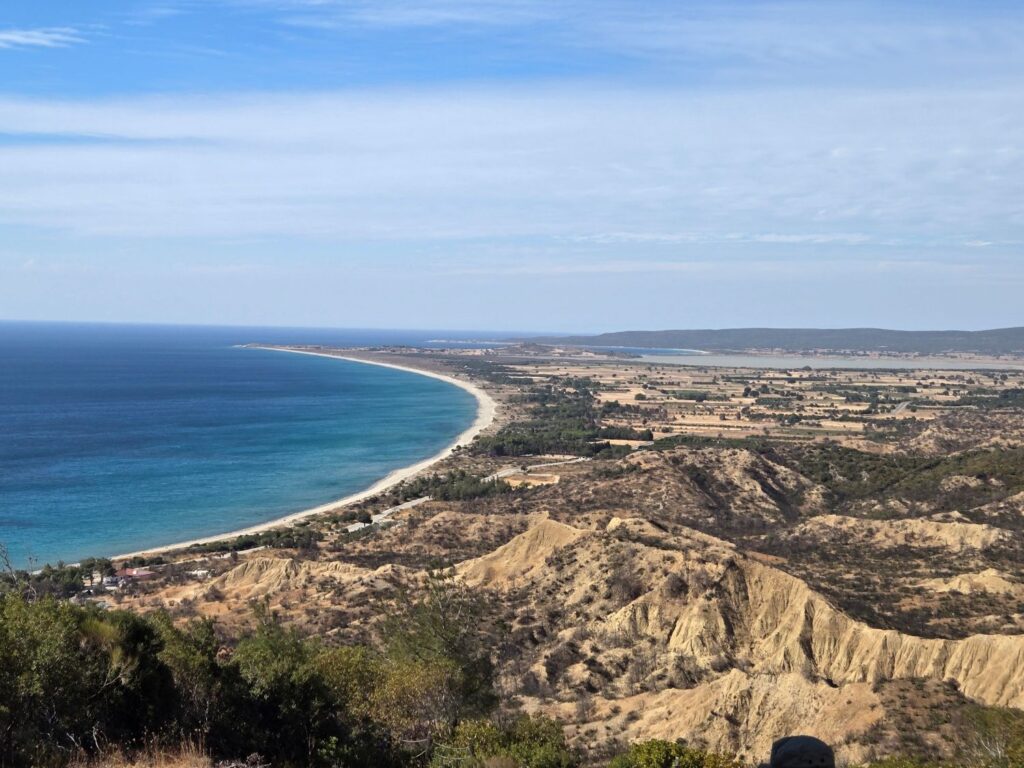
Suvla Bay.
Suvla Bay the amphibious landing site, August 1915. P. Ferguson image, September 2025.

Our day has featured thunder. Though a natural sound, some perhaps hear in its effect the chaos of hurt. We have passed through prickles and ants that bite, inclines, declines, plateaus, and trenches. At the end of this day a gathering of jackals passes without sound alongside our bus and into Gallipoli’s wilderness. There is voice in their silence.

10th Regiment Australian Light Horse panel at Lone Pine Memorial and Cemetery.
Panels 9-10-11 at Lone Pine Memorial commemorates the fallen of the 10th Australian Light Horse. P. Ferguson image, September 2025.

From notes written 17 September 2025

For additional information on the Harper Brothers please read And So We Will Walk, Short Days Ago. 1 September 2025.

An Australian runner at Gallipoli – ANZAC John Hazlitt

—SNIP—

Really Big Events

Introduction

Be safe. You begin…and I go to sleep.

Rosemary’s message. (Time difference: 10 hours)

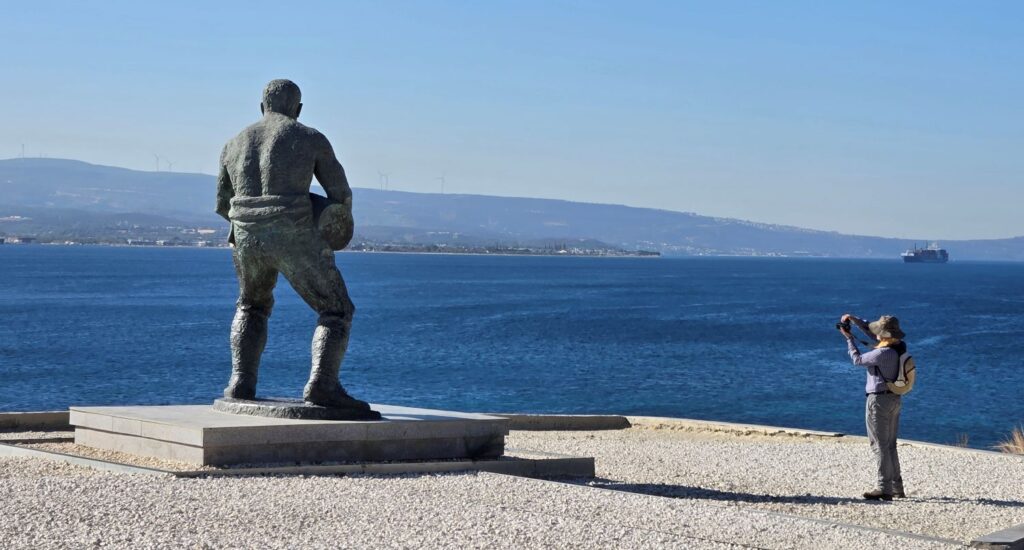
Seyit Ali Çabuk the Turkish artilleryman.
Statue of Seyit Ali Çabuk who single handedly carried heavy artillery shells 18 March 1915.
P. Ferguson image, September 2015.

Day Two (16 September): Helles 1

After the Dardanelles ferry crossing, our first in-depth stop is a review of the Dardanelles naval attacks with focus on the disastrous 18 March 1915 tumult. Onshore, Ottoman batteries, as well as newly laid Turkish underwater mines, hammered allied steel to misshapen form. Three vessels, the French battleship Bouvet, and two British pre-dreadnought battleships, Irresistible and Ocean are sunk.

If the Allies had been successful in forcing a passage through the strait, reaching Constantinople, there would never have been a land campaign. Allied success might have taken the Ottoman Empire out of the war gaining, for the Allies, a supply route to Russia. But there was no success…no Constantinople…the landings commenced in April.

Freighter in the Dardanelles.
A freighter sails through the Dardanelles.
P. Ferguson image, September 2025.

As details are provided I am pleased by all that I have retained over time. True enough – this Dardanelles naval battle is easiest for me to tangle my head around. The time – short (not back and forth over months), places and actions – familiar, the distance between the shorelines of the strait – narrow. I can see all the features and adding to my imagination the passing of modern freighters and container ships adds to my visioning abilities.

Sedd el Bahr Fort
No longer in ruins. Heavy restoration at Sedd el Bahr fort.
P. Ferguson image, September 2025.

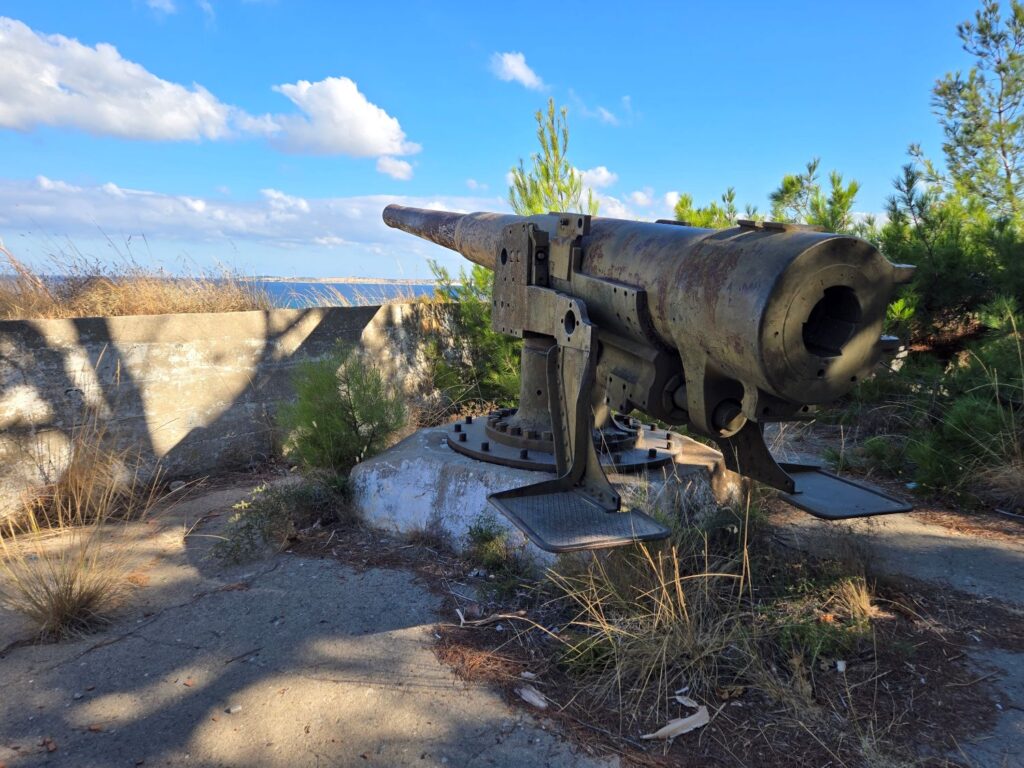
Several fortifications are being restored with newly rebuilt structures atop old familiar ruins. These sites feel careful and modern rather than…what once was left to time. Perhaps in the ruins there was more accuracy – closer to the time of study? Sedd el Bahr (Seddülbahir) fort is not the eye captivating ruins it once was with its now recreated stonework and interpretive panels. Later this day we will see previously abandoned French guns no longer in brambles and under other natural cover. No warnings about vipers required – their terrain is gone. The guns stand with newly built walls and pathways – as if props – their previous earthly reclamation far more interesting. Time though will improve these new sites as the surrounding area grows to welcome them and the current starkness replaced with character.

French guns.
French guns, formerly in the wilderness, now lie in the open.
P. Ferguson image, September 2025.

At V Beach – one of my favorite stops – we wander towards the River Clyde site. I am at first greeted by a beach volleyball net and after Sedd el Bahr wonder if this site has also changed? Fortunately, the landing site I seek is to the left. As we walk there is chatter of a new resort. Though it is hard to imagine beachgoers frolicking in the sand and water with the knowledge of the bloodshed that occurred here…for others – this is their home. Other sites of devastation have been rebuilt and repurposed. Imagine if London, Berlin, Normandy, Dieppe or Ypres were not? Commemorations remain – ruined churches and cathedrals in homage to what once was. It is important to remember. I doubt a day goes by without Turkish families recalling their Gallipoli battles…their ata, dede, nemen, their soyad.

V Beach - site of the SS River Clyde.
The site where the SS River Clyde was beached. Each wave an echo of the past.
P Ferguson image, September 2025.

Standing at V Beach, with the gentle lapping at the water’s edge, we hear the costly story of the British collier and “Trojan Horse” SS River Clyde and its 2,000 soldier/sailor occupants. On this bit of embattled shoreline, six individuals performed the deeds that were recognized with the award of the Victoria Cross. Many soldiers and sailors did not survive here. The River Clyde however survived being refloated in 1919 continuing in Spanish service as the Angela and later Maruja y Aurora until scrapped in 1966.

Walking towards the Helles Memorial.
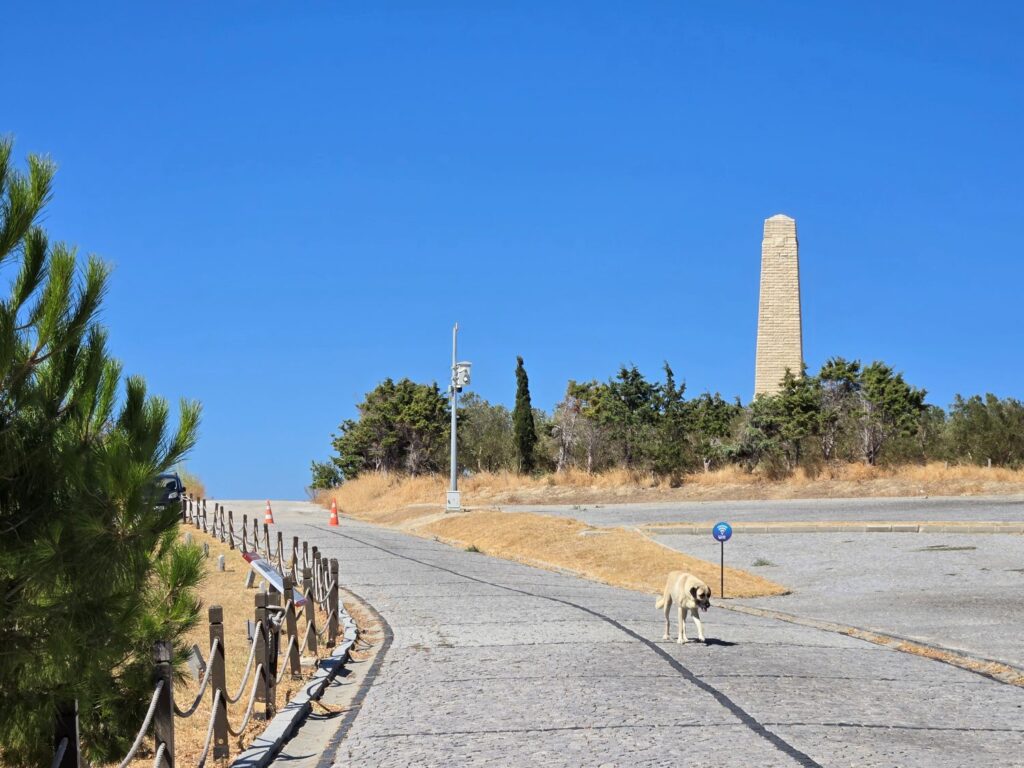
Walking towards the Helles Memorial. A Kangal walks towards our approach.
P. Ferguson image, September 2025.

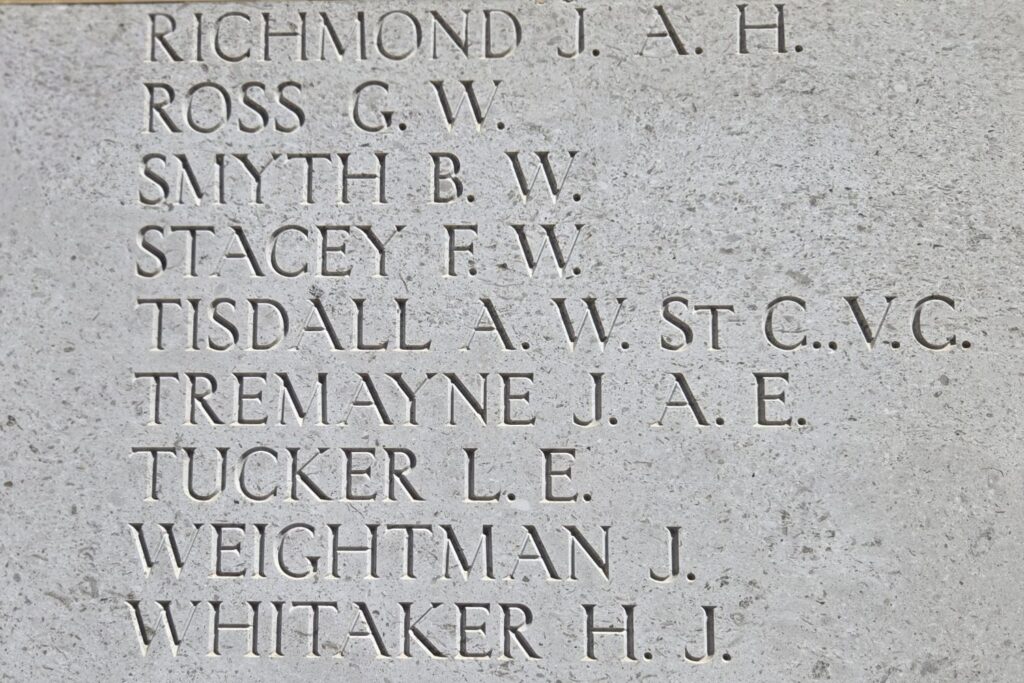
At the River Clyde site personal quotes are first read aloud adding to our understanding of this place. Words of the 1915 witnesses are passed around for individuals to read while laminated images pass from hand to hand. After a brief visit to V Beach cemetery we climb a rough path, difficult to scale in places, to the Helles Memorial, where I, at long last, find and visit with the name of F.W. Stacey of the Royal Naval Division and Chilliwack, British Columbia.

F.W. Stacey. Helles Memorial.
The commemoration of Frank Wendell Stacey, Chilliwack, B.C. on the Helles Memorial.
P. Ferguson image, September 2025.

In 2012 the memorial was undergoing restoration by the Commonwealth War Graves Commission. The names of the Royal Naval Division were covered at that time by work materials. Sub-Lieutenant Frank Wendell Stacey is also commemorated on Chilliwack’s local memorial. Stacey served with the Hood Battalion and after recovery from wounds received in the Dardanelles returned to the peninsula where he was killed 4 June 1915. After these respects I find the name of Hamo Sassoon the brother of poet Sigfried, a new interest for me to learn what Hamo’s famous brother may have written at the time of his loss*. Others become interested and wander over to see the name. Hamo Sassoon served with the Royal Engineers and died 1 November 1915 aboard the SS Kildonan Castle after having his leg amputated.

Lancashire Landing.
Great War wreckage at Lancashire Landing. Site of Six VCs before breakfast.
P. Ferguson image, September 2025.

Outside the Helles Memorial we eat lunch in the shade where we sit within our thoughts including the trails to come. Twenty minutes pass….we receive our notice…on to Lancashire Landing. More rusted Great War iron seems exposed here than previous as far more parts lie in sharp and corroded scaled contrast to the fluidity of the waves. The pier posts remain and provide watchful stands for gulls and a single cormorant. Our next climb – the difference between a scramble and a cliff? You can climb a scramble. At times I need help, but I largely ascend on my own until the slope suggests otherwise. I am at the top to see the craters left from three mines as well as the water reservoirs. We cross a 4’-5’ concrete plank – 2’ wide with 10′ drops to either side. Good gosh so good to be here.

Towards the scramble.
Visitors at Lancashire Landing. In the background the scramble we are to climb.
P. Ferguson image, September 2025.

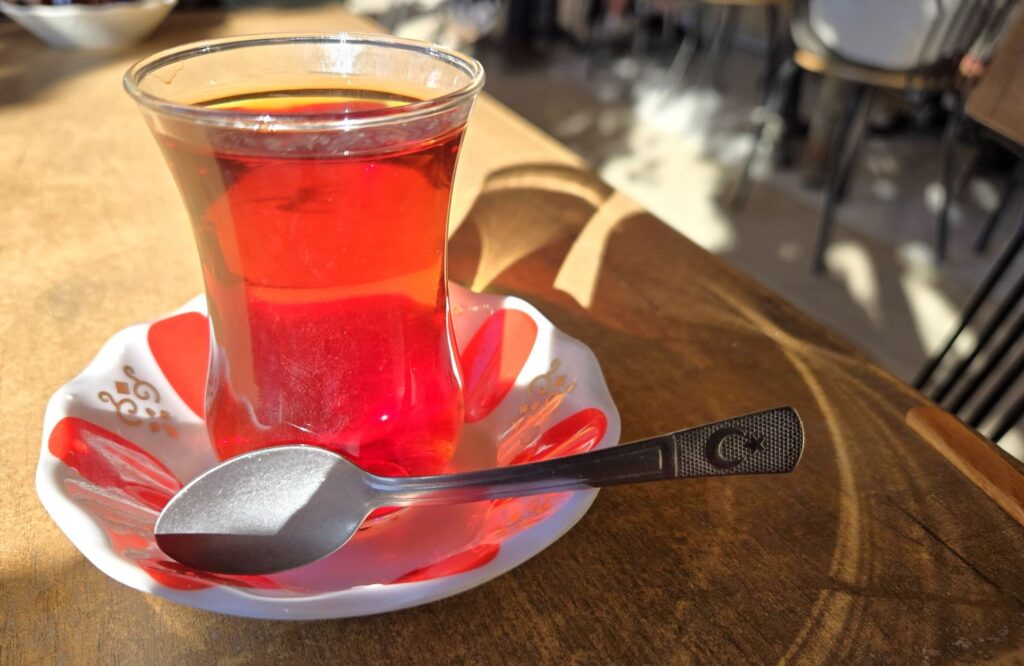
Our remaining day takes us to hop on hop off points of interest. At the Turkish Memorial we learn about the structure of Turkish family names courtesy of our Turkish guide Bulent. Our group has, for some 5-6 hours, heavily uploaded all that there is to learn here. Our hosts recognize when the well is perhaps, not dry but soaked for the day. We need refreshing and inevitably after wandering a museum at Krithia of rusted debris from the battlefield purchase ice cream and tea. To my great delight I am gifted a small Turkish teaspoon from the café. After a day of really big events it is nice to know the small and simple things still fit in.

Turkish teaspoon
At a Krithia cafe we welcome ice cream and tea. My souvenir spoon…a simple pleasure.
P. Ferguson image, September 2025.

*To My Brother

Give me your hand, my brother, search my face;  
Look in these eyes lest I should think of shame;  
For we have made an end of all things base.  
We are returning by the road we came.  

Your lot is with the ghosts of soldiers dead,
And I am in the field where men must fight.  
But in the gloom I see your laurell’d head  
And through your victory I shall win the light.

For Hamo from Sigfried.

From notes written 16 September 2025

—SNIP—

Spaces of Quiet

Weirwood tree and carillon.
Weirwood tree and Dutch carillon.
P. Ferguson image, November 2025.

Weirwood*

The benediction is read as two crows fly South-Southeast whilst framed by Victoria’s weirwood tree and carillon.

Standing at my usual post, with my familiar, perhaps junior weirwood tree behind, I am ideally positioned to observe all who gather here.  We have come to remember, to find our place within the “between” spaces of quiet, with spoken word, choral voice, aircraft and cannon. The lament…Flowers of the Forest.

Poppies at the cenotaph.
Visitor’s poppies left for the day at Victoria’s War Memorial.
P. Ferguson image, November 2025.

Our tranquil space, our weirwood thoughts, of flowers and fallen autumn leaves, the change to our season – time treading its course. I am of few words today…all have gathered here with connection to someone…to this 11th hour of the 11th day of the 11th month.

And so I watch, and so I listen. I find my between spaces of quiet…of those family houses who went before…whose words seem wiser than anything I might write. But then I re-remember that with this day, we are all connected. With our weirwood thoughts and with our search between spaces I watch as crows fly above gathered flowers and fallen leaves…these are our houses…

Maple leaves
Fallen maple leaves at rest.
P. Ferguson image, November 2025.

*Weirwood: A sacred tree well known to followers of Game of Thrones.

Our Family Houses

Edward William Ferguson
119 Battery, Royal Canadian Artillery
Royal Canadian Postal Corps
(United Nations Peacekeeper)

Lewis MacLeod Mills
15th Canadian Field Regiment (WW2)
Royal Canadian Artillery

Ray Morgan
4th Anti-Tank Regiment (WW2)
Royal Canadian Artillery

Eugene Ferguson
United States Army (WW2)

Donald Ferguson
United States Army (WW2)

Bob Wilcox
Royal Canadian Navy (1960s-1970s)

Ole Berget
31st Canadian Infantry Battalion (WW1)
3 May 1917

Ed Berget
Loyal Edmonton Regiment (WW2)

Bill Berget
South Alberta Regiment (WW2)

Bernard Kyllo
50th Canadian Infantry Battalion (WW1)
1 February 1917

Robert B. Kyllo
Calgary Highlanders (WW2
505th Parachute Infantry Regiment (82nd Airborne) (WW2)
US Army
14 February 1945

Rowland “Ron” Liversedge
West Yorkshire Regiment (WW1)
MacKenzie-Papineau Battalion (Spanish Civil War)

Thomas Robertson
Royal Canadian Army Service Corps (WW2)
26 December 1941

George Henry Prentice
12th (Nelson) Company, 3rd Battalion, Canterbury Regiment
ANZAC – Gallipoli (WW1)
18 November 1918

Victor Arthur Charles May
Home Guard (WW2)
Imperial Chemical Industries (Homefront WW2)

Edith Maud May
Women’s Institute (Homefront WW2)

Leonard May
Aircraft Production (Homefront WW2)

Fred May
Aircraft Instrumentation (Homefront WW2)

Harvey Brian May
Royal Air Force (WW2)

John McManus
Air Raid Precautions (Homefront WW2)

Irene Lowe (nee McManus)
Woolwich Arsenal (Homefront WW2)

Ted Lowe
Woolwich Arsenal (Homefront WW2)

Michael Wilson
Royal Air Force
South Arabia

Sleep A Challenge

Istanbul arrival.
Soon to arrive in Istanbul.
P Ferguson image, September 2025.

The Journey Out

Over the next several days eight records of my return to the Gelibolu (Gallipoli) Peninsula with Peter Hart (Battlefield Tours) will appear. Our journey (there were 21 of us this time) commenced 15 September 2025 and ended 22 September 2025. We stay at the Hotel Artur on the Asian side of Turkey at Çanakkale and take the ferry to the European side of Turkey, to the Gallipoli Peninsula, each day. (This was my second visit, 13 years after my first landing (May 2012) and 110 years after the events of the Great War, known to the Turks as the Battle of Çanakkale.

Each day I scavenged time to scratch down notes – on the ferry, the bus, at lunch, in the hotel…review, edit, markup, read, re-read, change and so on. Some original writings are nearly completely re-written but the base is there from the very day. They are what they are. I have been successful in the challenge of the climb…the days filled with sun…the encouragement to meet each day in partnership with like minded adventurers.

Widen Your World
Share in the journey. A message from the screen in front.
P. Ferguson image, September 2025.

Day One (15 September): Arrival Çanakkale

Sleep a challenge since arrival Thursday. Five hours over three days in all, and up early on this new day of travel – 1:30 am. Good grief. With my familiar aches and pains it is only my excitement that acts as stoker. There is a shortage of fuel…methinks it’s fumes only that pass over the shovel, fanned not scooped, creating my forward movement.

Our group has gathered first at Heathrow Terminal Two. Our flight is graceful and… comfortable and with our approach into Istanbul the phone’s camera becomes engaged albeit with hopefulness more than certainty for grand images. We land….descend the stairs to waiting busses, pass through an extensive crowd (other nationalities) at Control then wait. One more to arrive…

On our way to Çanakkale.
One of several rolling shots along the coast towards Çanakkale.
P. Ferguson image, September 2025.

Some time later, and with much chiding of the non-present being, our current conversationalist target arrives. We find our bus and the welcomes begin…as well as…a health and safety review. Hydrate, sun screen…and yes there is a first aid kit…including another of my own.

Footprints.
Footprints at Gallipoli. It is best to know where we walk.
P. Ferguson image, September 2025.

Thirteen years have passed since I left footprints at Gallipoli. The rolling journey is everything I seek…already I have found the notes to the scale…the letters to the words that make this a fine first day. I smile. We need to find the day’s music..as a crowned mermaid passes by the window. Turkish please…tea first.

From notes written 15 September 2025…~16:00 hours

—SNIP—

And So We Will Walk

Trekking the sites of Gallipoli.
Walking in the heat of the day requires appropriate gear. Remember the sunscreen and to hydrate.
P. Ferguson image, Gallipoli 2012.

Because We Came Looking

The 10th went forward to meet death instantly, as the 8th had done, the men running as swiftly and as straight as they could at the Turkish rifles. With that regiment went the flower of the youth of Western Australia, sons of the old pioneering families, youngsters – in some cases two and three from the same home…Men known and popular, the best loved leaders in sport and work in the West, then rushed straight to their death. Gresley Harper and Wilfred, his younger brother, the latter of whom was last seen running forward like a schoolboy in a foot-race, with all the speed he could compass.

(Bean, C.E.W., The Official History Of Australia In The War Of 1914-1918: Volume II, The Story Of Anzac: From 4 May, 1915 To The Evacuation, Angus and Robertson, Sydney, 1938, pp. 617-618.)

Gallipoli (1981) from director Peter Weir…The Water Diviner (2014) from Russell Crowe and one other to watch, Tolga Ornek’s documentary film Gallipoli (2005). Three films – their storytelling and open heart envisioned by three directors guides my anticipated return to Gelibolu’s (Gallipoli’s) water’s edge and rough-hewn landscapes.

And so, we will walk…and we will climb…the ascent escalating and our descent an equal challenge to balance…fleet of foot countered by sure of foot. To our eyes and imaginations, we will be shown much that our group seeks…ridges of conflict…hilltops and gullies…the landings…the fallen…the remembrance and the litter of war. There will be operational history and pilgrim sites.

French Gun.
French artillery gun near Sedulbahir fort, Gallipoli.
P. Ferguson image, Gallipoli 2012.

Film brought me here. Thirteen years have passed since my lens last scanned these views. I have changed, my interests, in the way I seek remembrance are different, finding evocative connection…the shot that stands above all. I hope to connect to familiar but also new audiences many of whom never met a Great War veteran… I know better now what I seek – I know better when I see it – but I await with eagerness whose voice the image will tell. To find new breath here in all these places of the sun is a fine reward.

Having followed new friends amongst these places of hurt; we fortunate few will afterwards share good food and drink, stories of why we have chosen this trek. Sharing (because we came looking), known lives, knowledge, and stories. Perhaps after the sun rests for its day a tune will rise, not unlike those once heard here before, but unlike all those who left this plain before their time we will have our time to rest, to wake, and start the song – the trek – another day…

Time to rest.
Walking and climbing Gallipoli. A day’s outing in the heat leads to rest where we find it.
P. Ferguson image, Gallipoli 2012.

The Harper Brothers

Both Gresley Harper (age 31) and his brother Wilfred Lutkin Harper (age 25) served as Troopers with the 10th Australian Light Horse. The sons of Charles and Fanny Harper of Perth, Western Australia the brothers enlisted together, service numbers 113 and 114. Both brothers were lost on 7 August 1915 and are commemorated on the Lone Pine Memorial, Gallipoli.

Lone Pine Memorial and Cemetery.
P. Ferguson image, Gallipoli 2012.

Sun – Moon & the Narrow Exit

Dunkirk.
View of the Dunkirk beaches with sand dunes and scrub.
P. Ferguson image, May 2025.

Dunkirk [Dunkerque] 13 May 2025

A good heart, Kate, is the sun and the moon— or rather the sun and not the moon, for it shines bright and never changes, but keeps his course truly.

(Henry V, William Shakespeare, ca. 1599)

The decision is made…after a few years talking about how…the obvious answer is delivered. With little time to spare we want the most of the day…no rentals…no petrol…no becoming lost…no worry about parking. I could go on.

Dunkerque road sign. We are getting close.
We are getting close. There is anticipation.
P. Ferguson image, May 2025.

Having conceived of the idea based on our taxi ride with Leo from Lille to Ieper…it becomes obvious. Book Leo for Dunkirk…and at long last 13 May 2025 we have our day. It does not disappoint. I ride in the front – waiting for a road sign to capture the closeness of our journey…I want to see Dunkerque. I attempt to memorize the directions, but it will be to no avail. Methinks a return journey will work using this same Leo tactic…but next time a few days or more…I already anticipate coming back and I’ve not yet arrived…

The mole at Dunkirk.
East mole at Dunkirk. A famed site of the 1940 evacuation.
P. Ferguson image, May 2025.

Our start is at the Dunkirk Museum, Bastion 62, where I step through the exhibits coming into contact with that which was Dunkirk 1940. Soon we will have the sand, the channel, the mole. Visuals and experience with the sun shining brightly our day is well met. The trek begins. Following our museum visit we climb up the nearby hilltop as sky cranes in behind maneuver the day’s work.

Operation Dynamo Memorial at Dunkirk.
The hourglass shaped Operation Dynamo Memorial. A symbol of passing time and turning defeat into victory.
P. Ferguson image, May 2025.

We look in all directions and then on towards the mole – the greatest walk – knowing of the proceeding footsteps here, with menace from above and from advancing enemies. Then the return path and along the beach – the English Channel lapping at the shoreline – waves cresting and breaking while on the horizon the sails of little ships hint at what once was here. One can only imagine in this place.

Fisherman on the mole looks back towards the beach at Dunkirk.
A day in the sun fishing along Dunkirk’s mole. Our subject looks back…one can only imagine his thoughts.
P. Ferguson image, May 2025.

Walking some considerable distance upon these sands of conflict, the moon rhythm of the tide reminds me, like the Hourglass Memorial, of time’s passage. The dunes with their scrub, the places of thinking soldier souls – waiting their turn…their turn for home or perhaps not to be.

The large sign at Dunkerque.
Dunkerque beach sign.
P. Ferguson image, May 2025.

We return along the promenade. Along its length it is hard to escape the largeness of the Dunkerque sign…the largeness of this place…once filled with confusion but this day, now filled with playful wanders within the shoreline, as water laps at bare feet, as persons rest and absorb the sun, children fill their toys with sand and visitors acquire ice cream.

Ice cream Parlour along the Dunkirk Promenade.
An ice cream stand at Dunkerque beckons visitor’s to its tasty delights on a fine sun filled day.
P. Ferguson image, May 2025.

Postscript: The Narrow Exit

The enemy attacked on all sides with great strength and fierceness, and their main power, the power of their far more numerous Air Force, was thrown into the battle or else concentrated upon Dunkirk and the beaches. Pressing in upon the narrow exit, both from the east and from the west, the enemy began to fire with cannon upon the beaches by which alone the shipping could approach or depart. They sowed magnetic mines in the channels and seas; they sent repeated waves of hostile aircraft, sometimes more than a hundred strong in one formation, to cast their bombs upon the single pier that remained, and upon the sand dunes upon which the troops had their eyes for shelter. Their U-boats, one of which was sunk, and their motor launches took their toll of the vast traffic which now began. For four or five days an intense struggle reigned. All their armoured divisions-or what Was left of them-together with great masses of infantry and artillery, hurled themselves in vain upon the ever-narrowing, ever-contracting appendix within which the British and French Armies fought.

(We Shall Fight on the Beaches speech, Winston Churchill, 4 June 1940)

Harry Styles graffiti.
“Harry Styles Was Here.” Mr. Styles was a cast member in the Christopher Nolan feature film Dunkirk. 2017.
P. Ferguson image, May 2025.