The walk to Captain R.L. Hoare. P. Ferguson image, May 2026.
And the leaves of the tree were for the healing of the nations
(Revelations 22:2)
After Agny the drive to Gommecourt British Cemetery No. 2, takes about twenty minutes. As we near I contemplate this landscape and horizon…it is quiet…now…these were battlegrounds. There are four Gommecourt cemeteries created after these battlefields were cleared in 1917. Here at No. 2 cemetery I step towards Captain Richard Lennard Hoare lost to our world, his family and friends 1 July 1916. Many of the graves are from that dark day of the British Army when 19,240 were killed and 35,493 wounded…101 are buried at Gommecourt No. 2. (107 at No. 1, 117 at No. 3 and 70 at No. 4).
The stairs to Gommecourt British Cemetery No. 2. P. Ferguson image, May 2026.
With my approach towards our Captain’s rest and in the near distance, too quick to film, too sudden for a picture a startled cock pheasant breaks its cover and storms skywards…as quick as its flight – it descends, landing nearby but again obscured by nature’s layers and colours. Hidden from view the pheasant has found refuge where its heartbeat can return to a gentle pace. Equal to its wing’s pounding one can imagine the pace of its frantic heart. We have all heard this beat within ourselves.
Pheasant before flight. Image courtesy of Pixabay.
Today at my keyboard I carry again with this promised visit my own frantic heart. One that beats to my wishful promise. I hear my heart now, the steady beat that is life. My pheasant memory, my Gommecourt steps, Captain Richard Lennard Hoare (12th London Regiment. The Rangers) will endure for the remainder of my days. I reminisce…at home walking the farm fields and wire fence lines of my youth the sudden explosive flight of a pheasant. Great surprise to myself the wanderer. The sudden wing-burst cannot be forgotten. The bird escapes danger. I have been witness here at Gommecourt to nature’s accent to my kept promise.
Alongside the rest of Captain R.L. Hoare. A promise fulfilled. P. Ferguson image, May 2026.
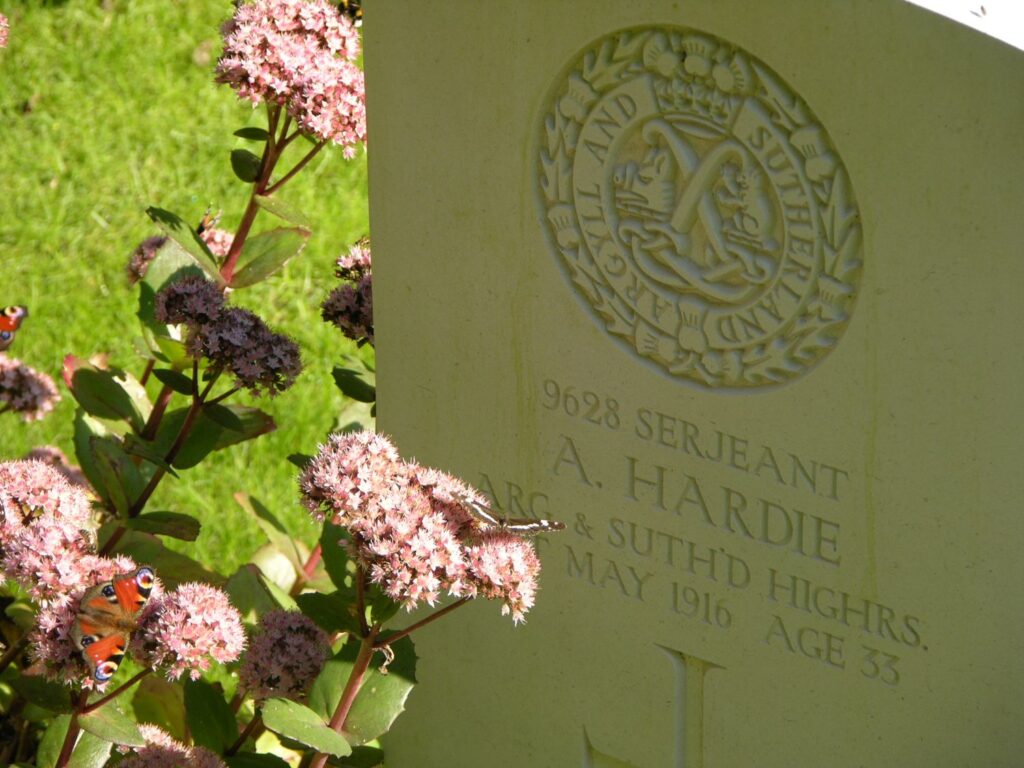
I became interested in Captain Hoare when learning of his marker inscription provided by his mother Mrs. Laura Hoare And the leaves of the tree were for the healing of nations. The inscription, from the book of Revelations, describes the apocalyptic visions of John culminating in Christ’s final victory over evil. With the phrase I see the many, the colours of earth, green and coloured leaves that cling to tree branches the providers to our world of oxygen and carbon sequestration, new and old life, the multitude of souls…amongst the green, the red, the organic beckoning and symbols of life’s cycle.
Captain Richard Lennard Hoare. Killed 1 July 1916. A known visitor to Talbot House, Poperinghe, Belgium. Image from A Surgeon Goes to War. (Cambridge University Press)
Here amongst Gommecourt’s colours, green grass and flowers the contrast of grey solemn stone markers, but so too the brilliant colours of the rising pheasant. With its wing-burst (the flush) the drone of past echoes (reflected sound). In chaos finding the peace. This day I have made my way, my promise complete…my connection to Gommecourt, to Richard Lennard Hoare and his mother Laura, complimented by a surging winged heartbeat. And here at home I rest my eyes, find a few more words and close to the sounds of another chorus that equally endures in Gommecourt’s peace and chaos that cuts my red heart in two…the pain of separation from loved ones…the longing for lost memories.
Special thanks to the Wallander (BBC. 2008 – 2016) series that brought me to Emily Barker as the crow (or pheasant) flies.
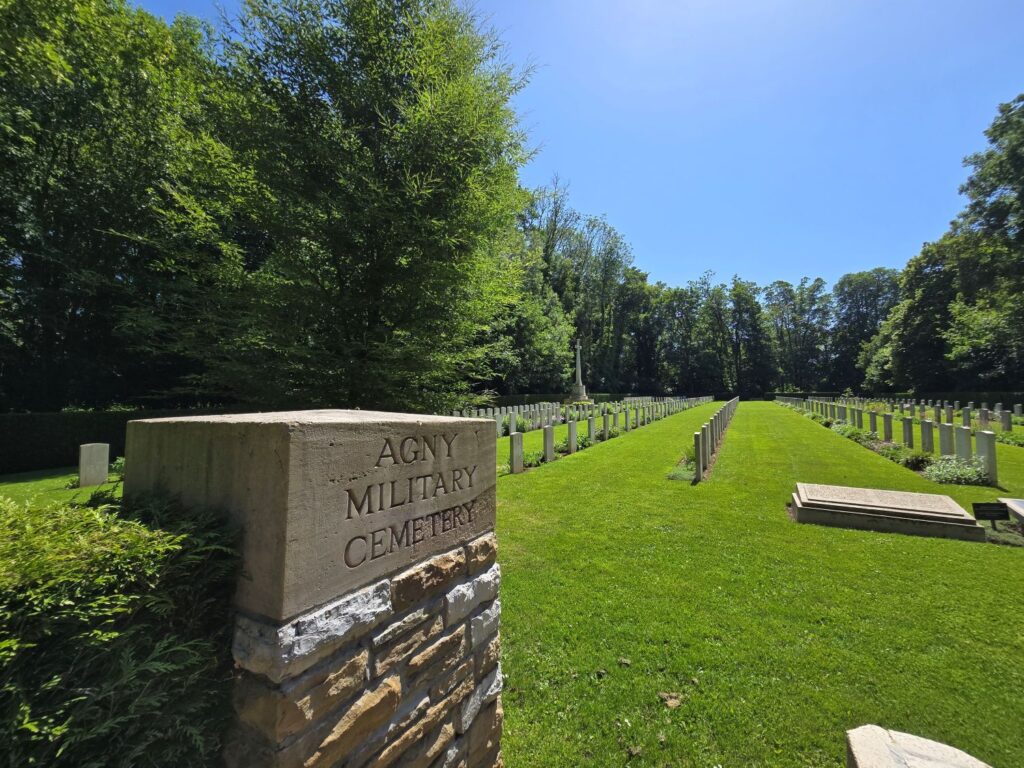
Agny Military Cemetery, France. P. Ferguson image, May 2026.
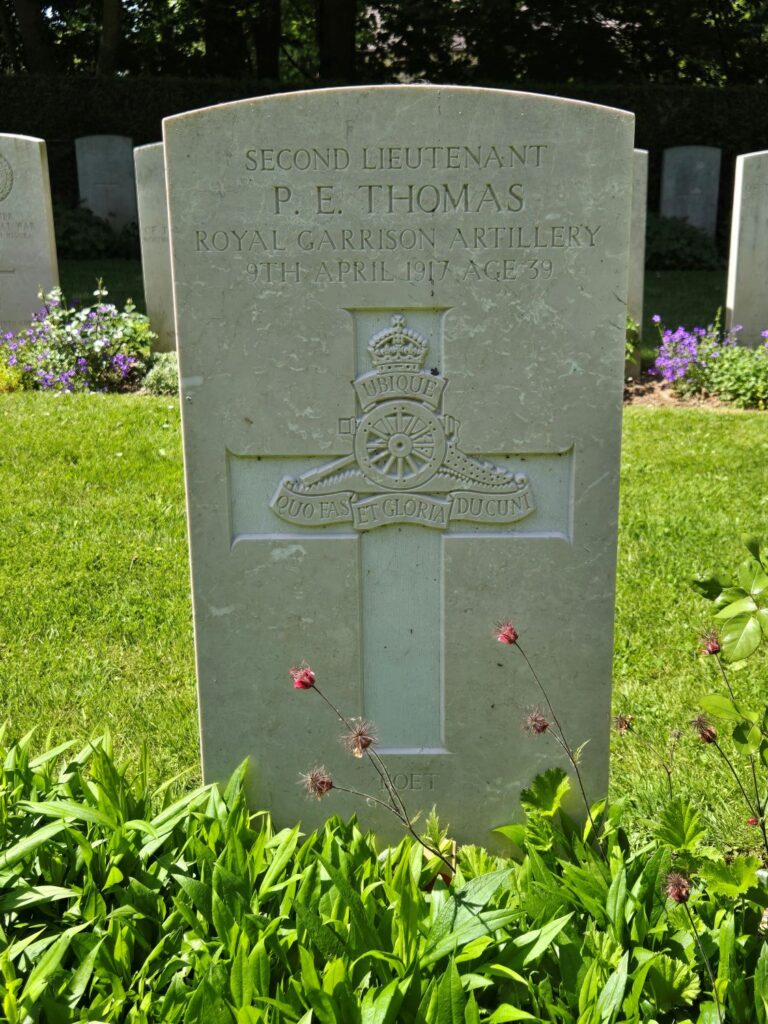
Second Lieutenant Philip Edward Thomas, Royal Garrison Artillery
And there we were 27 May 2026…upon this place of Agny. I shall be telling this with a sigh ages and ages hence.
I sought this trail when I first learned the poem’s lesson. Here at this portion of Agny…the English friend, of Robert Service rests. Two roads diverged in a [yellow] wood and – perhaps by chance – two separate paths lead to Philip Edward Thomas, lost on Easter Monday, 9 April 1917 serving with the 244th Siege Battery.
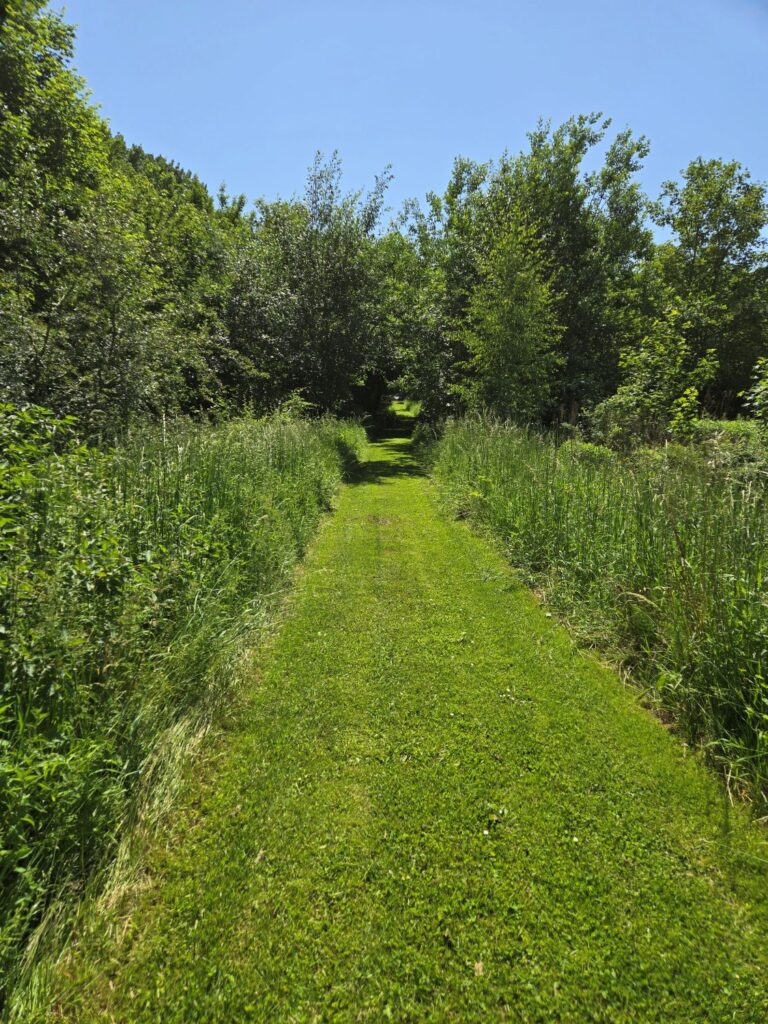
One of two roads, Agny. P. Ferguson image, May 2026.
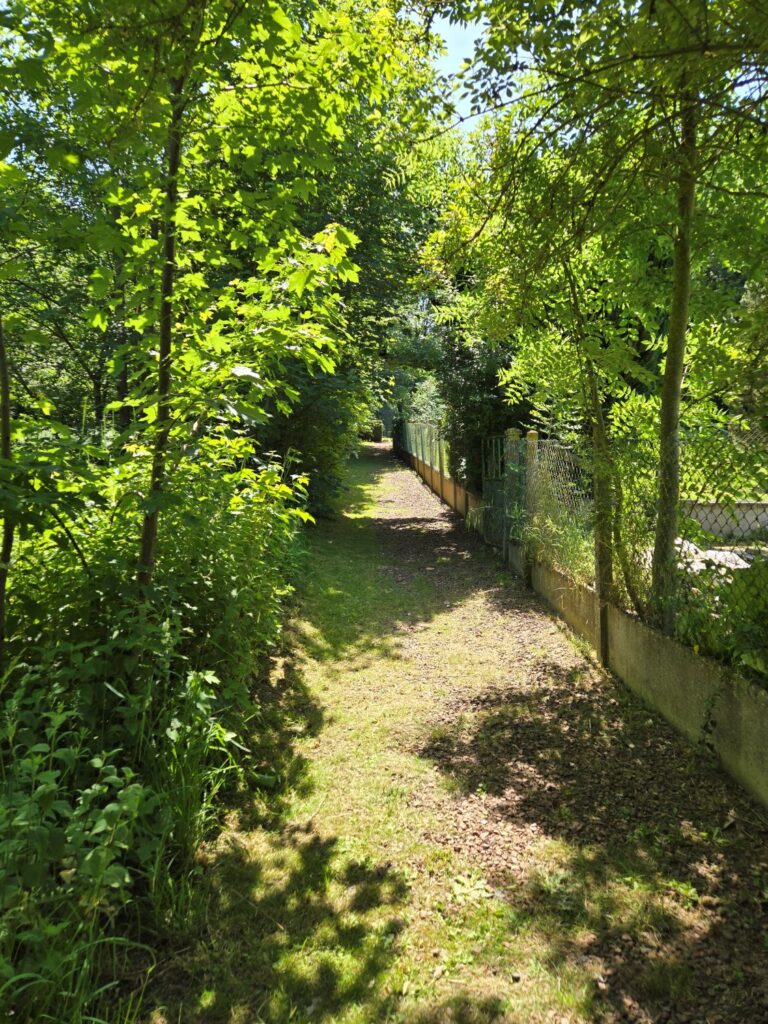
And so with two paths a choice was made, do we follow the first or having seen a sign pointing the way to Agny Military Cemetery, do we take the identified trail? We take the second path.
Two of two roads, Agny. P. Ferguson image, May 2026.
Without Thomas, the Frost poem The Road Not Taken would not have been penned and published August 1915. And now I am here…left within my thoughts…and that has made all the difference.
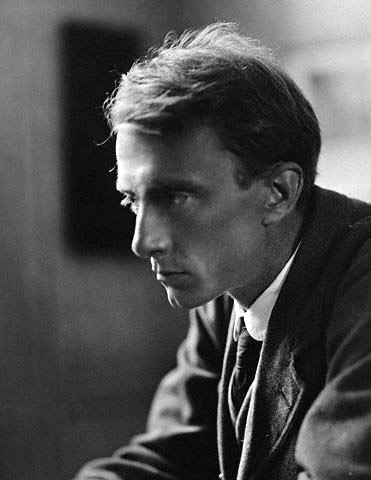
Philip Edward Thomas. (Wiki from the Hutton/Stringer Archive, circa 1905).
Philip Edward Thomas was, like Frost, a poet. Within his words we find the feelings of my reflections for my time here in France and Flanders. One wonders the stories that are to follow…one step at a time…
In Memoriam (Easter 1915)
The flowers left thick at nightfall in the wood.
This Eastertide call into mind the men,
Now far from home, who, with their sweethearts, should
Have gathered them and will do never again.
Philip Edward Thomas, friend of Robert Service. P. Ferguson image, May 2026.
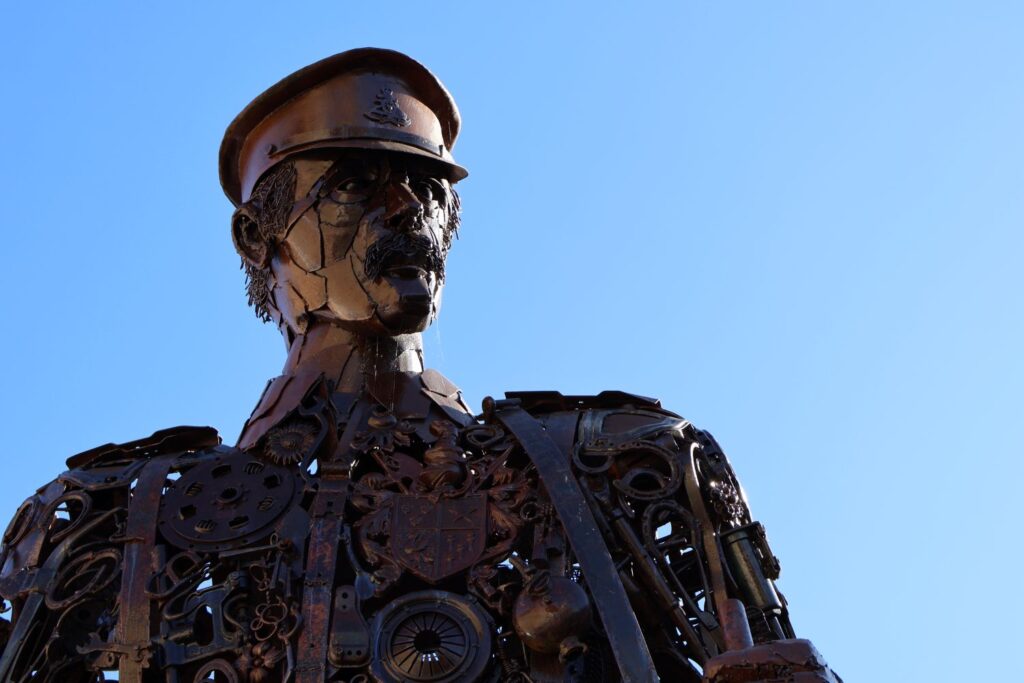
The Hauntings sculpture outside the Menin Gate Memorial. (P. Ferguson image, March 2026).
Decompression Tour – Ieper – 17 March – 31 May 2026
I could not understand why men who knew all about good and evil could hate and kill each other.
Attributed to Mary Shelley, 1818.
Sadly these words attributed to Shelley do not appear within the pages of her 1818 Gothic horror…Frankenstein. The words are a perpetuation, without direct confirmation, a paraphrase of her work. These nineteen words are, however, an all fitting summation that align with the horrors of the Great War.
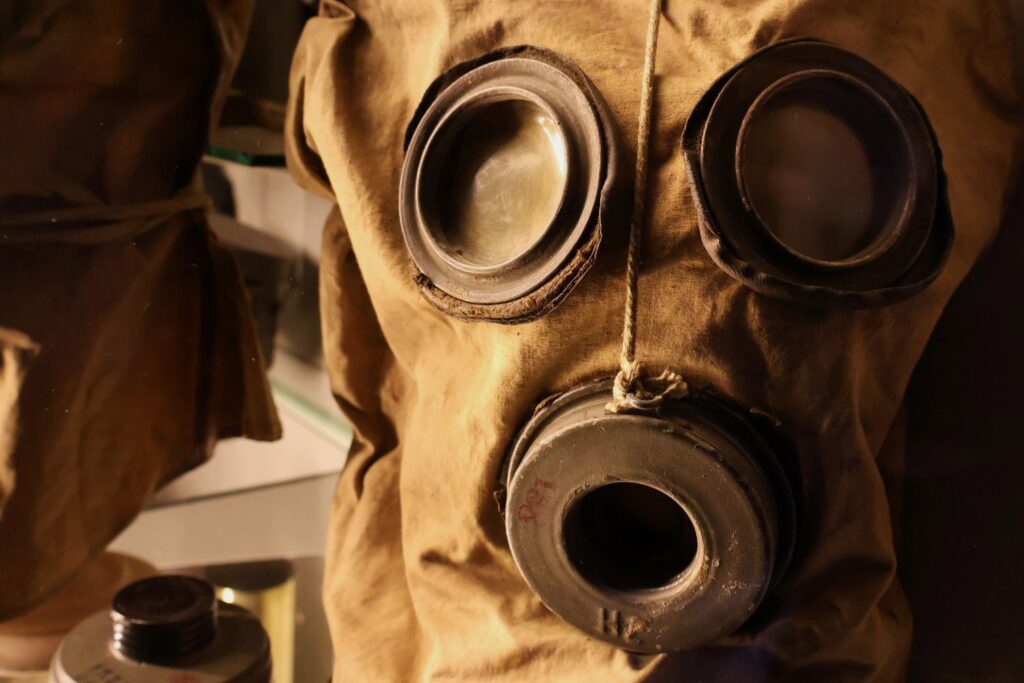
German gas mask at Hooge Crater Museum. P. Ferguson image, April 2026.
For two and half months I rambled, in contemplation, hiking the Ypres Salient (occasionally with ride assistance) – north to Langemarck, south to Ploegsteert, west to Lijssenthoek, east to Passchendaele and all points between. That this was by foot and hours long at a time provided considerable insight. I felt every step as my journeys brought my contemplations to a considered empathy. The ground on which elders clambered, now without words, speaks and whispers across these landscapes.
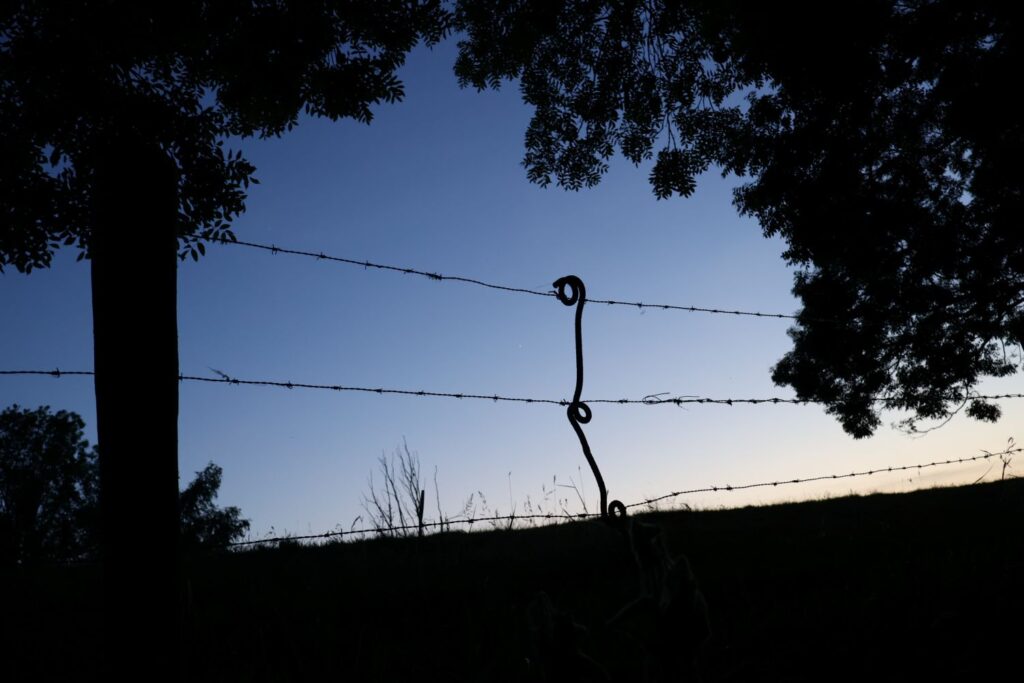
British screw piquet stands like a question mark on the landscape. P. Ferguson image, May 2026.
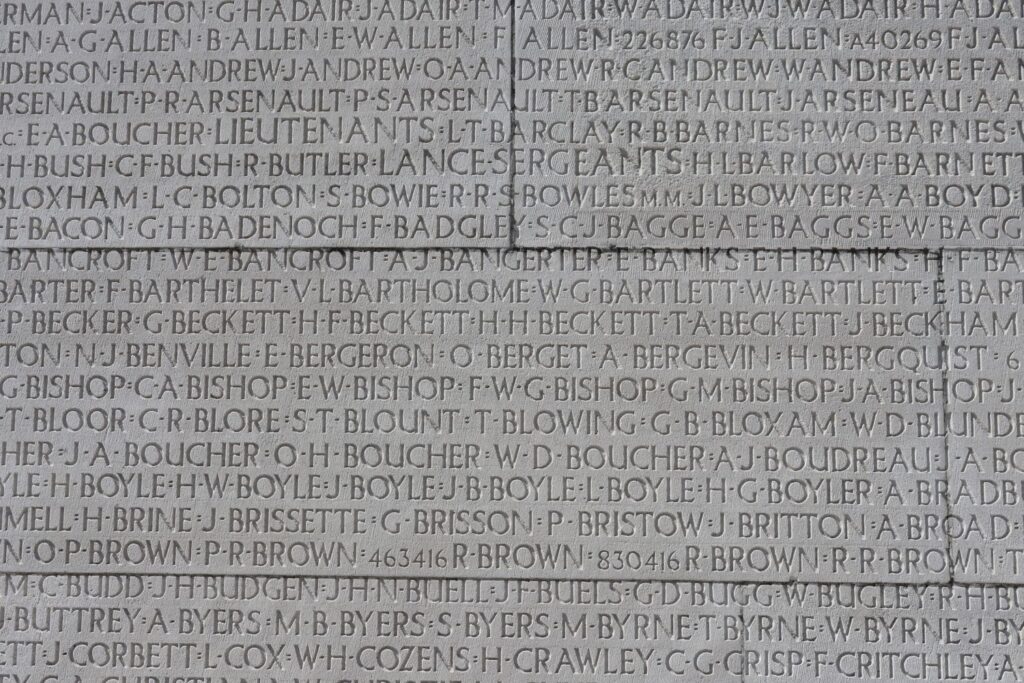
Within walled gardens I visited the witnesses of conflict and with each stride had ample time for meditation…Shaw, Tomblin, Rowland, Brunner, Hofmann, Roth. Graf, Vandenberghe, de Ridder, Delvaux, Dubois, Rousseau, Gauthier, Singh, Chee. Christian, Jewish, Muslim, Hindu, Sikh, Buddhist. 1914, 1915, 1916, 1917, 1918. Poet, And The Leaves of the Trees Were for the Healing of the Nations, Known Unto God, A Soldier of the Great War. So true my penned words from my first visit to Vimy, How many eyes have seen these names and whispered voices read them softly?
Names of the missing at Vimy Memorial. P. Ferguson image, May 2026.
Have I changed?…of course…Though I remain the same being, there has been a metamorphosis, a coming to terms and confirmation of my thoughts on what and how I seek. No longer am I content amongst these haunting landscapes to depict only their facts but also to find within these facts the prajña of my reflections. I have by my hours on the salient found within my person – my own peace, my own healing, my own words reaching to these steps. Questions for our kind, not unlike those after the Great War who found their expressiveness through their arts.
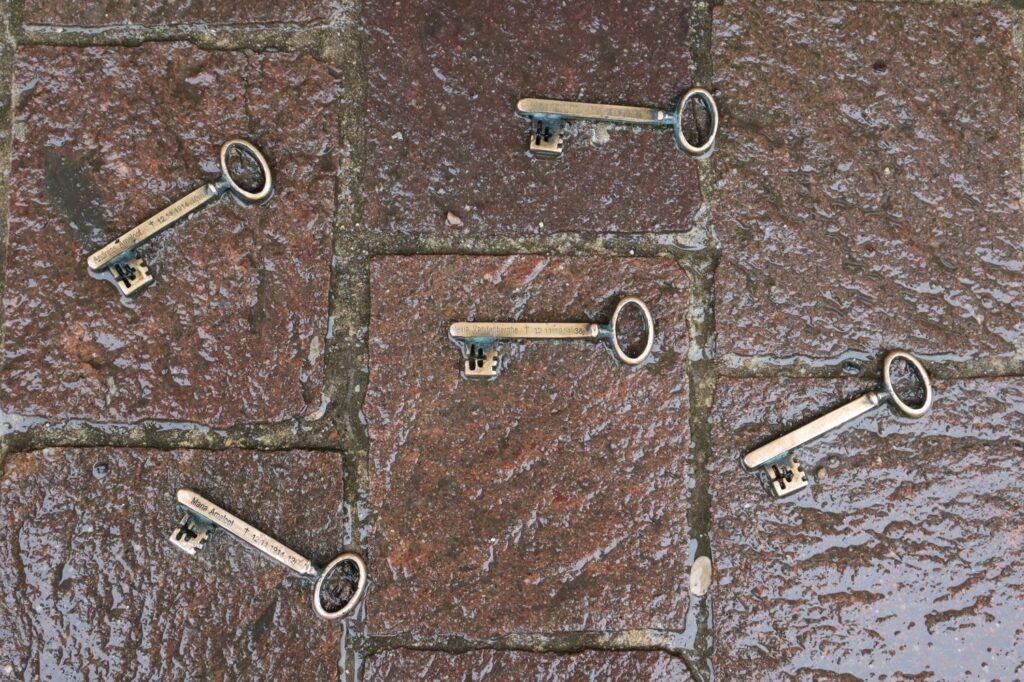
Memorial keys to Ieper civilians. P. Ferguson image, May 2026.
I have managed with my downtime at my Rijsselstraat home, to read through the pages of Conrad, Shelley and Stoker, stories of moral failings, hauntings and isolation. I have held these themes with each personal Salient step, and found across this landscape where these themes occur time and time again. It is the between the years of the two world wars, from about 1919 – 1938, that I have found in the arts many others coming to grip with the horrors of our kind. An exploration I envision to continue, decades leading to decades, understanding context one by the other.
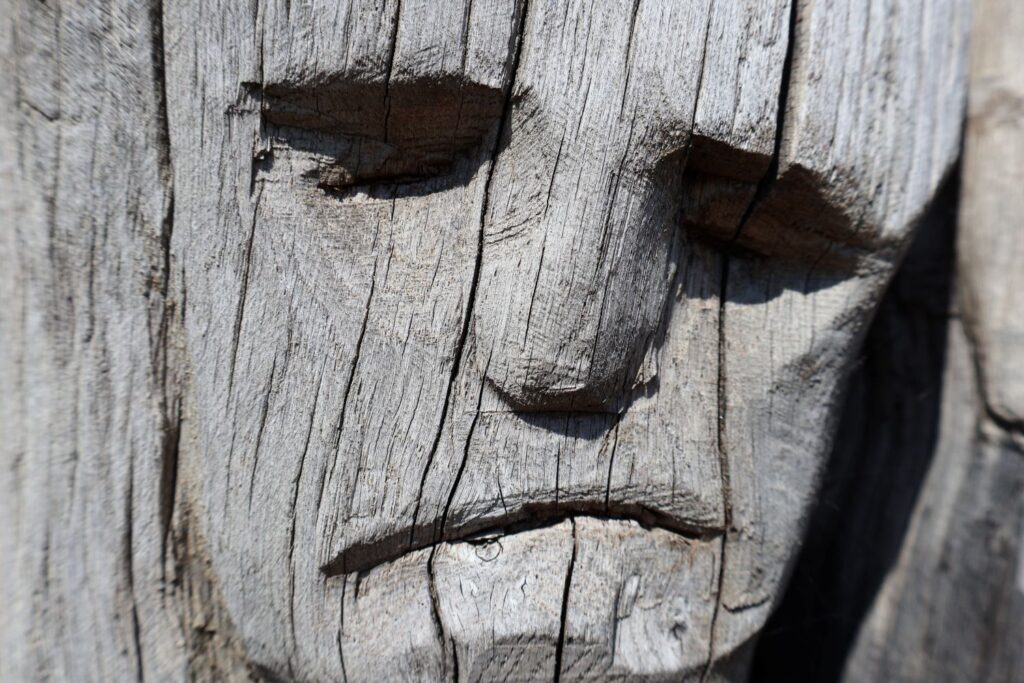
Carved face on a wood sleeper. Faces of War installation. P. Ferguson image, April 2026.
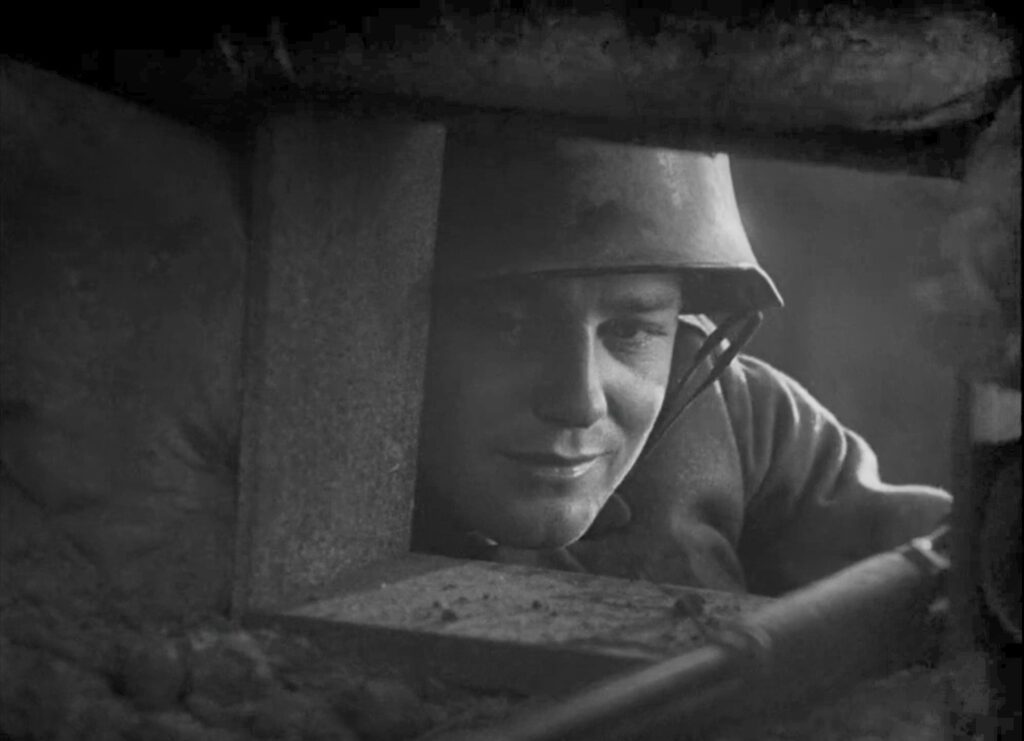
In German cinema Pabst’s Westfront 1918 (1930) depicts the Great War as a nightmare. In 1933 with the rise of the NAZI’s Westfront 1918 was critiqued as degenerative…a depiction of cowardly defeatism and banned. Actor Gustave Diessl was held for a year as a prisoner of war during the Great War played the disillusioned soldier Karl. His well known line, We are all to blame! Diessl later performed as Lieutenant von Schill in one of the last films of the Third Reich, the historical propaganda epic Kolberg (1945).
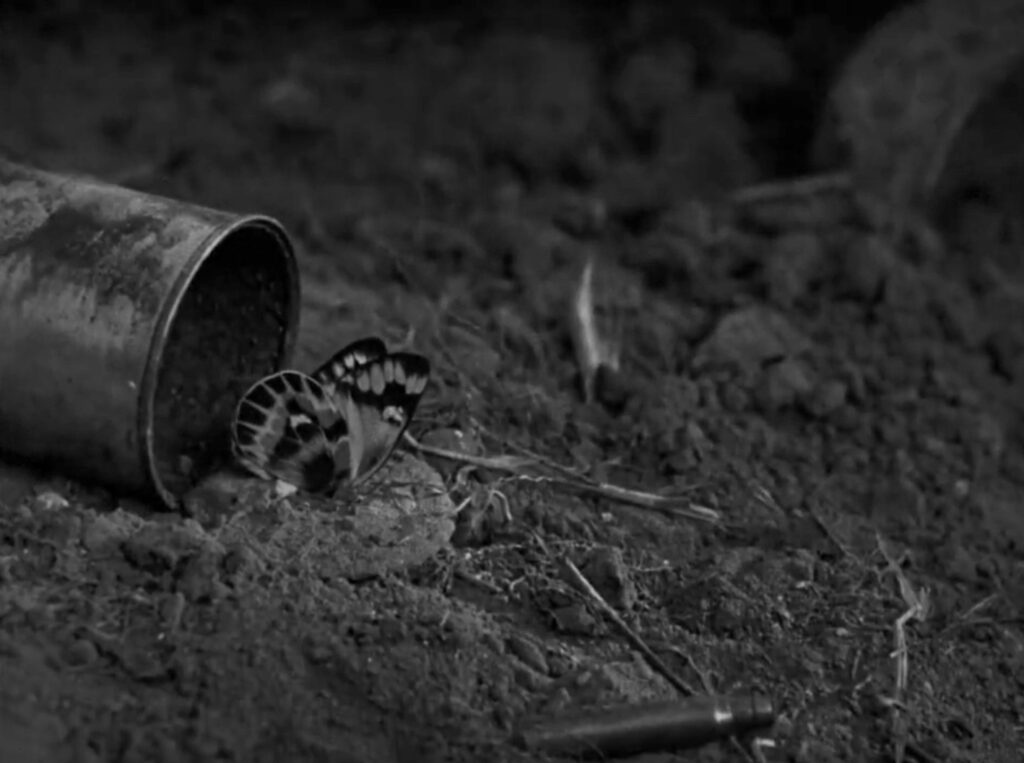
In American cinema, Lewis Milestone’s All Quiet on the Western Front (1930) is regarded as one of the great anti-war films and opened to wide acclaim. The film’s end scene gave me my pursuit of butterflies in Flanders (with an ending there is a beginning). The written words of All Quiet on the Western Front, authored by German veteran Erich Maria Remarque were also banned and the book subjected to targeted burning.
These portrayals are not without their companions…depictions of horror as monsters…and profoundly influenced by Great War veterans who took their expression to moving images, paint, sculpture, other media and voice.
Frankenstein (1931) directed by former British Army officer and Great War veteran James Whale, reflects in his monster the deep scars of war. In the creature’s footsteps and expressions, one can see the suffering of those whose Great War left them shattered. Watch as step after step takes us to the treatment rooms of hospitals where Great War soldiers continued their struggles. Known then as shell shock, now as Post-traumatic Stress Disorder, the Great War poets Wilfrid Owen and Siegfried Sassoon met in 1917 at Craiglockhart War Hospital an officer’s military psychiatric hospital in Edinburgh, Scotland. Who are these? Why sit here in twilight?…Dawn breaks open like a wound that bleeds afresh…Pawing us who dealt them war and madness. (Wilfred Owen, Mental Cases, 1918)
Former Austro-Hungarian officer, Bela Lugosi appeared in Dracula (1931), a performance some suggest was influenced as a witness to the tumult. Lugosi was wounded three times, rarely spoke of his war though in an apparent 1941 interview Lugosi stated If I am mad, I ask, are not all men who have been through a war a little mad?Have they not the right to be a little mad?
Previously another German film Nosferatu (1922) was heavily impacted by the experiences of Great War veterans Friedrich Wilhem Murnau (Director), Albin Grau (Producer) and Max Schreck (Actor). The film’s rat scene is one of several visuals symbolic of the Great War and its aftermath. Trench rats thrived in the unsanitary conditions of the Great War numbering in the millions creating considerable hardship as they fed off littered rations, corpses, and human waste. Siegfried Sassoon’s poem Aftermath (1919) speaks of the pestilence…Do you remember the rats; and the stench, Of corpses rotting in front of the front-line trench – And dawn coming, dirty-white, and chill with a hopless rain? Do you ever stop and ask, ‘Is it all going to happen again?’…
Similarly the same can be said for the post-war depictions of the Great War on canvas and other surfaces. The considered accumulation of paint on pallets being decidedly fashioned with brush strokes to canvas or board. All are evidence of coming to terms with the haunting aspects of mankind’s ability to destroy one and other. And how have I let slip, till now, Tolkien’s Great War with Lord of the Rings, his fight on the Somme turned to written pages and now film. How these works continue to provide influence and thought. By delving a little deeper…that we might learn from our follies?
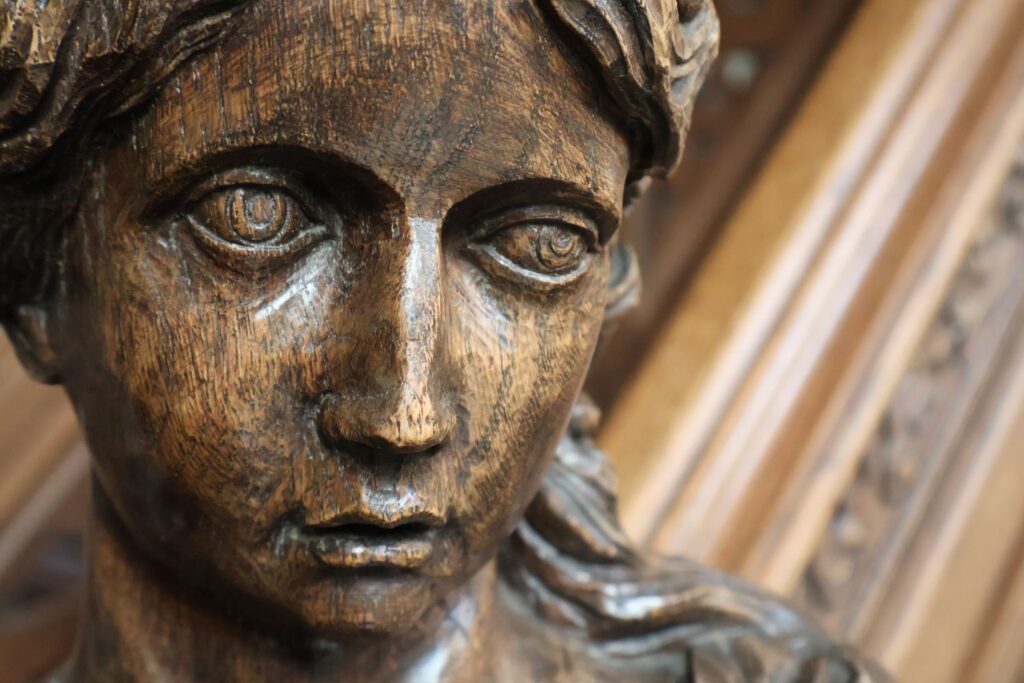
Sint-Pieterskerk figure, Rijselstraat, Ieper. P. Ferguson image, May 2026.
Within all the words I have read…one passage from Dracula speaks to the truth of our paths (our pilgrimages), though the truths (the evidence of remembrance) remain in France and Flanders…so too does the monster. In the summer of this year we made a journey to Transylvania, and went over the old ground which was, and is, to us so full of vivid and terrible memories. It was almost impossible to believe that the things which we had seen with our own eyes and heard with our own ears were living truths. Every trace of all that had been was blotted out. (Stoker, Dracula. Note).
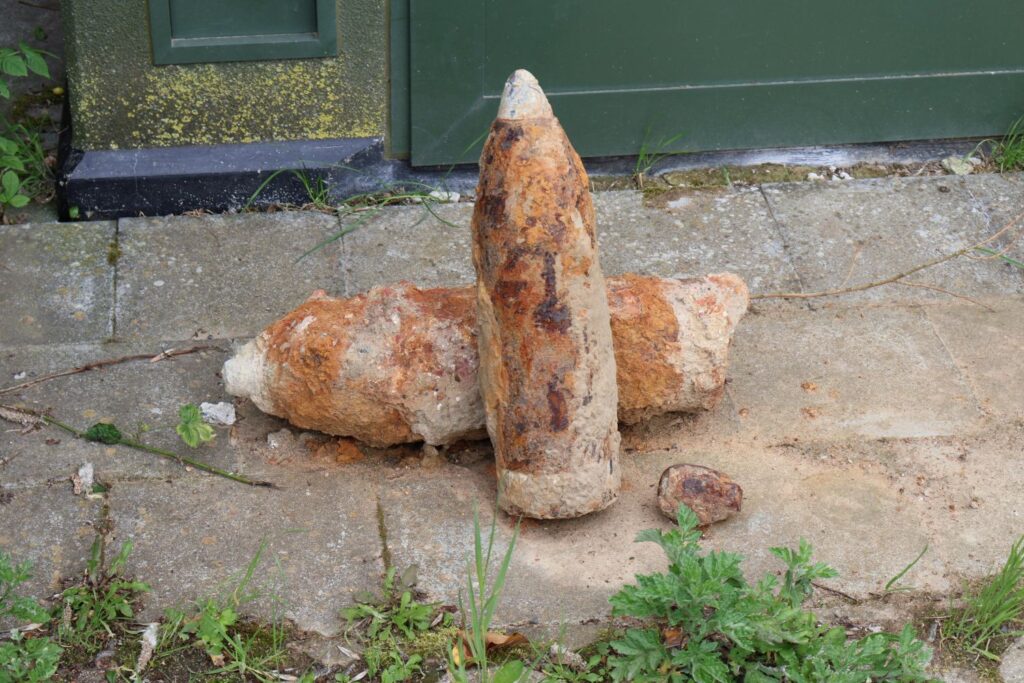
Shrapnel shell along the Kriekstraat. P. Ferguson image, April 2026.
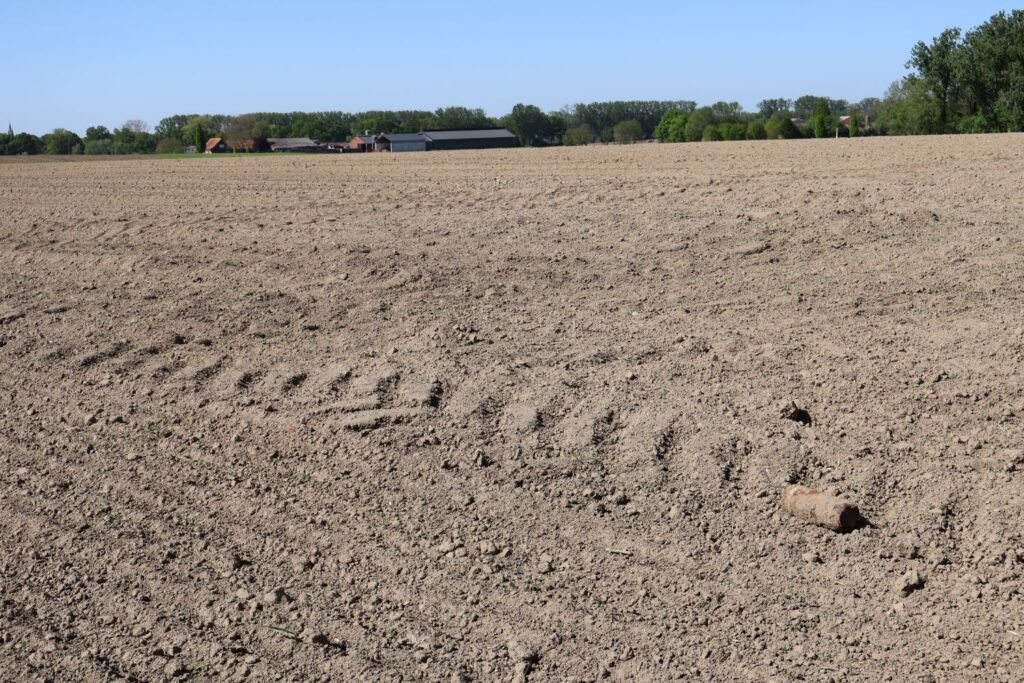
Finally one other monster existed on my hiking trails. After years of burial the iron harvest’s rusted form rises to the surface time and time again as blades of steel carves these lands in preparation of the fields of bounty. Prior to these encounters the harvest seemed dormant until a news story reported 85 Great War shells were discovered on a single day. As I walked along the Kriekstraat and on another day at Gravenstafel three rounds were seen along the roadway’s edge.
It is at these times I recall the profits of the war’s aimed engineering becoming twisted within law. After the Great War German munitions firm Krupp sued British munitions firm Vickers for royalties based on the use by the British company of the German patented artillery fuses during the conflict. And so the monster continues…now rusted and scarred…but taunting the tenets of peace by their presence.
Large shells await their disposal by Belgian authorities. Gravenstafel. P. Ferguson image, May 2026.
Whilst on the trail of my essence of place search, I captured many hundreds (thousands) of images. At times, in my review, I became aware that many pictures were purely for future reference. The images I became especially interested in were those within the context of my feelings about place…about Ieper…the Salient…France…and the Great War. Mingled with stories read and films watched I have sought within my Ieper (and France) experience the images that capture my overarching themes…the Conrad…the Shelley…the Stoker…my words…my adapted screenplay of the Great War I hiked.
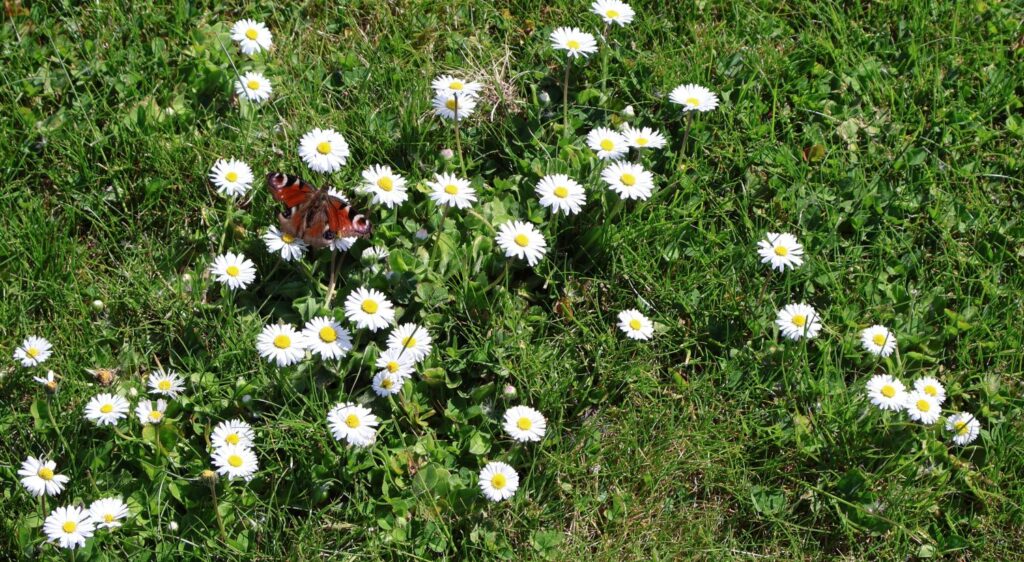
My pursuit (of happiness). Peacock butterfly at the Brooding Soldier Memorial, St. Julien. P. Ferguson image, April 2026.
Though now, 31 May 2026, is the time in Ieper to say to those I have passed either as messengers, friends, pilgrims and the fallen…be well…remember them well. I have spent my time finding as much in the peace as in the conflict. I am slightly older, chased the powdered wing across the stones of heaven…read and reread the names of the many but sadly like Conrad’s Stein I must be leaving now…
He [Stein] is ‘preparing to leave all this; preparing to leave…’ while he waves his hand sadly at his butterflies. (Conrad, Lord Jim, 1900)
Addendum 3 June 2026
I descend the stairs of the Windermere Hotel towards the dining area. With my first steps Sign of the Times fills the air. I smile…a full circle completed…my decompression complete. For two and a half months Harry Styles’ song has resonated with my steps…the bullets, the bullets… I have thought upon its lyrics, watched Mr. Styles walk, reflect and rise caught between earth and heaven. His hand at times outward, palm towards the ground…like Maximus…there is something here…there is something wherever we choose to look…the greater act is in the choosing. We never learn, we been here before…we can meet again somewhere…we don’t talk enough, we should open up…all I have seen…all I have contemplated…my decompression complete.
Special thanks to Rosemary (my best friend), Shannon (web wizard), Elodie (Main Street Hotel and Apartments, Ieper), Nele and Robin (Commonwealth War Graves Commission, Ieper), Christian and Annette (Camalou Tours, Vlamertinge) and all of the Great War’s elders.
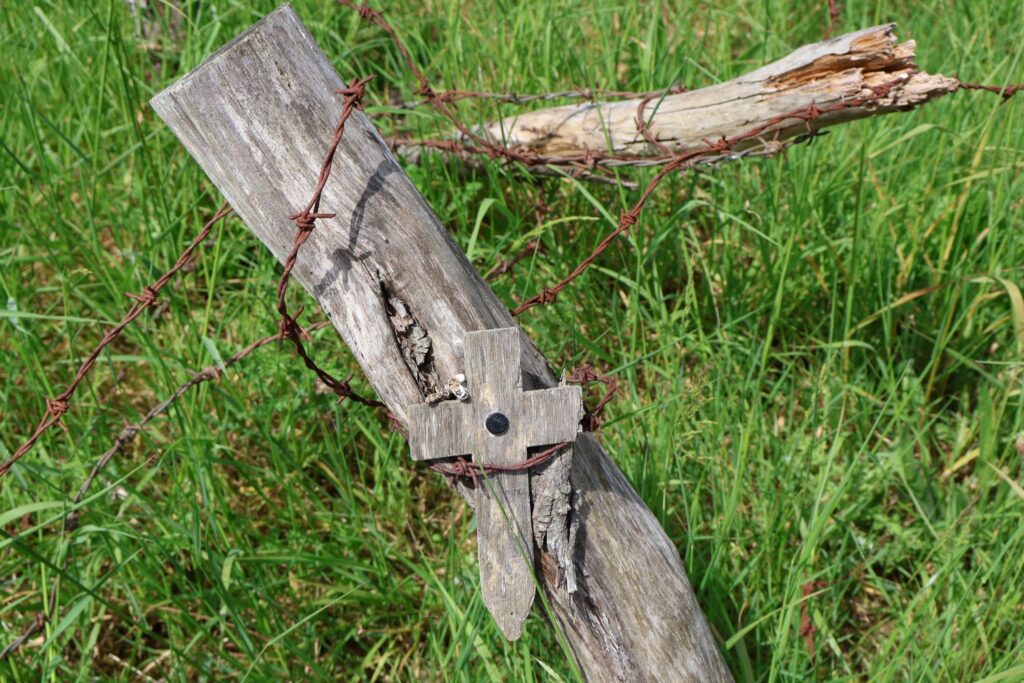
Remembrance Cross on a barbed wire post near Ploegsteert Wood. P. Ferguson image, May 2026.
Eg Skar Mítt Navn
Today (24 May 2026) has been a hot day – and my hours on yesterday’s road (also in the sun) have (this day) slowed me down. Yesterday’s steps (23 May 2026) on the Salient started at Rifle House (Ploegsteert Wood) where I sought Peacock butterflies amongst the markers. But it was not to be – not a single flutter to be seen. How I miss their eyespots looking upwards towards the lens receiving life from the sun.
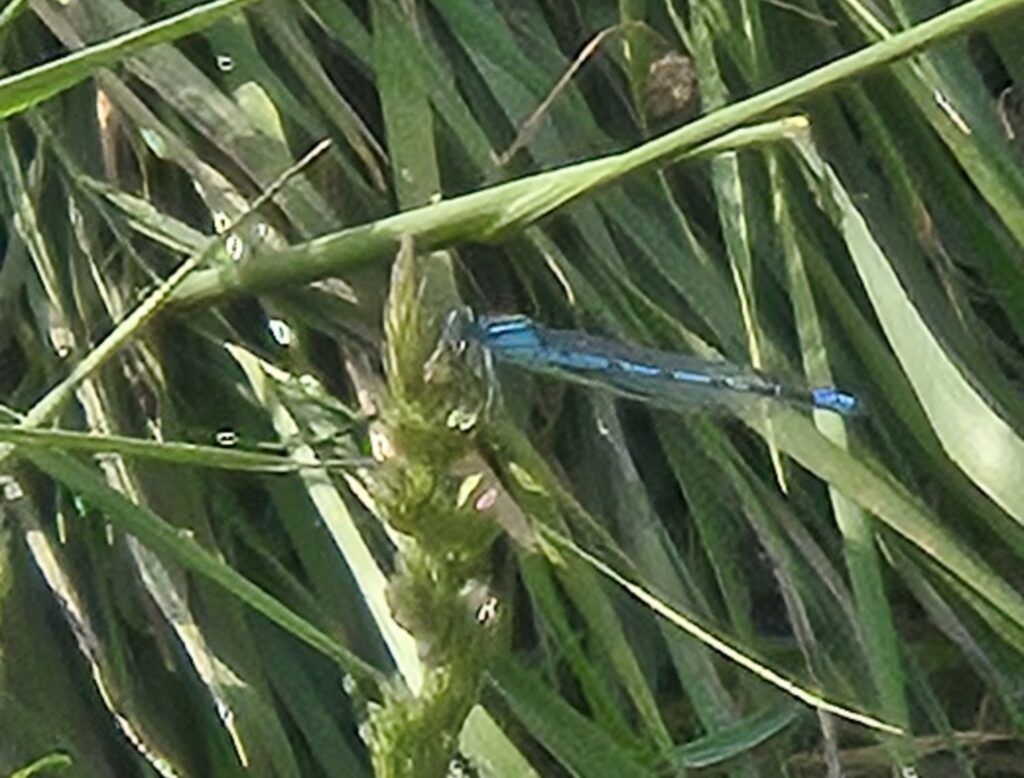
No butterflies. Though one dragonfly appeared. P. Ferguson image, May 2026.
And thus my yesterday moves forward from Rifle House to Mesen (Messines) to Wulvergem and Wijtschate. Seven and a half hours on the trails of others – no butterflies but visits with soldiers of the 16th (Canadian Scottish) at Rifle House, La Plus Douve Farm, Kandahar Farm and R.E. Farm. Along the way two stops for cold drinks, ice cream and a large bottle of water that carried me through to my rest point on a park bench at Wijtschate.
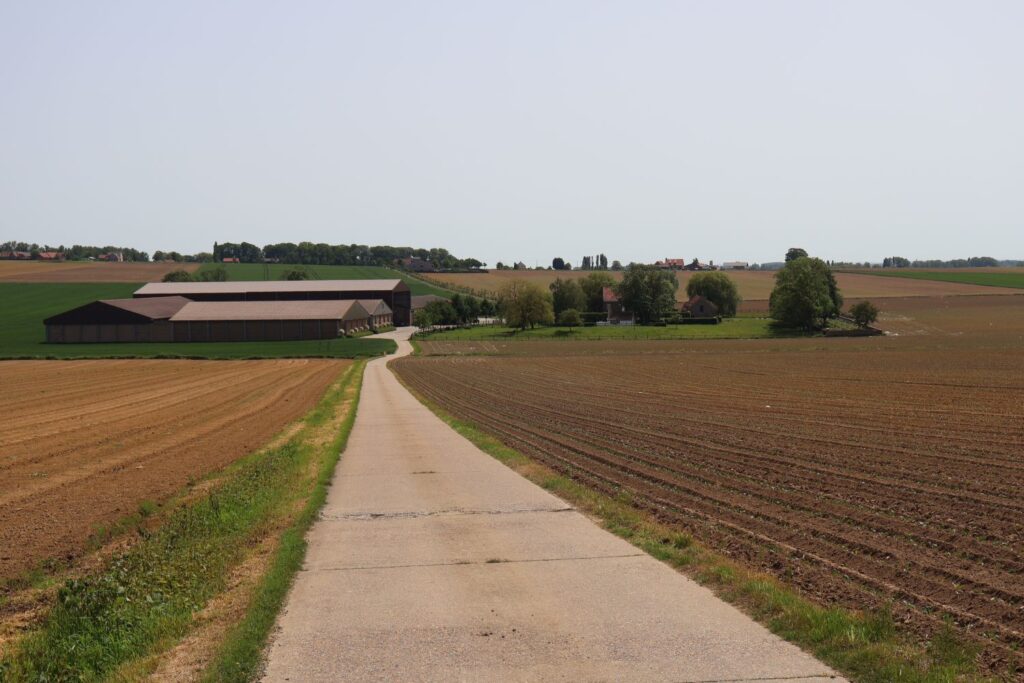
Road leading towards La Plus Douve Farm. P. Ferguson image, May 2026.
At my Wijtschate perch I considered several scripting ideas about my recent Salient travels. There is much to work with but by happenstance on this next day, a day of rest, I am provided with another gift via another kindly act of remembrance when a brass band from Sherborne, England begins to play a tune that needed to be played here surrounded by carved names. I am caught quickly by the tone. There are many people gathered on this lovely evening of warmth watching as the red jackets of the Sherborne Town Band perform. Standing in the background I listen to the notes as they rise within the gate. I have my story, though I must meet with one of them to learn the lesson’s name.
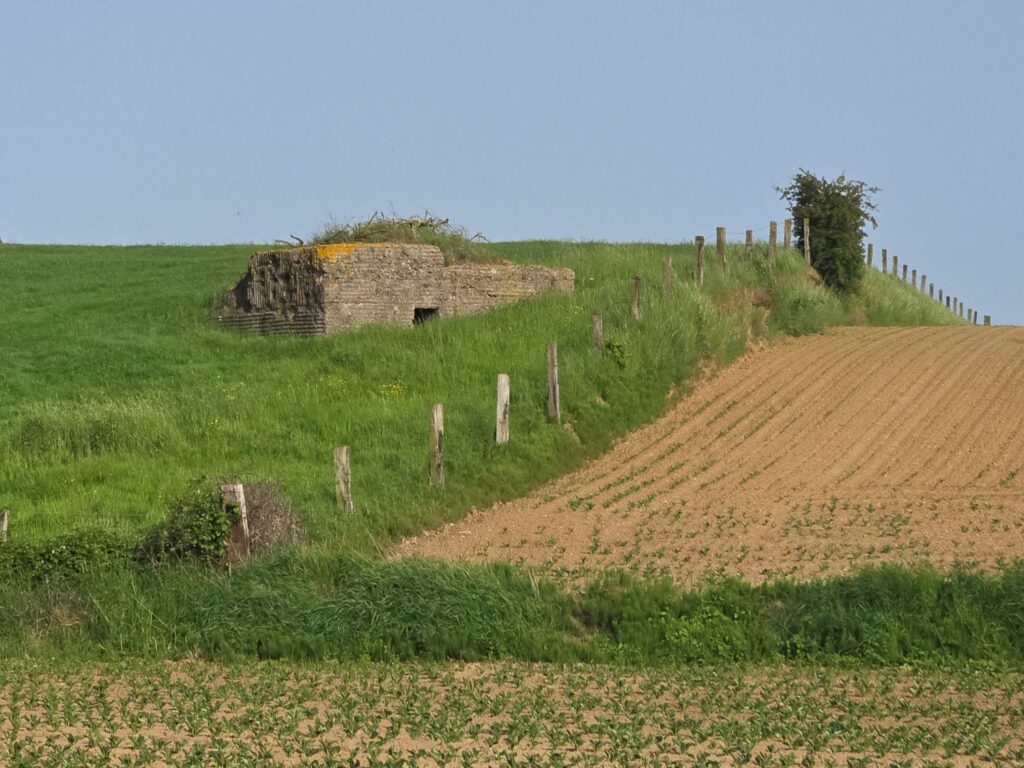
German bunker at Skip Point along the Wulvergemstraat. P. Ferguson image, May 2026.
Within this great hall of carved names and as the crowd disperses I find my way to a band member who upon my request provides the sheet music to provide me with its title. I am grateful. Soon I spot the band’s banner and ask if I might photograph it, and then speak with the band’s deputy conductor, Peter, who provides the translation and what it meant to him to perform Eg Skar Mítt Navn within these walls. Truly a heartfelt moment.
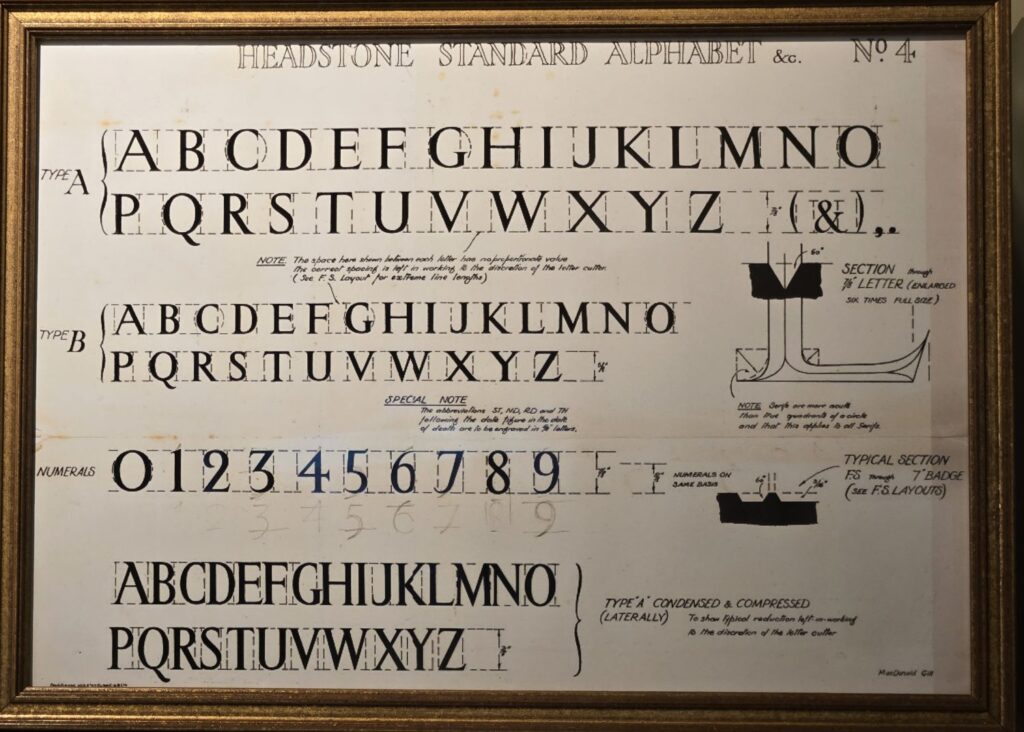
Carved letters. The Headstone Carved Alphabet by MacDonald Gill. P Ferguson image, May 2026.
The headstones stand in the sun with their names carved across their stone pages. So too at the memorials where people stand and read. They have come perhaps for someone or as a matter of interest they have taken their time to see, to feel. I watch them at the Gate raise their mobile phones to record the events, to take pictures, and to read these names. Heartfelt, like Peter who chose this song (it must be played here) Eg Skar Mítt Navn – (I Carved My Name).
Special thanks to the Sherborne Town Band who made this a very special evening.
A festival evening at St. Martin’s. P. Ferguson image, March 2028.
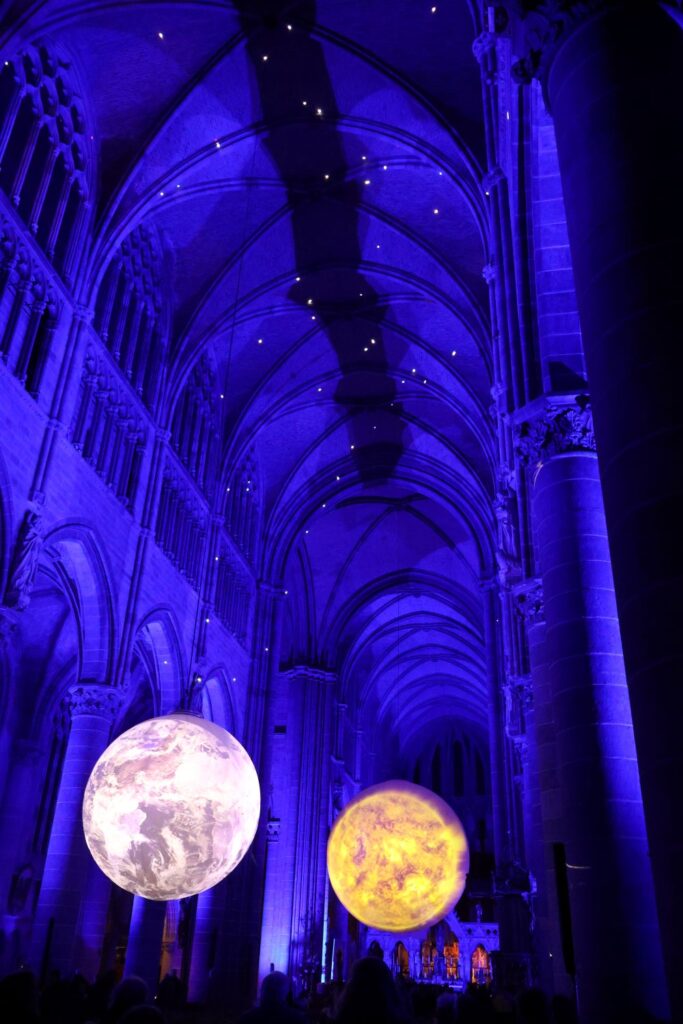
Within the Cathedral of St. Martins, Ieper
A being must carry the shadow to embrace the light, and blend these vital breaths to make harmony.
(Tao Te Ching, 2nd Century BCE))
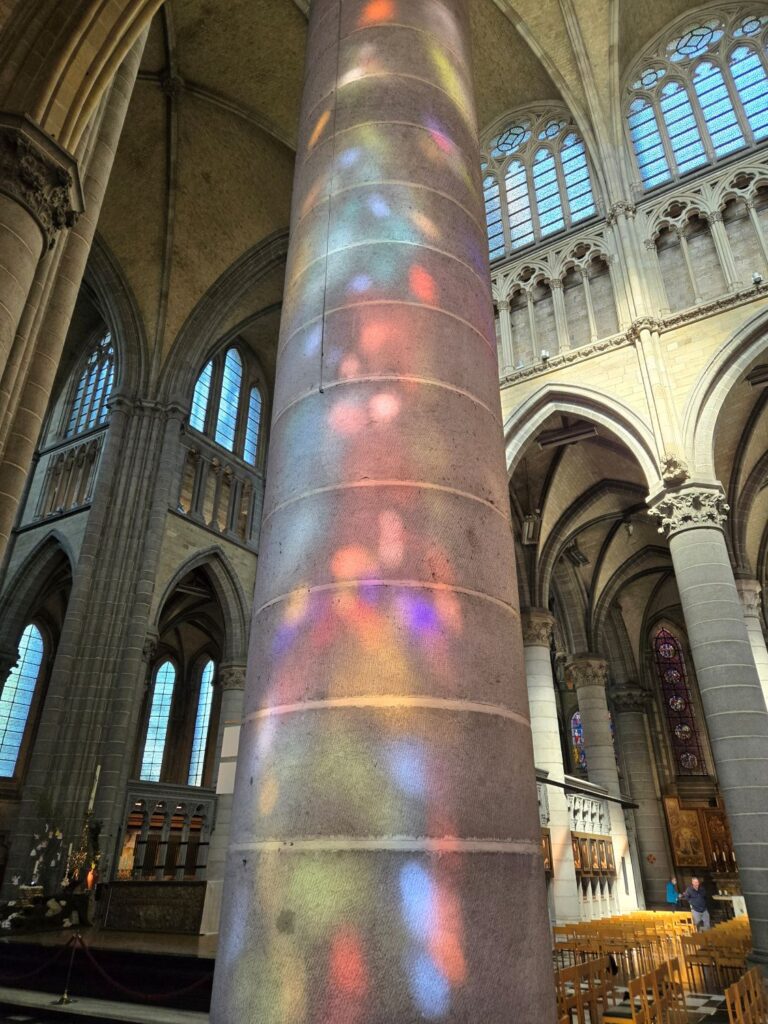
I see them as light across a column rising in support of the vaulted ceiling. Music plays softly in the background as footsteps tread across the stone tiles of black and white. The voices rise together answered by a single voice. In the near distance the sound of water. If you can’t fight and you can’t flee flow.
Pallet of coloured light that I might see wild flowers. P. Ferguson image, April 2026.
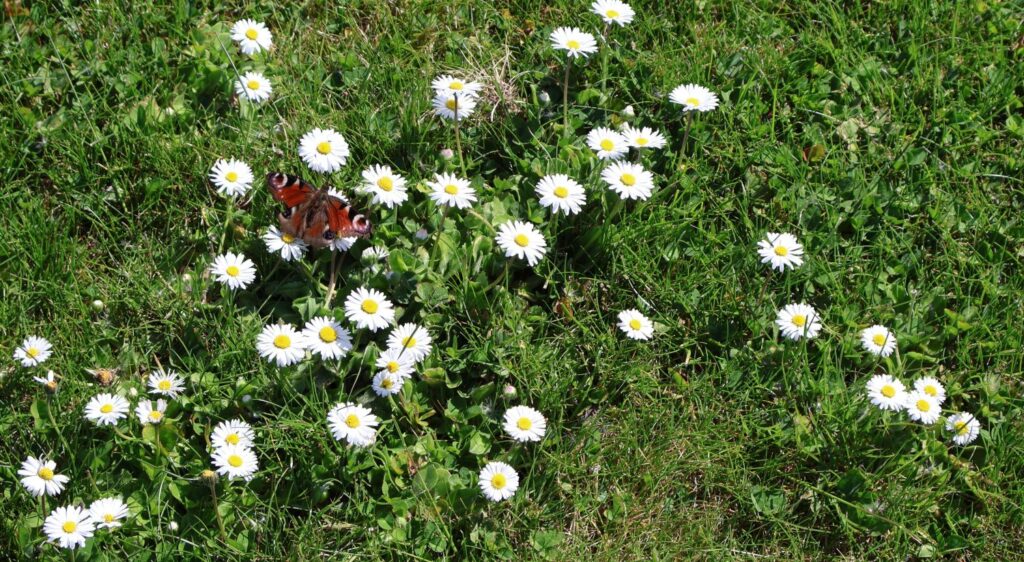
There are no spoken words here unless softened voices from one close by ear to another. I have walked this hall before, but today is the impressionist’s pallet of colored light on the great column I witness. There is joy in my heart to see such colour. At first a poppy, a bluet, dandelions and then daisies. These gifts from a gentle hand, the brush strokes of heaven.
The song of light and joy brings breath to the stillness. There are within, commemorations of those who saw this land in shock. Now today a place of tranquility and echoes. Once shattered and since rebuilt. A parent and child…two generations, both generations witness to conflict.
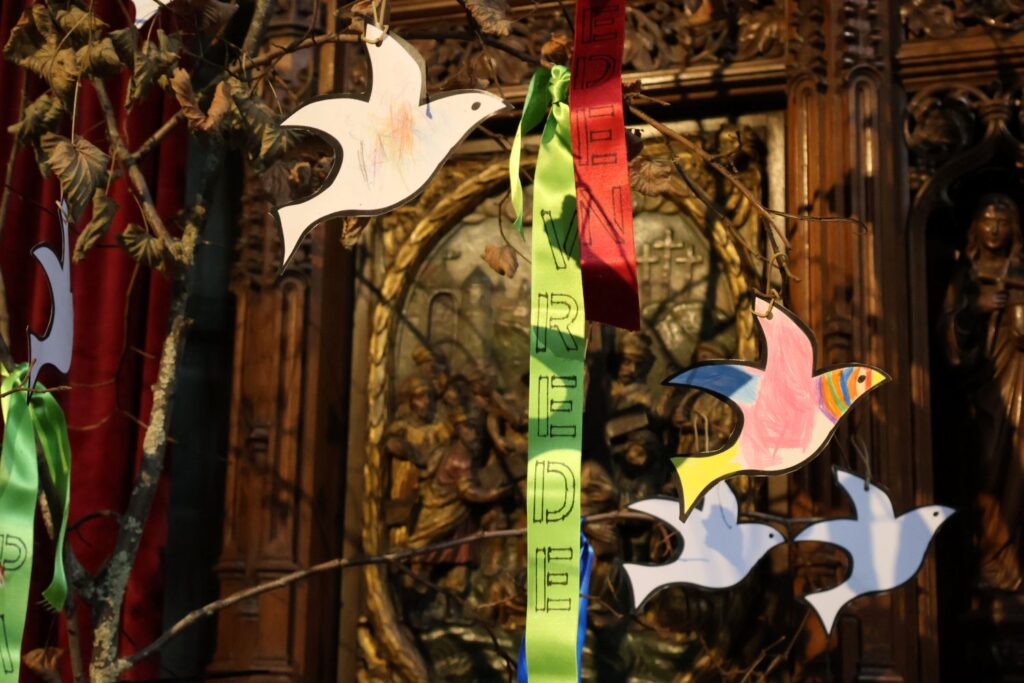
Peace doves within the cathedral. Vrede – peace, calm, tranquility. P. Ferguson image, April 2026.
Who has walked within this great structure from both sides of the fence? As I sit I contemplate peace and flowers of light painted against stone. One wishes these colours to further pass across the markers of the many. Though petals of colour grow in abundance at their base…it is this pallet of light that today brings me hope.
From a spontaneous note written at St. Martin’s Cathedral. April 30, 2026
Peacock butterfly near the St. Julien Memorial. P. Ferguson image, April 2026.
The shadow prowling amongst the graves of butterflies laughed boisterously.
(Lord Jim, Joseph Conrad, 1900).
My downtime in Ieper is filled with books, Lord Jim, Frankenstein and Dracula. All three novels appeal to a quest for a single line, perhaps more, to inspire pen and ink in scripted movement from left to right. Phrases become my impetus for more. All three novels speak to moral failings, hauntings and isolation – none are about the Great War – their over arching themes reflective of Great War’s truths.
Peacock butterflies at Rifle House Cemetery. P. Ferguson image, September 2005.
Their author’s words are just my start. One phrase (sometimes the unlikeliest of choices) can surmount all others and leads to the next conception and more. From Conrad’s shadows and butterflies I return in reminiscence of Rifle House Cemetery where the annunciated turn of an iron gate launched a thousand and more butterflies towards the welkin. The smeterling’s colour, against the sombre green hanging and attachment of flora, mixed as impressionists within the graves of frail memory.
Paul Bäumer, from his trench, sees the butterfly. All Quiet On the Western Front. 1930.
True Conrad’s pen describes Stein’s collections of Lepidoptera but this phrasing, like music, hints at recollections of threads to be gathered. Rifle House delivered my All Quiet moment. I am that shadow walking amongst the fallen whilst powdered wings take flight then rest. How I should like to see them again – as equal to my first Flanders poppy.
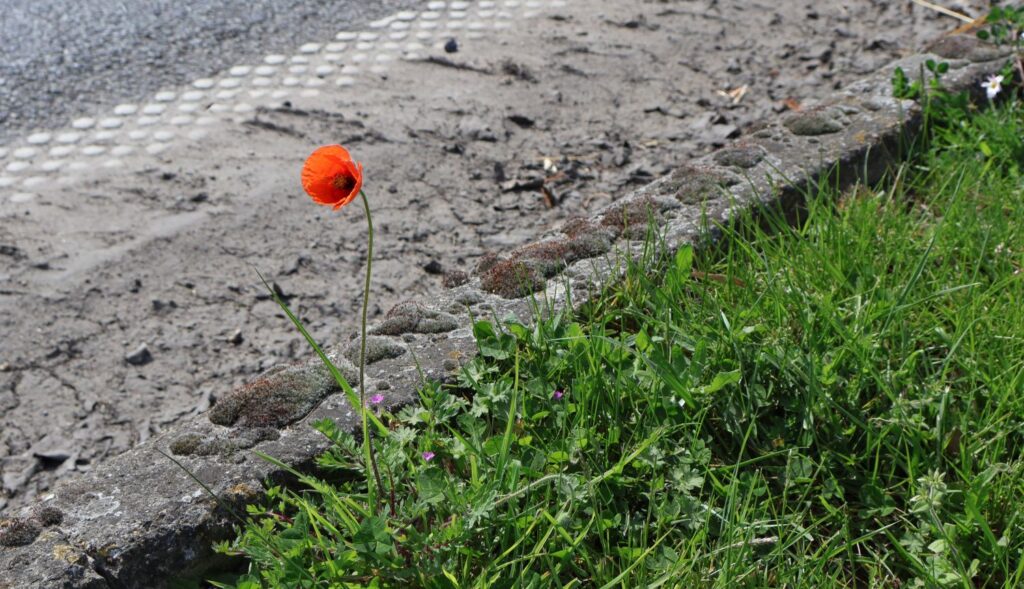
First poppy seen. Hellfire Corner. P. Ferguson image, April 2026.
I do not, as the shadow, laugh within these walls. Der schmeterling of Milestone and Freund within these current days of unquiet blood and the biting of granite – can we not find again your metamorphosis. Just when the caterpillar thought the world was over, it became a butterfly (Chuang Tzu).
Oh my wing clapping eurkalyte, harbinger to my immediate vlidners gevolg. With each basking of your wings a reflection upon life’s fragilities and élan vital; as erratic as my own searching footsteps. My shadow and you – we will meet again.
Butterfly beside the debris of war, a tin and brass cartridge casing. All Quiet On the Western Front. 1930.
Visitor’s poppy cross at the Menin Gate. P. Ferguson image, March 2026.
…and so I have an idea…
My time here is filled, with each step, a scanning of perspectives – to think…I wander across landscapes I have travelled before either with bicycle or car. Walking…walking…brings new impressions and sentiments…I learn about distance and roads (paths too) less travelled. I find routes once taken via the long path to be traversed in half the time by my desire (and inclination) not to travel the same way twice.
These walks…my walks, perhaps of pilgrimage (perhaps salvation) have totalled 26.5 hours on foot. True there is time to stop, to write in my leather bound journal. Otherwise it is the next step…the next row…the next landscape. My bearings are kept by…Kemmel to the south…Ieper’s towers to the north. With these beacons I am able to position myself within the Salient. Without either in site, my red and black acrylic compass tells me in which direction to travel.
Wreaths and lone poppy…they have been. P. Ferguson image, March 2026.
Walk Summary…
28 March (Saturday) Bedford House (4.5 hours).
29 March (Sunday) Voormezelle, Elzenwalle, Ridgewood (6 hours).
31 March (Tuesday) Duhallow ADS, Essex Farm (4.5 hours).
2 April (Thursday) Railway Chateau, Divisional Cemetery, Belgian Battery Corner (4 hours).
4 April (Saturday) Railway Dugouts (Transport Farm), Blauwepoort Farm, Zillebeke Churchyard, Hill 60, Larch Wood (Railway Cutting), Maple Copse (7.5 hours).
But so too on these perspectives I question what may be too much of “more of the same”. Many of the images I take are for reference, future study. I feel as yet I may be failing to capture the heart, the soul of a site in a unique way. And for today, a day of rest after all the time on the road yesterday I routinely think upon the Menin Gate…of Sassoon’s poem On Passing the Menin Gate…In the apartment I read and reread Sassoon’s lines…Paid with a pile of peace-complacent stone…Rise and deride this sepulchre of crime.
Detail from UNESCO panel. P. Ferguson image, March 2026.
Not to pillory the words of poets, both Sassoon and Owen (and others) had their time in the trenches and both were recipients of the Military Cross…I think…I do not stumble. How can Sassoon’s words influence my picture choice for a Menin Gate gallery?…and so I think. Do not use the gate…use words…of those who come to visit…Within this idea, a walk (on a day of rest) back to the Menin Gate…where Flemish text …special thanks to Feline (surname redacted)*…has given me this day and I have found words from others for the gallery.
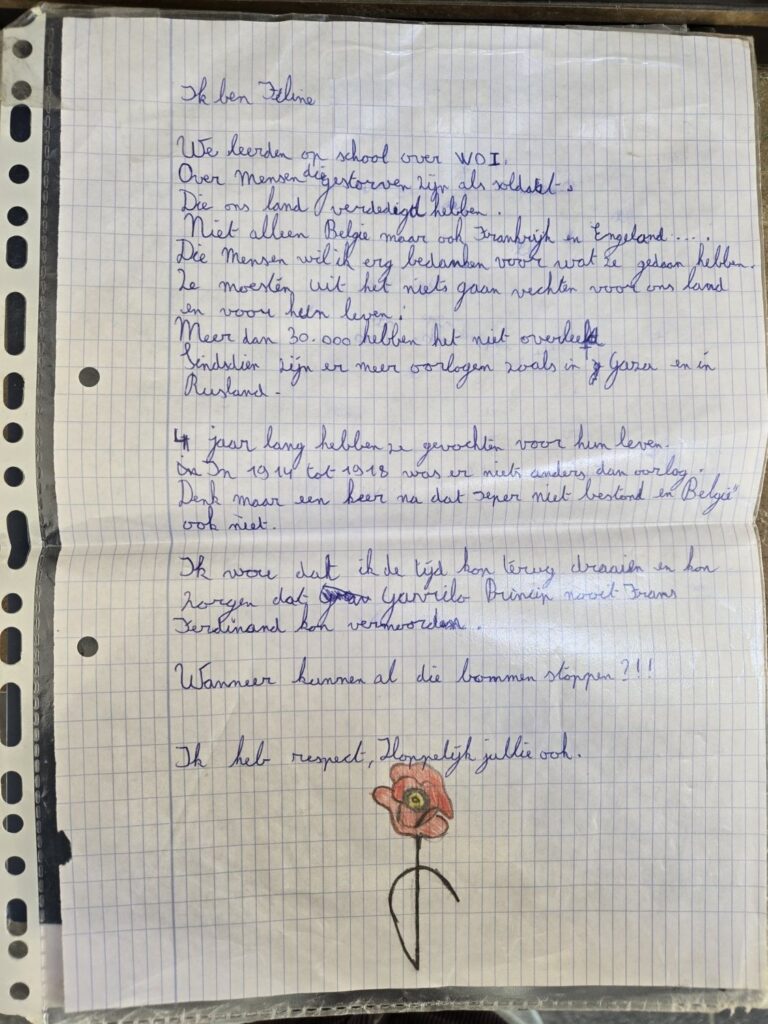
Feline’s words for all to read at Menin Gate. P. Ferguson image, April 2026.
I am Feline….**
We learned at school about WWI.
About people who died as soldiers.
Who helped defend our country.
Not only Belgium, but also France and England…
I would really like to thank those people for what they have done.
They had to go fight for nothing, for our country and for their lives.
More than 30,000 did not survive.
Since then there have been more wars, such as in Gaza and in Russia.
For 4 years they fought for their lives.
From 1914 to 1918 there was nothing but war.
Just imagine that this never ended and Belgium and Ypres didn’t exist either.
I wish I could turn back time and make sure that Gavrilo Princip never shot Franz Ferdinand.
When will all those bombs stop?!
I have respect. Hopefully you do too.
Citation for the award of the Military Cross (London Gazette 27 July 1916)
For conspicuous gallantry during a raid on the enemy’s trenches. He remained for 1½ hours under rifle and bomb fire collecting and bringing in our wounded. Owing to his courage and determination all the killed and wounded were brought in.
Citation for the award of the Military Cross (London Gazette 30 July 1919)
2nd Lieutenant Wilfred Salter Owen
5th attached 2nd Battalion Manchester Regiment
For conspicuous gallantry and devotion to duty in the attack on the Fonsomme Line on October 1st/2nd, 1918. On the company commander becoming a casualty, he assumed command and showed fine leadership and resisted a heavy counter-attack. He personally manipulated a captured enemy machine gun from an isolated position and inflicted considerable losses on the enemy. Throughout he behaved most gallantly.
*Feline…your voice has spoken. In gratitude…with respect… **Translation by Elodie Delplace, Main Street Hotel, Ieper. Thank you Elodie.
The incised lettering at the entrance to Bedford House Cemetery. P. Ferguson image, March 2026.
To Bedford House
It has taken a few days. Rosemary has returned to Canada and the local weather has not been conducive to any long wanderings. After two days I take the chance and begin with a short distance venture (1.6 to 2.5 km). It is a four hour wander, a visit with coffee and cats at Zuid-Bellegoed where in August 2018 Rosemary and I shared in similar cats, coffee and ice cream. It is part of myself becoming part of the landscape…not all doing…some relaxing as various kittens of adult size share the sun’s warmth from their window side perches. I like the way the cats gently close their eyes…I can learn something from their days of rest.
Calico cat rests gently at their window. P. Ferguson image, March 2026.
I have cycled this path before but today, Saturday 28 March 2026, I follow my feet instead of rotating wheels. There is more to see as I can pause easily. I enter Bedford House Cemetery, where 5,139 Commonwealth soldiers are buried. And this…but one of more than 250 cemeteries in Flanders row on row. The day marks the first time I carry my leather-bound journal with me, to record my thoughts in the moment. The journal is part of a larger imagination I have…a possibility for the future created from an earlier story 100 years prior to 1918.
Leatherbound journal travels on this visitor’s treks. P. Ferguson image, March 2026.
So too I have seen something similar in the Displaced exhibition created by the In Flanders Fields Museum. A poetry book…from which I create more notes based on what I see…threads always come together…not a weaving…perhaps an embroidery or tapestry. There may be better words for this but this is the limit of my textilian (new word!) imagination today.
Poetry book with watercolours at the Displaced exhibition, Ieper. P. Ferguson image, March 2026.
Silence…only silence…though I will share my time here, later, with a father and son who have come here to walk this way. They find time for play…the father recognizing where they are but junior happy in the innocence of his small pedal bike. Father will remember this day, for junior perhaps an impression has been created. I believe they will walk and play here again. Row on row I walk.
…Private Peaceful…an impression has been created. P. Ferguson image, March 2026.
My search here are commemorations from visitors and what they have chosen to leave with the fallen. Poppies, figures, flags, poppy crosses, pictures, and notes. I capture these with the shutter. With today’s writing I search for descriptions of the two domed architectural features and find them described as circular Classical temples…so too a description of the cemetery itself, irregular and rambling in its layout. This suits me greatly for my start of walks and writing. I sit within the Temple and write. Fountain pen in hand, pencil nearby for sketching. Another couple walks through, some rows away, and with their mobile take some pictures. I move to the other Temple directly opposite.
Temple with Indian soldier’s grave marker. P. Ferguson image, March 2026.
With my decision to return to my Ieper temporary home, I start for the entrance/exit but find interest in the empty benches and flowers that attract the most enormous of bumblebees. I discover that bumbles are suffering in Belgium due to habitat loss and climate change. The Commonwealth War Graves Commission (CWGC) has been busy providing for species; insect homes and bird houses appearing at their sites. So too I become most interested that Belgium is a leader in rearing commercial bumblebees for pollination. Credit to the CWGC for their values to becoming environmentally friendly, to increase biodiversity and working towards sustainability. Indeed I have noticed the change.
Time for nature…towards sustainability. A Bumble dances their magic. P. Ferguson image, March 2026.
Benches have always been of comfort to me, not only for my ability to rest upon them and observe, but as a photo study of their meaning alone in a landscape. The benches beckon comfort, for a visitor to join them in their watchful gaze. I find time to enjoy their horizontal and vertical slats from which I take in the views. With birdsong in my steps I move again towards the entrance/exit and reread the introductory text provided.
A bench watches over the fallen as if calling for visitors to reflect. P. Ferguson image, March 2026.
Notes about the chateau once here sends me back to the ruins (and moat), the ruins taped off but viewable. Chateau Rosendal, renamed by the British as Bedford House was used as a headquarters and hospital, but was never captured. The impact of shell fire destroyed the chateau and trees and on one single day some 500 gas shells fell here.
Chateau Rosendal image. Passchendaele Memorial Museum.
I leave now…seemingly (once again) wondering when the thread, the impetus for writing will come? I have my notes, my journal, my pictures. Early Monday morning I see the video of the reborn Rush at the 29 March 2026 Juno awards. With drummer Anika Nilles and keyboardist Loren Gold I am thrilled for Rush to return to the stage. Their music means much to me, providing the desire to play guitar…(how many time have I played Working Man?…and others…) The song they chose for their return…Finding My Way from their first album released in 1974…
Providing care for the past and the future. P. Ferguson image, March 2026.
Though the lyrics of Finding My Way are pre-lyricist and drummer Neil Peart (The Professor) Rush’s return after last performing 1 August 2015 are heartfelt. The loss of Neil Peart in 2020 to Alex and Geddy, and to all those close to the drummer was…before his time. Would Rush ever play again? And so they did – as so too I walk these rows of trauma, before their time, finding my way, finding my way back home…
Thanks to Geddy, Alex, John, Neil, Anika, Loren and 5,139 others this day.
Trauma does not heal. However, post-traumatic growth can allow us to build resilience. Through the footsteps of others…I find healing…my sustainability…find your way.
Rosemary pauses at St. Martin’s Cathedral, Ieper. P. Ferguson image, March 2026.
Compassion and Grace
We walk through the cobbled streets and paths of Ieper and Rosemary asks, “What will you write about Bruges (Brugge)?” It has been two days and no scratching upon a notepad has followed since our wonderful wander with new friend Roel. As we walk I simply say, “There are not enough threads to connect yet”.
There can be no doubt that The Madonna of Bruges was a distinct highlight. I had wanted to see the carved marble figure of the Madonna and child since learning about the statue on an airplane in December 2014. I know this date well as I watched The Monuments Men, released 2014, on the tiny back of a chair screen on my way to London.
A visitor to Bruges finds grace amidst the blossoms. P. Ferguson image, March 2026.
The film was not my first introduction to stolen art of the Second World War. Visits to museums, art history books and other resources had informed me, but The Monuments Men film with its Christmas timing and being relevant to my then current search for faith in humanity was timely. So too the film Woman in Gold (2015), and similarly an earlier film with Peter O’Toole as the psychopathic General Tanz in The Night of the Generals (1967). Tanz suffering a mental breakdown in the Room of Martyrs while viewing paintings of Van Gogh. Within Tanz’s being – the duality of his fine art appreciation tangled within his horrid inhumanity.
De Halve Maan brewery sign, a symbol too of compassion. P. Ferguson image, March 2026.
As we wander the City of Bruges we learn considerably from Roel who has been most gracious in giving his day to our fine adventure. We wander and observe, sit, drink coffee, find ourselves lunch and return to key points of interest. Rosemary is delighted…we are both amused with the 3.2 – 3.3 km (~ 2 miles) beer pipeline of De Halve Maan brewery. Steadily I snap away seemingly always a few feet or more behind.
My destination for the day. The Church of Our Lady in the background. P. Ferguson image, March 2026.
The day builds to our entry within The Church of Our Lady. We walk slowly, graciously in search not of the Madonna but of other accents, and then, and at the right moment we are upon mother and child. Carved of white Carrara marble by Michelangelo its compassion resounds from within its setting.
Within the church…I walk with sensitivity for what we are to see. P. Ferguson image, March 2026.
There are many people within the church, many pause but I am in need of reflection. More than a pause – I take my time, find time for others, return, view from one side and the other, to the front, to the centre and from various distances. The figure does not have to speak it is perfection to these eyes…a grace upon the earth.
That The Madonna and child has returned not once but twice due to theft astonishes me. I reflect on what the world would have lost if lost to us all. The Madonna of Bruges, once taken by the Nazis 7/8 September 1944; returned by the Monuments Men from an Austrian salt mine in 1945 and previously, in 1794, by Napoleon’s forces, and repatriated in 1815. Still yet, despite this success I cannot help but wonder upon all art works lost to us all and for all time…a deprivation to humankind…more than 30,000 works lost, stolen, destroyed through the processes of hate and want.
Visitors to the Madonna of Bruges. P. Ferguson image, March 2026.
So this day as we walk from our Ieper apartment to outside the Menin Gate of missing souls, I continue to think on my few words…where are the threads, and yet it will come in the unlikeliest of places, from a speaker box above our bounty..as I step the right words (the right thread) fall upon my ears…
There’s a blaze of light in every word…It doesn’t matter which you heard…The holy or the broken Hallelujah...*
*Hallelujah. Leonard Cohen, 1984.
In Bruges we find grace and compassion…a time of reflection. P. Ferguson image, March 2026.
Special appreciation to Roel for his time with us and to Rosemary – always by my side.
Coronation Avenue. Rebuilt after the Blitz. P. Ferguson image, March 2026.
Stoke Newington High Street Walk
The two pence piece lay atop the coping stone of the 3′ wall at Coronation Avenue. After a number of years I have made my way to this tragic site of the Blitz.
Once and some while ago Rosemary and I purchased tickets for a visit here only to have the train cancelled due to a rail incident. That time it was not meant to be. My return to Liverpool Street Station this day was meant to be. I am able to travel to Stoke Newington on my Oyster card. Once exited from the station I turn left and walk the High Street in anticipation.
Arrival at Stone Newington Station. P. Ferguson image, March 2026.
As I move along I search for new and old brick and stone, evidence to 1940-1941…built and rebuilt. The eyes find the shots…the background history to come later…buildings and features, road names, persons until I find the corner destination…the arches of Coronation Avenue.
The architectural lettering of Coronation Avenue and the commemorative plaque indicates the tragedy here. The plaque is well above eye level. During my 30 minute visit I watch as passers by occasionally look towards my interest…my camera indicating there is something to see. No one asks questions…I have my time here.
The arches of Coronation Avenue. P. Ferguson image, March 2026.
With my return to the station the circular two pence stands out against the grey coping stone. It is copper, weathered from its time here. A lost piece of 1980 somehow becomes a 40th anniversary reckoning with what occurred here. I have had my time…and require no more this day…richer for this experience as I walk I think upon 160+ souls.
A reminder of the Blitz here at Stoke Newington. P. Ferguson image, March 2026.
To Rescue Those In Peril
The 13 October 1940 bombing of the Coronation Avenue residential block led to three individuals being recognized with the award of the George Medal. The Air Raid Precautions’ citations summarize case reports recorded in official Civil Defence records. Easthope’s award being reviewed by a non-civil defence committee.
John Cochrane Easthope Assistant Engineer Stoke Newington
Mr. Easthope was on duty in the Control Room and hearing that a large number of persons were trapped in a Public Shelter, he volunteered to go to the scene of the incident. He arrived and entered the middle compartment of the shelter through a window at the rear. In spite of the danger of a further collapse of the debris and of the fact that water was then about 4 ft. deep in the shelter, Mr. Easthope worked his way over and under the debris into this compartment in an endeavour to rescue anybody who might be there, but primarily to carry out a reconnaissance to direct the squads who were working above. He found debris blocking the centre compartment up to a distance of 15 ft. from the point of entry. Several persons were were pinned under the wreckage. Mr. Easthope then came out and entered again through the emergency exit into the north compartment and crawled along the top tiers of the bunks in an effort to discover whether any persons were still in that compartment. The water was several feet high and appeared to be rising. Mr. Easthope emerged from the shelter again and reported on the conditions inside.
He then re-entered the shelter and confirmed the position of the debris.
Regardless of the danger of being crushed to death at any instant, or being trapped and drowned, Easthope made four separate visits to the shelter through the hole he had made, fully aware of the risk he was running while searching for trapped people.
Albert James Sambridge Member, Air Raid Precautions Rescue Party Hackney
A high explosive bomb struck a building and started fires in the upper floors and breaking water mains. An opening had to be made in the wreckage for members of the squad to enter the basement where water was three feet deep and still rising. A woman was found but could not be moved. The water had by this time risen to five feet and the men were advised to leave. Sambridge, however, continued his efforts to release the victim.
By going under the water, he managed partly to free her. He then had a rope passed down which he tied to himself and the woman. He directed the men above to pull on the rope taking the strain on his own body and by this means the woman was released. The water was by now within two feet of the ceiling but he managed to guide her to the hole through which she was hauled to safety. Owing to the complete darkness and the difficulties in dealing with the casualty, Sambridge was left swimming in the water, which rose to within six inches of the ceiling before he also was rescued on the point of collapse.
Sambridge, in effecting this gallant rescue, showed extreme devotion to duty and total disregard of personal safety.
Edward William Clark Skilled Member, Air Raid Precautions Rescue Party Stoke Newington
A H.E. bomb demolished a building . The gas and water mains were fractured and the wreckage caught fire.
People were trapped in the basement which was rapidly flooding . Despite the danger of further collapse of walls and debris, several men of the Rescue Party, among whom was Clark, succeeded in extricating a number of people.
Clark determined to satisfy himself that all had been saved. Again and again he dived into the water under the debris. His perseverance and disregard of danger resulted in him saving a woman who, trapped at the far end of the basement, would certainly have been drowned but for Clark’s gallant efforts.
Having completed his task, Clark collapsed from the effects of exposure and coal gas poisoning.