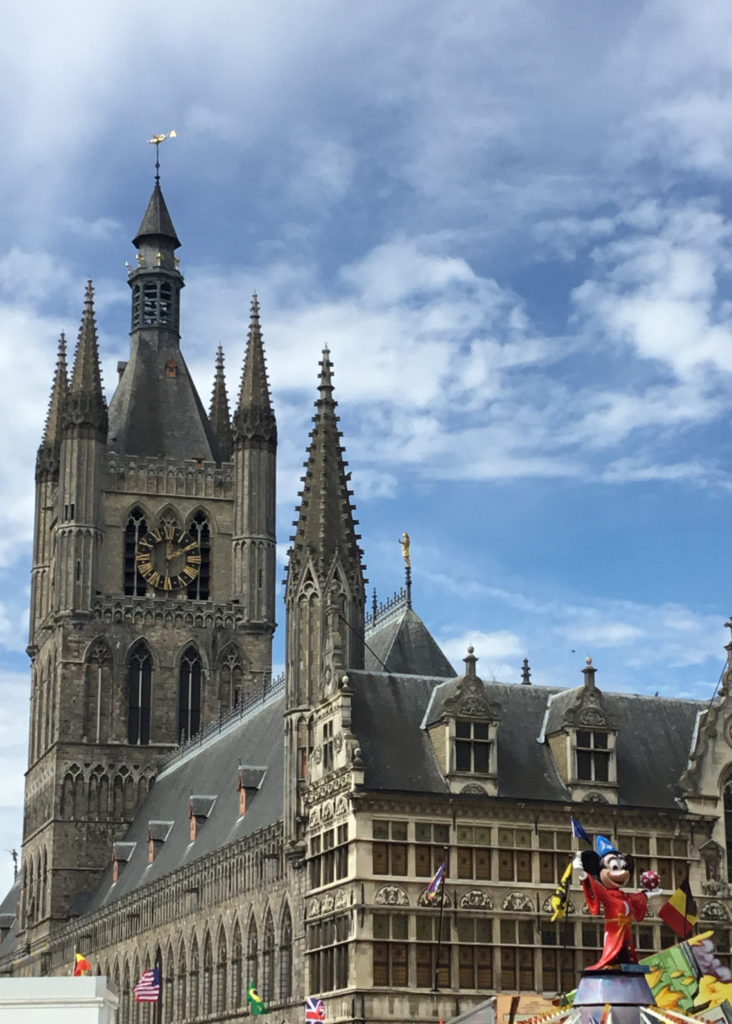
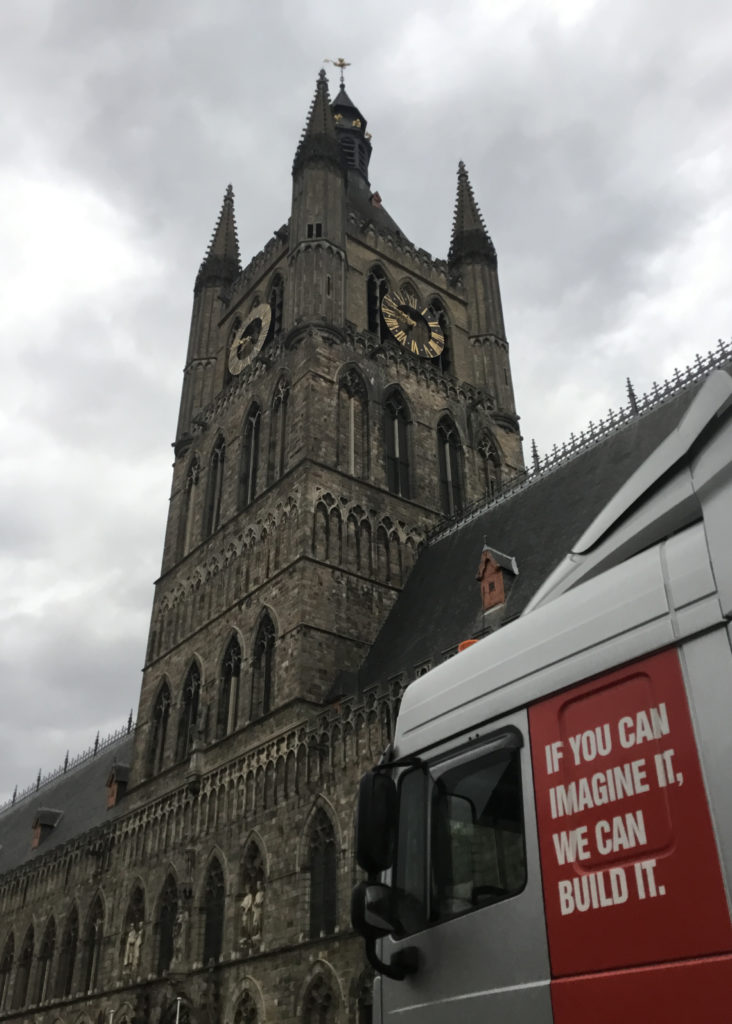
The Sorcerer’s Apprentice, from Fantasia, near to the Cloth Hall, Ypres (Ieper). P. Ferguson image, August 2918.
Thread Eight
Despite those of us who have been drawn to Ypres because of the Great War there are other colours to this town. It is alive and filled with the voices of today and hopes for the future. Ypres – Ieper is filled with community – its own community – its own people. There is colour here – a kaleidoscope of vibrancy with fine shops and dining on the square and the in-between places to discover just around each corner.
Some are surprised to see that the Menin Gate Memorial is within the city, a short walk from the square where traffic is stopped for every evening’s Last Post by the buglers of the Fire Brigade. Since the 2018 Great Pilgrimage has returned home, a fair, midway, carnival has occupied the square offering all the rides and games that children and families enjoy. Guns crack at targets whilst bumper cars bounce into each other as glees of laughter rise up from the occupants. Plush toys are gathered by children as the sounds of music and bistros mix together.
And then there is myself finding joy in the happiness of families. I smile gently with this peace…but as always am on the watch for one more reminder of whence this peace came. It is then that I find myself with the Sorcerer’s Apprentice near to the Cloth Hall…we can only imagine what this town has endured…once the black and white world of conflict…now filled with the colour of peace.
Fantasia (Night on Bald Mountain 2/2)
—–SNIP—–
Previously published Pipes of War website, 12 August 2018
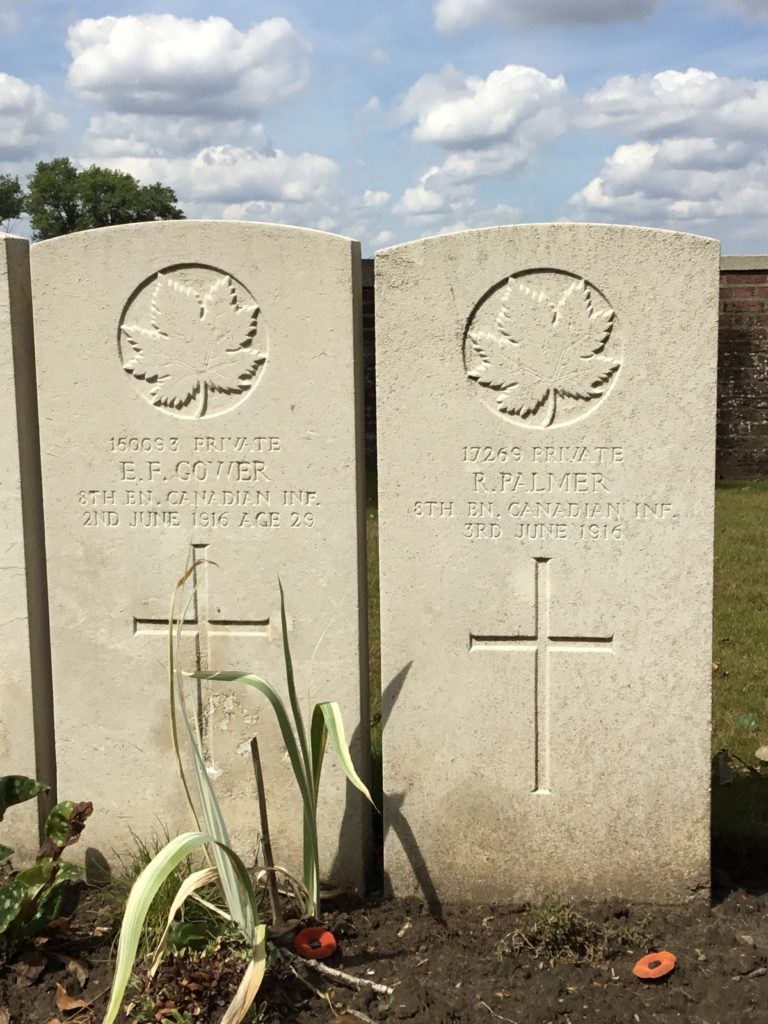
Standing in the footsteps of Kate Palmer. At her son’s grave, Private Roy Palmer,Woods Military Cemetery, Belgium. P. Ferguson image, August 2018.
Thread Seven
1922 – Kate Palmer of Victoria, B.C. journeyed to Belgium to visit her son’s grave at Woods Military Cemetery, south of Ypres.
Today, 11 August 2018, we retrace Mrs. Palmer’s path and decide to walk from Ypres to the grave-site of Roy Palmer, located some five miles south of the city. It is a wooded area and a place I have visited before. Mrs. Palmer’s journey came to me when recently researching through the pages of Victoria’s Daily Colonist newspaper, “widow of Deputy-Chief of Police returns from Ypres, where she visited her son’s grave, which she found well cared for by Belgians…Woods Military Cemetery, Zillebeke, killed in action at Sanctuary Wood Jun 3, 1916.” (Daily Colonist, 1922-09-03, p.5)
As we find our way I re-visit a demarcation stone that I regularly photograph, and also return to both Spoilbank and Chester Farm Cemeteries. Nearby, horses tug at the grass across the road from a farmer’s field where, over the years, the fragments of war routinely appear. They are part of the crimson that lies and grows here – iron and poppies.
As I approach Roy Palmer’s grave I can only wonder of Mrs. Kate Palmer’s footsteps. Could she hear her own heartbeat? Was she alone? How did she get here and from where exactly did she come from? Have I passed by her place of stay in Ypres and, as I stand before the marker, have her tears graced this soil? I am here today standing within her footsteps, the moment is not lost upon me. Across the fields the towers of Ypres rise above the horizon.
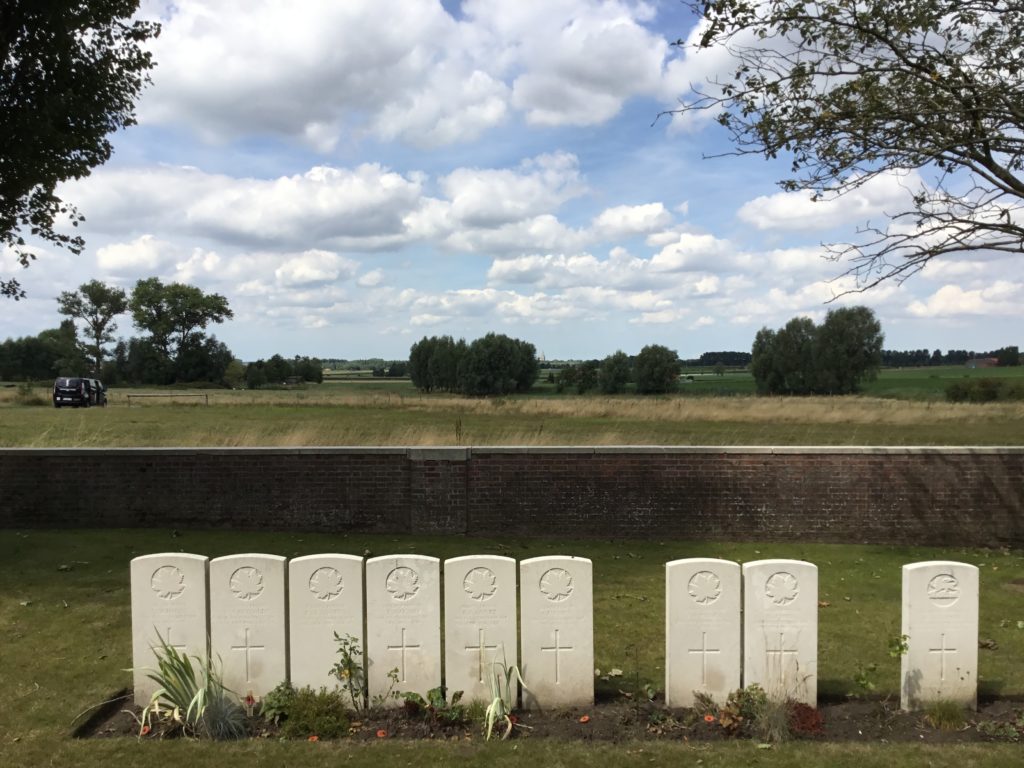
I remain a while, standing alongside the graves of seven other members of the 8th Battalion CEF (Roy’s comrades), knowing too that another message, from Kate, appeared in the Daily Colonist, “In ever loving memory of Roy, eldest and dearly beloved son of Kate and late Thomas Palmer, Deputy Chief of Police, KIA Jun 3, 1916 at Ypres, also all his dear comrades.” (Daily Colonist 1923-06-03)
Side by Side
881 Sgt. J. Nicholas (3 June 1916) 622680 Pte. R.W. Reynolds (2 June 1916) A/22682 Pte. P.M. Stevens (3 June 1916) 150128 Pte. T. Jackson (3 June 1916) 150093 Pte. E.F. Gower (2 June 1916) 17269 Pte. R. Palmer (3 June 1916) A/22772 Pte. F.W. Ridley (4 June 1916) 460813 Lt. A.J. Hill (4 June 1916)
Published on the square, Ieper (Ypres), 11 August 2018
Side by side…comrades of Roy Palmer lie together at Woods Military Cemetery. Together with one other from an English regiment. P. Ferguson image, August 2018.
——-SNIP——-
Previously published Pipes of War website, 11 August 2018
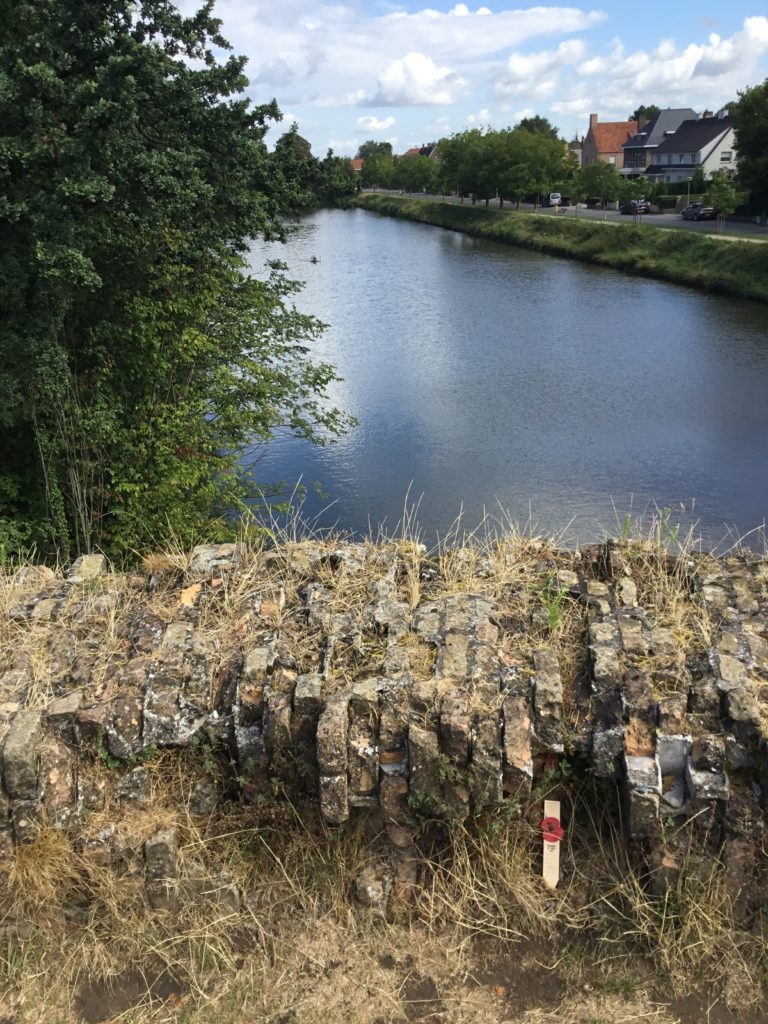
A non-denominational remembrance upon the ramparts near to the Menin Gate Memorial. P. Ferguson image, August 2018.
Thread Six
Each day is a search. Wandering, watching and wondering, with each step, what will appear before us. Some days the image stands out from our first encounter, lingers for the day unless its place is taken by the next special encounter.
Words come occasionally at awkward times necessitating notes in an archaic script to be interpreted later. Some days it is a search amongst the frames to find the day’s visual as words turn to fumbles.
…and there it sat upon the rampart, left by someone who chose this place here by the stone, above the canal, towards the Kiplinglaan. Contrasted against the stone and living world of greens and blues, its plain form with red remembrance. What care someone took to choose this place…meaningful to themselves and for all who pass by…wandering, watching, wondering…searching.
——-SNIP——-
Previously published Pipes of War website, 10 August 2018
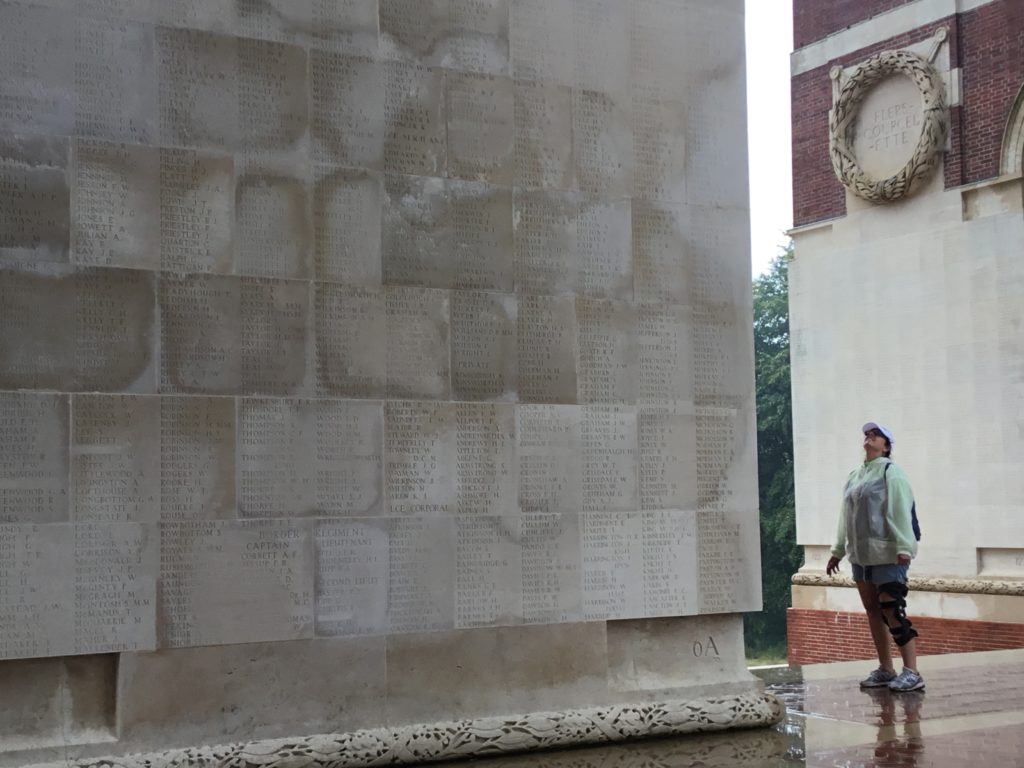
A new visitor to Thiepval reads their names. From floor to skyward and around the next corner, name upon name, life upon life. P. Ferguson image, August 2018.
Thread Five
The steady crunch of loose gravel beneath our feet announces our arrival to the names recorded here. As we move across from stone to grass the silence is heartfelt…it is respect. A mist upon the horizon, silhouettes at the Stone of Remembrance…the shock of looking upon the Thiepval Memorial for the first time. For some this place, recording more than 73,000 lives, is overwhelming. They console each other within each other’s arms…trying to find words…but still it is too much. All the while rain falls within this structure, pooling tears only adds to the hurt.
For one within our group their reaction records a racing mind trying to respond to the enormous presence of this loss, these persons missing on the Somme.
This is unbelievable. This is…it’s just…it’s…um…it’s the only word……….”but to whom the fortune of war denied the known and and honoured burial given to their comrades in death”…so these guys are just lying out there?….unbelievable…..unbelievable…the absolute magnitude of this…I guess it has to symbolize that 73,000 were not laid to rest, not resting…but remembered…[Thiepval] you have to go there and step onto it, to understand it…and why it is there.
As we leave we step again through the silence and across the crunch of gravel. If names might have memory, they understand that we can return home whilst their silent vigil, for all time, continues through the crunch and silence of visitors.
——-SNIP——-
Previously published Pipes of War website, 9 August 2018
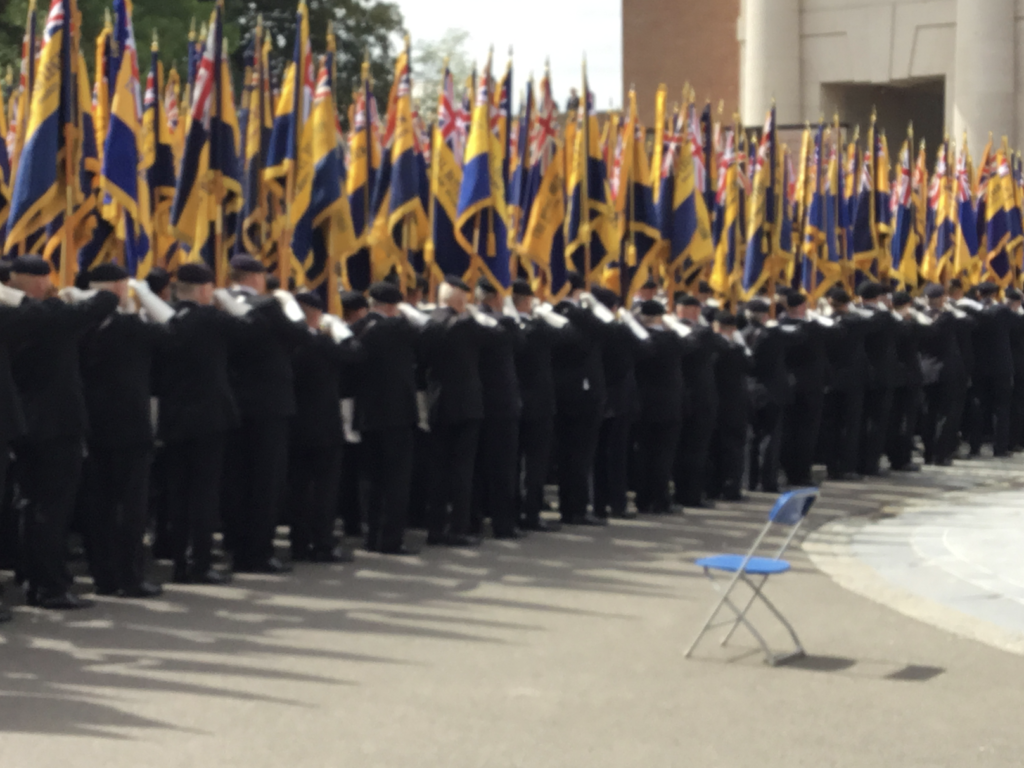
An empty chair at Menin Gate. Have you news of my boy Jack? Not this tide. When d’you think that he’ll come back? Not with this wind blowing, and this tide. P. Ferguson image, August 2018.
Near to the early evening the bells call, an announcement of faith or on this day of the Great Pilgrimage a note for every unit, every battalion. The notes grow faint as if to start speaking the names of all who are recorded here.
Standing near to four Yorkshire men, their banter speaks to their time with the service. As the parade moves by they speak the names and nicknames of regiments, light infantry, cherry pickers and others.
I move on, across the canal to bring myself closer to the British Legion flag bearers who have carried with them their identities from across the United Kingdom. The branch names are many, the people are many, they have come to remember, they have come not to forget. I watch them struggle with spoken words, come to terms with names on the wall…well done boys, well done girls…to absent friends…this day at Ypres (Ieper).
——-SNIP——-
Previously published Pipes of War website, 8 August 2018
As the clouds gather. The present-day Cloth Hall – a reminder to us all, of both war and accomplishment. P. Ferguson image, August 2018.
Thread Three
We awake to the sound of church bells announcing that our day is to begin. Refreshed and reinvented, our breakfast and table furnishings delight the soul as I continue to refine a short piece for the Western Front Association.
Our day takes us to the In Flanders Fields Museum where the current temporary exhibit Traces of War provides an engrossing and not unwieldy examination of First World War archaeology. Taking the bus to Zonnebeke, I at long last remember to photograph a Canadian artillery plaque anchored to an exterior wall of the church. We visit at the Zonnebeke Research Centre and then turn towards the Memorial Museum where, yet again, one always finds something new to focus upon.
Returning to Ieper (Ypres) aboard the number 94 bus, we attend the Last Post ceremony, meeting new friends and where I truly begin to understand the powerful symbolism of the 90th anniversary of the British Legion Great Pilgrimage. This year’s journey, by thousands of pilgrims, in commemoration of the last 100 days of the Great War, is a marvel of logistics and will be rewarding for all who attend here this eighth day of August.
After a day and a half of heat we are caught, at the end of the day, in a storm, the lightning – as if flares – and the roar of thunder – as if artillery. The Cloth Hall lights up time and time again as the sheets of lightning bask the building in a familiar glow of torment. Knowing what this building has endured and how it has risen reborn to Ieper, it is a gift to us all who seek an understanding of peace from conflict.
As we walk the rain-refreshed path back to our Ieper home I remind myself again, it’s better when it rains, these tears of heaven.
——-SNIP——-
Previously published Pipes of War website, 7 August 2018
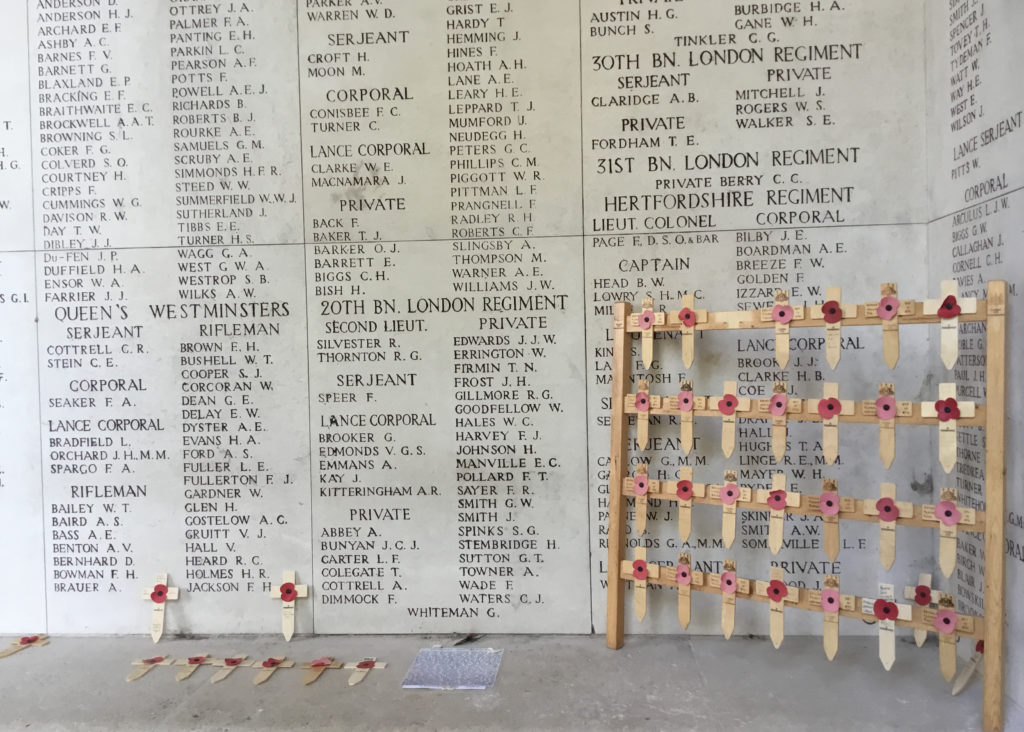
Lady Haig poppy crosses row on row.
Some with simple messages, others acknowledging a life upon the wall.
P. Ferguson image, August 2018.
Thread Two
The moth flies in erratic fashion fleeing the notes of multiple bugles at the Menin Gate Memorial tonight. Many visitors are here this fine and warm evening armed with cameras and children held aloft for better views. What is it that they have come to see?
Following the ceremony, the bugles rest, and the assembly lingers casting their gaze ever upward. Name upon name, elders and youth, some frail – others able to leap the stairs two at a time as regimental names provide the subject lines of the missing.
My observations have witnessed two families this evening. The elder father – a former serviceman with married son, daughter-in-law and grandson. They stand for pictures here amongst the wreaths. And yet there is one other family, with a teenager who stops his motion at the top step – turns his eyes towards the right and in an instant you see the understanding he has found. Something on this wall has mattered to this set of eyes. He lingers…we are still learning from the Great War.
——-SNIP———
Previously published Pipes of War website, 6 August 2018
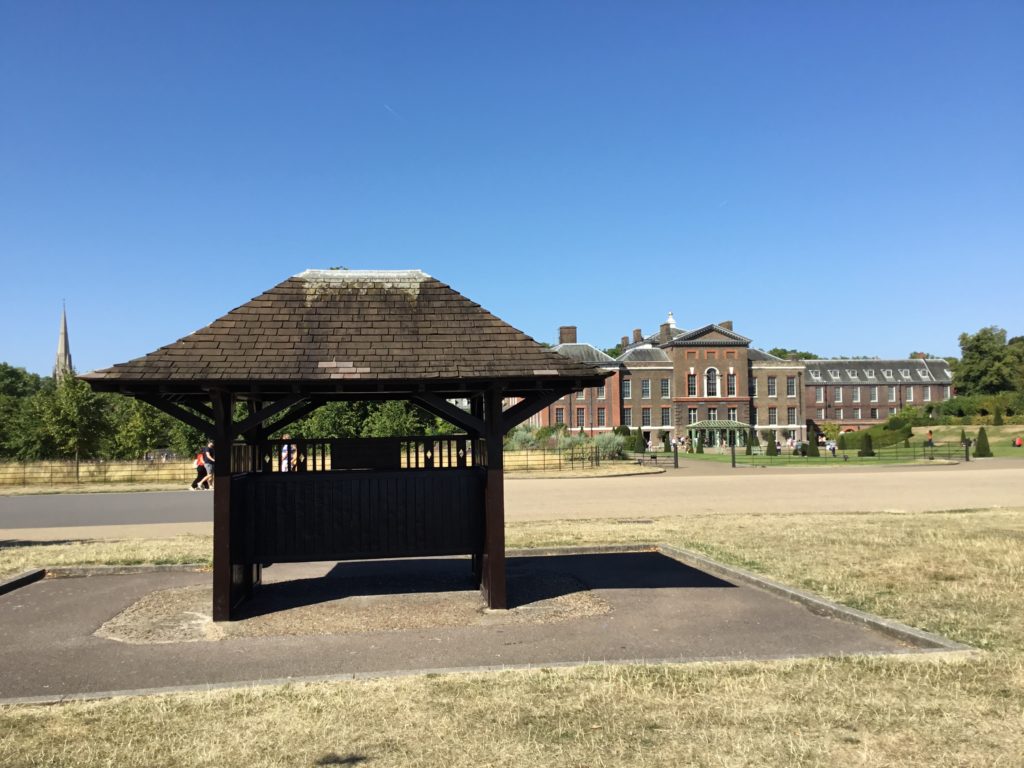
One of two Silver Thimble Fund Great War 1919 Memorial Shelters in Kensington Gardens. P. Ferguson image, August 2018.
Thread One
The heat is upon us as loose threads, from many previous investigations, are brought together in a single expedition across London. Firstly, a walk to Kensington Gardens where we are to encounter two memorial shelters of the Silver Thimble Fund. As we walk toward them, we see them across the pond, with Queen Victoria’s likeness, and her own pond flowers floating atop the circular moat. In the background Kensington Palace.
The Silver Thimble Fund was founded in 1915 by Miss Hope Elizabeth Hope-Clarke. The fund collected damaged thimbles made from precious metals which were then melted down to raise monies for the purchase of medical equipment. As one of the most successful charitable organizations of the Great War it collected, via 30 appeals and 160 collecting centres across the Commonwealth, 60,000 thimbles that were converted towards 15 ambulances, 5 motor hospital launches, 2 dental surgery vehicles, and a disenfector. How does one ever think upon a seemingly simple tool, the thimble, the same way again?
Two signs, in each of the shelters, record: Erected by The Silver Thimble Fund 1919 and In Memory of Our Soldiers Who Fought in the Great War 1914 – 1918.
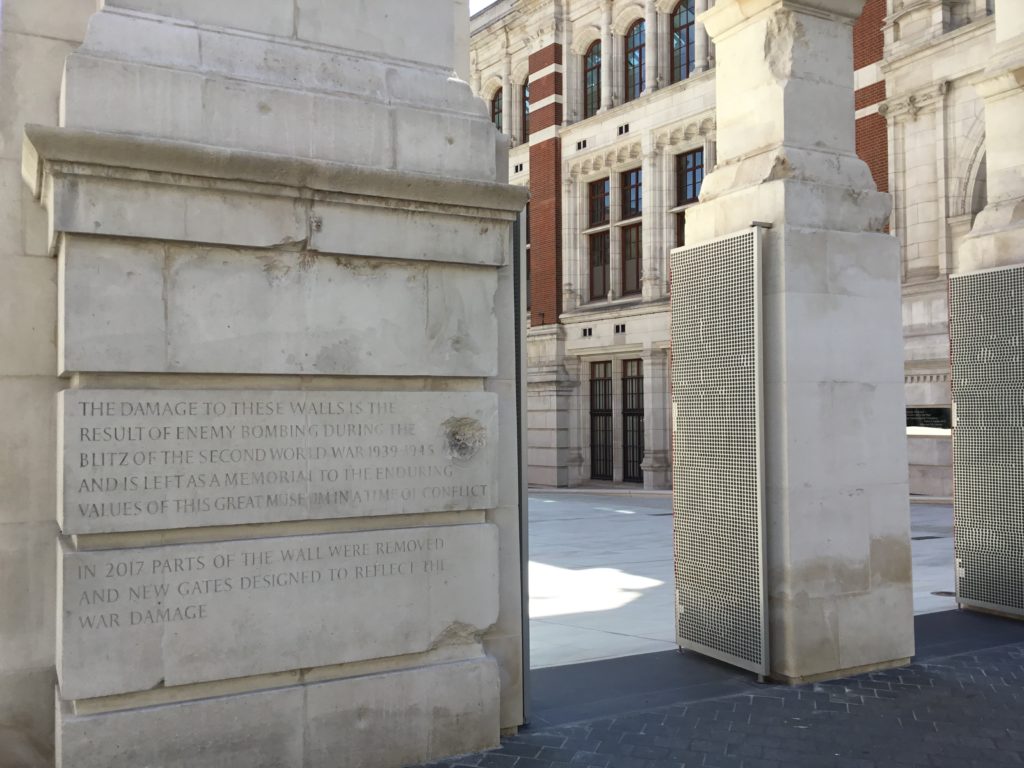
Blitz bomb damage and contest at the Victoria & Albert Museum. P. Ferguson image, August 2018.
From Kensington Gardens we head towards the Victoria and Albert Museum not so much to see inside but to view the damage to the structure during the Second World War. Walking down Exhibition Road we come across our goal, finding the pockmarks left behind by accelerated debris. The building is scarred but the V&A has accepted its look. This is not a facade to be fully repaired but to set within the context of the events.
The damage to these walls is a result of enemy bombing during the Blitz of the Second World War 1939 – 1945 and is left as a memorial to the enduring values of this great museum in a time of conflict.
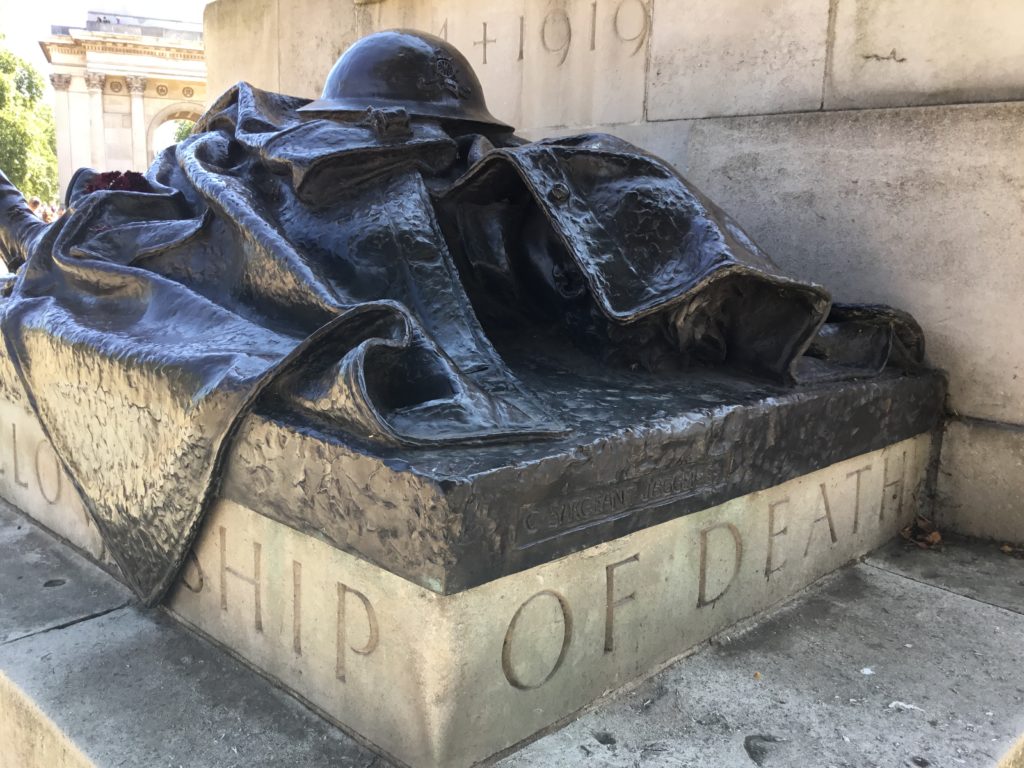
Fallen artillery soldier statue. Royal Artillery Memorial. P. Ferguson image, August 2018.
We return to an old friend as we head towards the Royal Artillery [RA] Memorial featuring its 9.2” gun and bronze soldier statues at Hyde Park corner. Before we turn towards the gunners a stop to the nearby statue of David of the Machine Gun Corps Memorial reminds us, Saul has Slain His Thousands but David His Tens of Thousands. In contrast to one of the several inscriptions on the RA Memorial, designed by Charles Sargeant Jagger MC, Here Was a Royal Fellowship of Death.
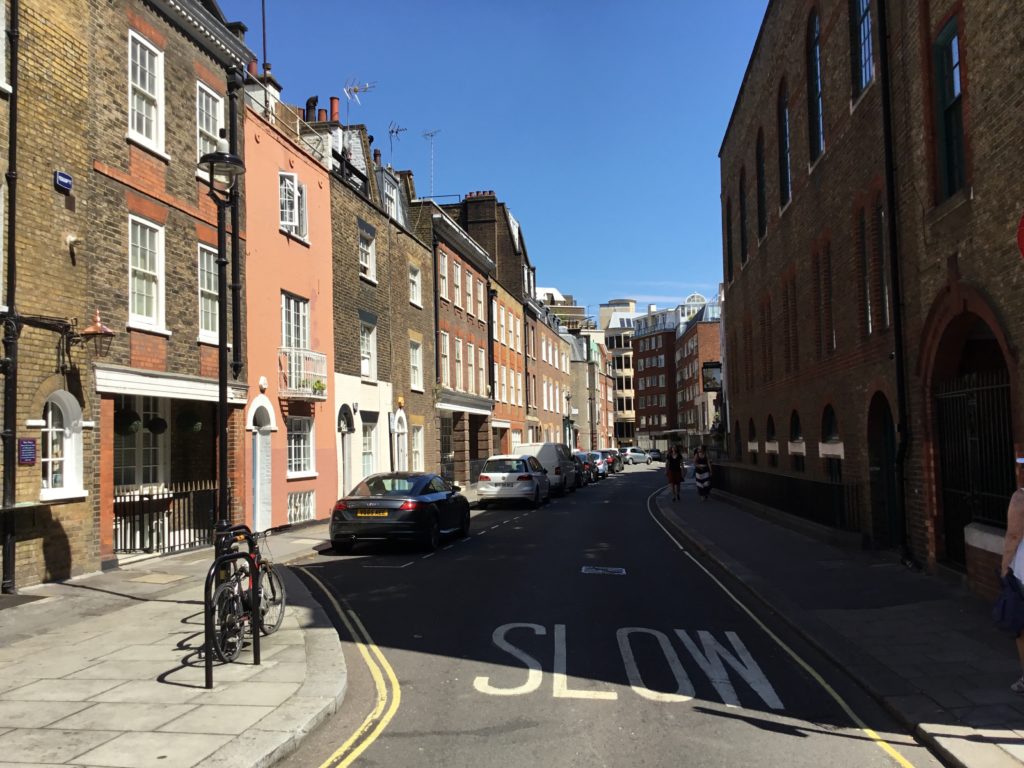
South of Buckingham Palace we arrive on another landscape of loss of the Second World War. Somewhere along Wilfred Street two Canadians, Cicely Matson, age 43, and her daughter Mary Jane Theresa Matson, age 18, were killed Friday June 23, 1944 in a V-1 incident. Cicely’s eldest brother, Guy Simond’s, was one of Canada’s finest Second World War generals. The women’s story is little known.
Wilfred Street , London, along its length a V-1 flying bomb exploded 23 June 1944. Canadian mother and daughter Cicely (age 43) and Mary Jane Theresa Matson (age 18) were killed. P. Ferguson image, August 2018.
We journey on toward Parliament Square having photographed, along the way, a suffragette memorial. As we arrive upon the square we encounter countless visitors jockeying for position in the tourist-scape. Immediately I choose not to find Churchill and Gandhi within a single frame. Its on to Whitehall stopping by the Cabinet War Rooms to reacquaint myself with Churchill’s work ethic.
As we make our way along the walkways towards Admiralty Arch we encounter the encumbered. Tired visitors from across the globe, overheated and exhausted, they unknowingly block the thoroughfares, wondering where they are and have become site blinded having seen so much. We are among them.
Refreshed after snacks and tea (even in the heat) we attempt to make our way to Rectory Road, but like a bridge too far it becomes a logistical impossibility due to rail issues and forces beyond our control.
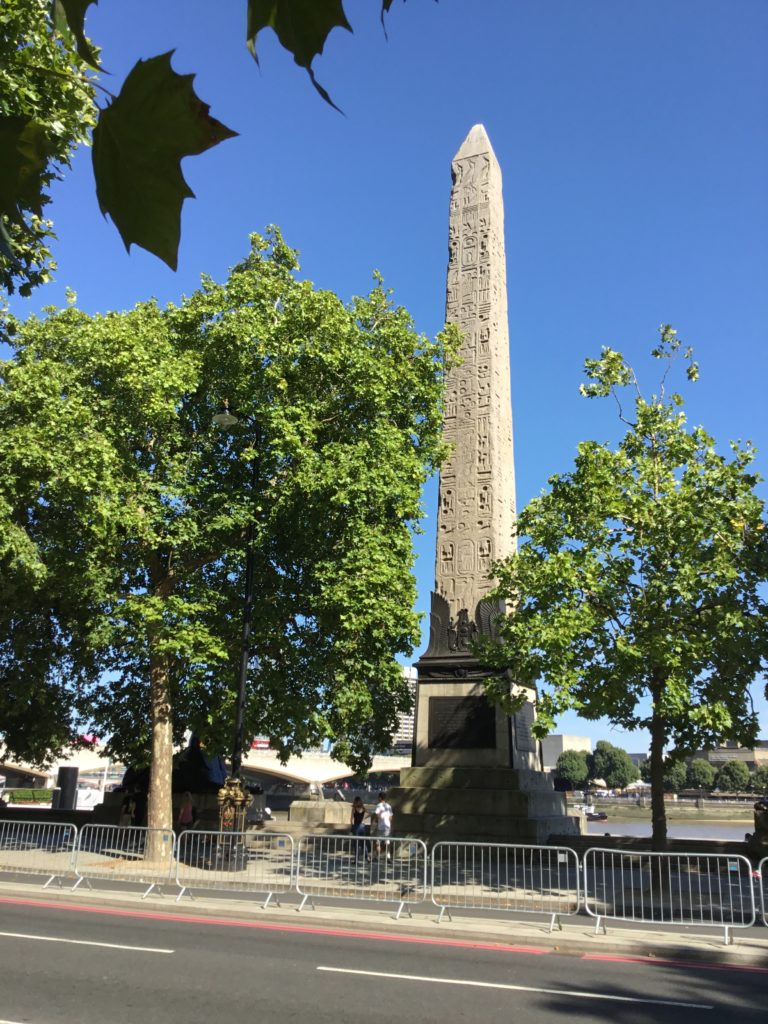
Cleopatra’s Needle along Victoria Embankment. P. Ferguson image, August 2018.
We end our day at an obelisk, well outside our usual scape. Located along Victoria Embankment we stop to photograph Cleopatra’s “needle” a gift from the ruler of Egypt and Sudan in 1819. The red granite obelisk stands alongside the Thames calling out to tourists for images amongst its guardian Sphinxes. Nearby a Great War memorial, from the thankful people of Belgium to Britain, receives scant attention and recognition from visitors to the area. Like a single grain of sand, the Belgian Memorial is lost amongst the dunes of memory in London. Another thread to follow for another day.
With Cleopatra’s Needle rising above these dunes it has become a fitting way to call an end to our day that started with thimbles. Stone and silver, large and small…both ambitious…both equally precious…this day together.
—–SNIP—–
Previously published Pipes of War website, 5 August 2018
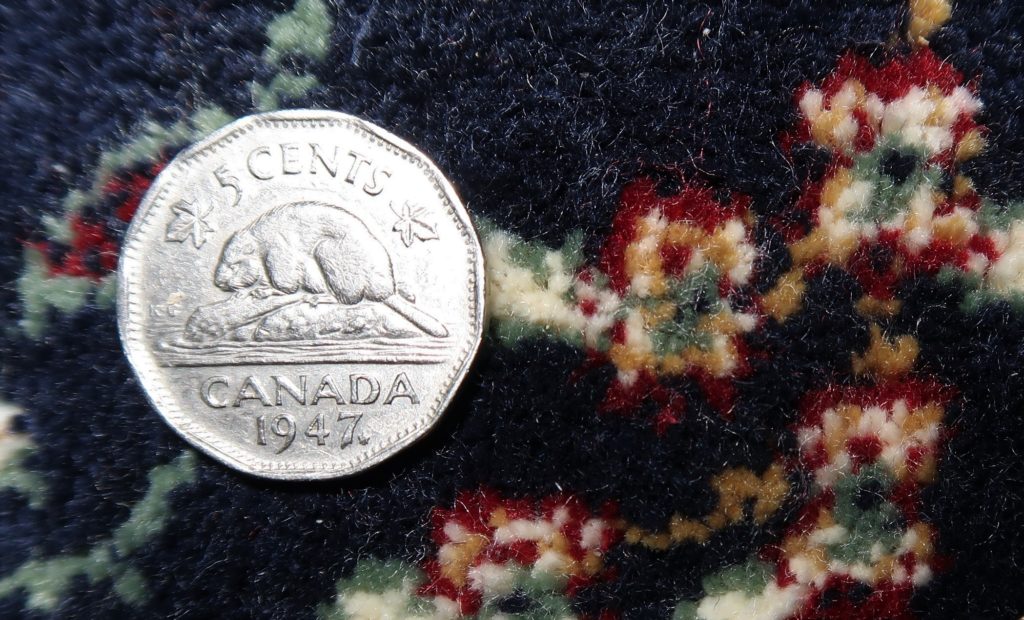
From today’s change…a 1947 Canadian nickel. Seldom seen now…but the memories it can provide. P. Ferguson image, August 2018.
A Little Bit of Change
It’s not every day that one receives a King George VI Canadian nickel in pocket change, but there it was. Perhaps not unusual, and some would allow it to slip by towards the next cup of coffee, the next biscuit, the next something. But there it sat, with me, so I pondered its age commencing with its emergence on the Canadian scene in 1947.
I suspect it has not always been in circulation, perhaps its been resting in a jar found in a desk, rediscovered but then let go. Perhaps its been lost? Discovered with the trowel that digs at dandelions on our manicured lawns. We can never know, but in my hands, it is a reminder…of the magic of storytelling and how there can always be more.
In 1947 veterans of the Second World War may have been home for two years, maybe more, maybe less. They may of, had a child born in 1939 that they hardly knew after years away or perhaps that child was of younger years, but how many of us recall our fathers, our mothers taking us for ice cream? Its cost in 1947 was five cents…ice cream…a memory perhaps we all have.
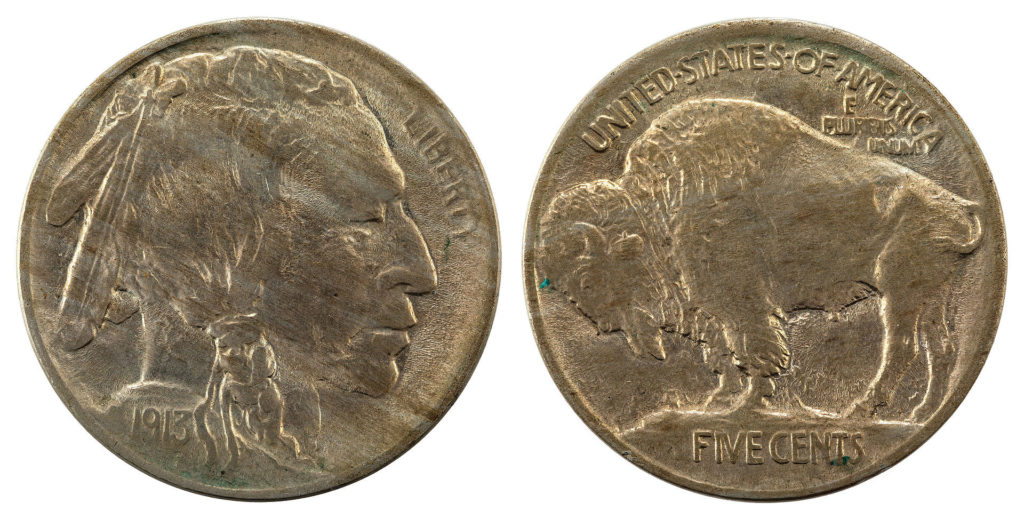
American Buffalo nickel produced between 1913 and 1938. My mother, when a girl, used to find these amongst her Canadian change. (Wiki Image)
Still today’s found coin takes me to another nickel vintage from outside Canada, the Buffalo nickel, that includes a portrait of one of the United States’ first peoples. My mother gathered the few that she found, amongst her Canadian change, when she was a girl. She liked them. There is a small handful of them lurking about, probably in a jar, in a desk, in some drawer.
Maybe one day this, my rediscovered nickel, will find its way into one of those date oriented coin collector books…but then I remember there is also a film…a scene….a reminder to us all of memories, not based on value but based on love.
[Throw Momma from the Train – Owen’s Coin Collection]
Special thanks to Danny DeVito and Billy Crystal.
Previously published Pipes of War website, 2 August 2018
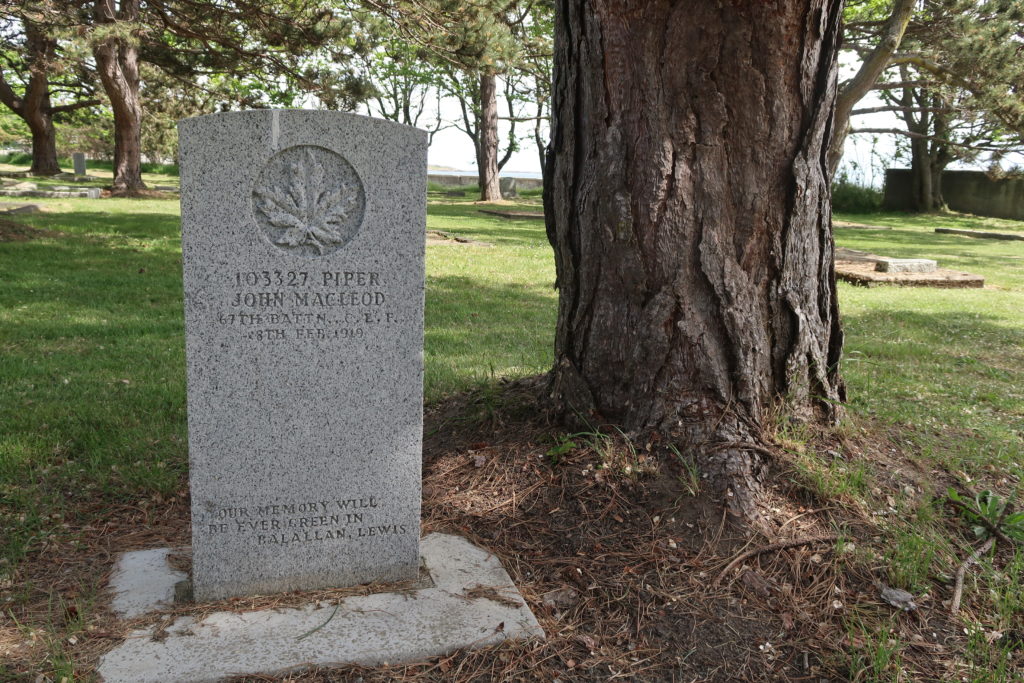
Pipe Major John MacLeod. Great War veteran with the 67th Battalion (Western Scots) and 102nd (North British Columbians) P. Ferguson image, May 2018.
…a while ago
I have stood here many times, brought others to you and wondered who you are…and yet for all the time that has passed – today you have spoken. Who are you Piper John MacLeod?
…this day
I have walked this place of memory since the late 1970s, read and re-read markers, family messages lettered upon the stones that rise here or lay upon the surface. I have watched the deer, squirrels, families and passers-by visit Ross Bay where the friends and family of old Victoria and not so old Victoria rest. Some names are better known while others wait for some wanderer to find interest. Amongst the war graves 103327 Piper John MacLeod – your memory will be ever green in Ballalan, Lewis.
Allan’s village – Ballalan is to be found on the east coast of the Outer Hebrides, Isle of Lewis, Scotland situated at the head of Loch Erisort. A near famous neighbour and near to the opposite coast, Camas Uig is about 49 minutes away – a distance of 34 miles. It is here, in the Bay, that the 12th-Century Lewis chess pieces were found in 1821.
e4
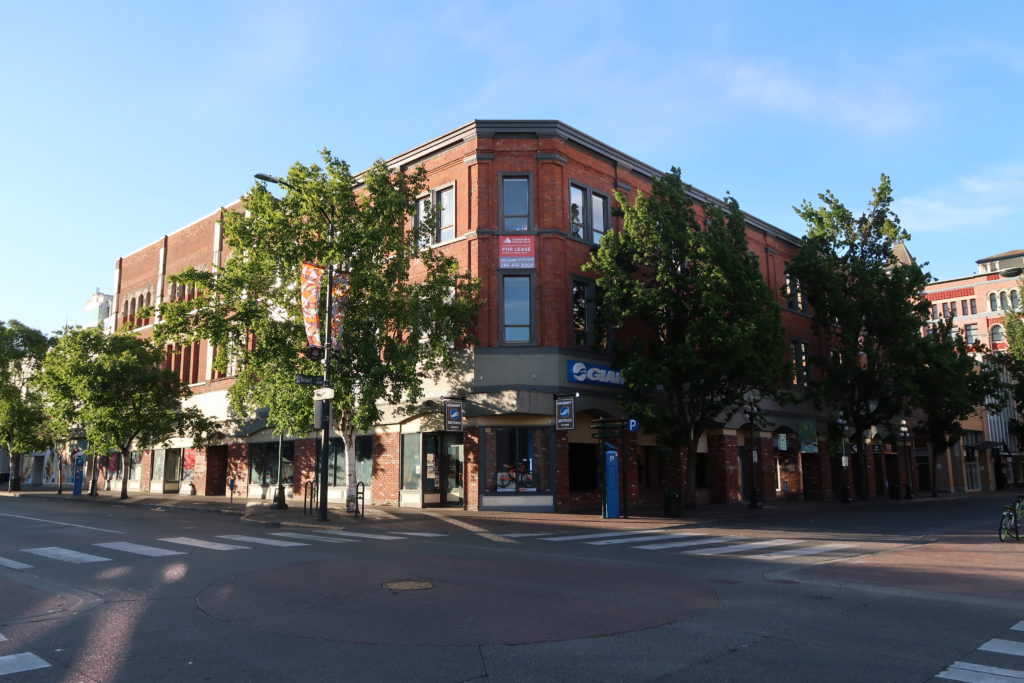
The King Edward Hotel in Victoria, British Columbia was established in 1901 on Yates Street. At that time Victoria was becoming a popular tourist destination and the 98-room hotel, 48 with attached baths, was frequented by travelling businessmen. Of special note was a 78-seat dining room where John MacLeod worked as a cook, waiter and steward. Other King Edward Hotel staff who served in the Great War were Second Boer War veteran Sergeant Harry Hardy (16th Battalion CEF), door-keeper and commemorated on the Menin Gate Memorial, (Ypres), Belgium and night clerk James C. Hanna (7th Battalion CEF).
The former King Edward Hotel where John MacLeod worked. Yates Street, Victoria, B.C. P. Ferguson image, June 2018
c5
Prior to the Great War John MacLeod served with the 7th Scottish and with the 50th Regiment (Gordon Highlanders). Joining the 67th Battalion John served with the unit in France and Flanders, organized as a pioneer battalion trained in infantry tactics, engineering and construction as part of the Fourth Canadian Infantry Division. John’s 67th service, on the Western Front, commenced 13 August 1916 but in May 1917, his unit was absorbed by other units in the Canadian Corps and John became one of 260 other ranks from the 67th drafted to the 102nd Battalion CEF (North British Columbians). The 102nd’s commanding officer, John Weightman Warden DSO, was especially keen to have a regimental pipe band and led by Pipe Major “Billy” Wishart, the 67th Pipe Band, albeit for a short while, became the pipe band of Warden’s 102nd.
d3
In late December at Lens, France, John MacLeod became ill with Albuminuria, first diagnosed at #42 Casualty Clearing Station and he was subsequently sent to Etaples, France, and the King’s Canadian Red Cross Hospital at Bushey Park, Hampton Hill, Middlesex, England. At Bushey Park John was further diagnosed with acute Nephritis and he subsequently returned to British Columbia where he was cared for at the Victoria Military Hospital, Esquimalt and probably at the Resthaven Hospital, Sidney. On 28 August 1918 John MacLeod was discharged from the Canadian Expeditionary Force as medically unfit for further service. Though mentioned in some early wartime medical reports, John MacLeod also suffered from arteriosclerosis reported as having originated prior to enlistment in a 20 April 1918 medical report.
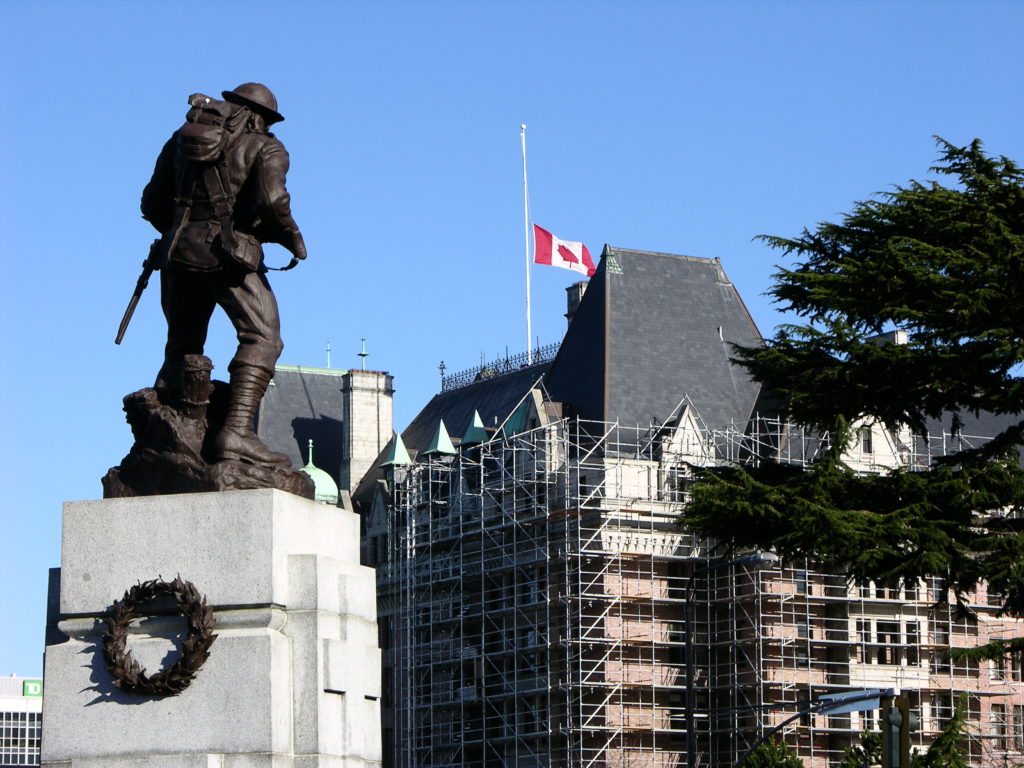
Victoria’s War Memorial and the Empress Hotel with its Canadian flat at half-mast. P. Ferguson image, November 11, 2015.
N.18E T.
On 8 February 1919 John MacLeod, aged 40 years, left us.
John had previously returned to work at the Empress Hotel located on the inner harbour, Victoria, where each 11 November morning the hotel’s Canadian flag, one of several in the city, flies at half-mast. After John’s prolonged illness, due to exposure and hardship attributed to the fighting at Passchendaele, John MacLeod was laid to rest at the Ross Bay Cemetery, Victoria, British Columbia. John’s draped casket was carried to the cemetery upon a gun carriage with Privates Stead Trickett (67th Battalion), C. Haggerty, Hugh McColl Henderson (67th Battalion), J. Robinson, J. Grant, Henry Clear (29th Battalion) as pallbearers. Pipe Major Billy Wishart, of the 67th (Western Scots) and the 102nd (North British Columbians) formed a pipe band to play at John MacLeod’s service. At the graveside three volleys were fired and a bugler played the last post…someday we will meet again, I’ll return to leave you never, Be a piper to the end.
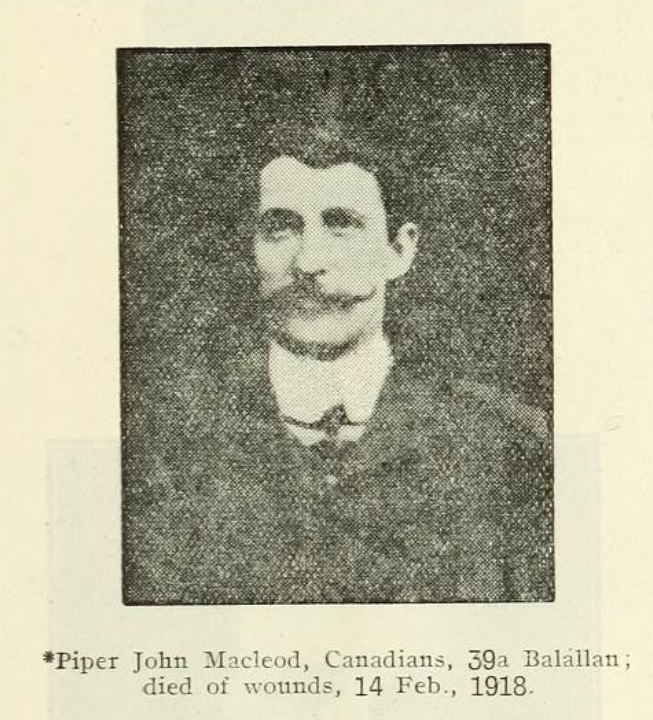
Piper John MacLeod. From Royal Lewis Roll of Honour (1914 and after). Stornoway, 1920. The publication has included an incorrect date of death. Available from archive.org
Previously published Pipes of War website, 10 June 2018