And the leaves of the tree…

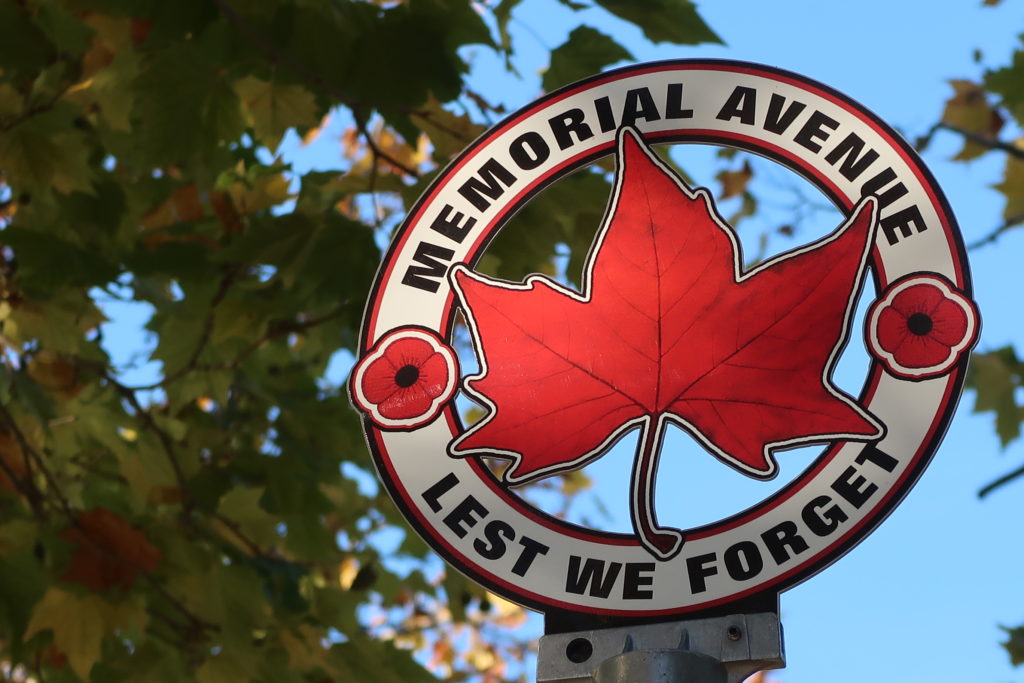
A circular sign atop a street sign-post. The colourful red, white and black sign features a red maple leaf and two red poppies. The sign reads "Memorial Avenue Lest We Forget".
Memorial Avenue sign topper, Shelbourme Street, Victoria, B.C. Placed in commemoration of Great War Memorial tress rededicated 2018.
P. Ferguson image, October 2018.

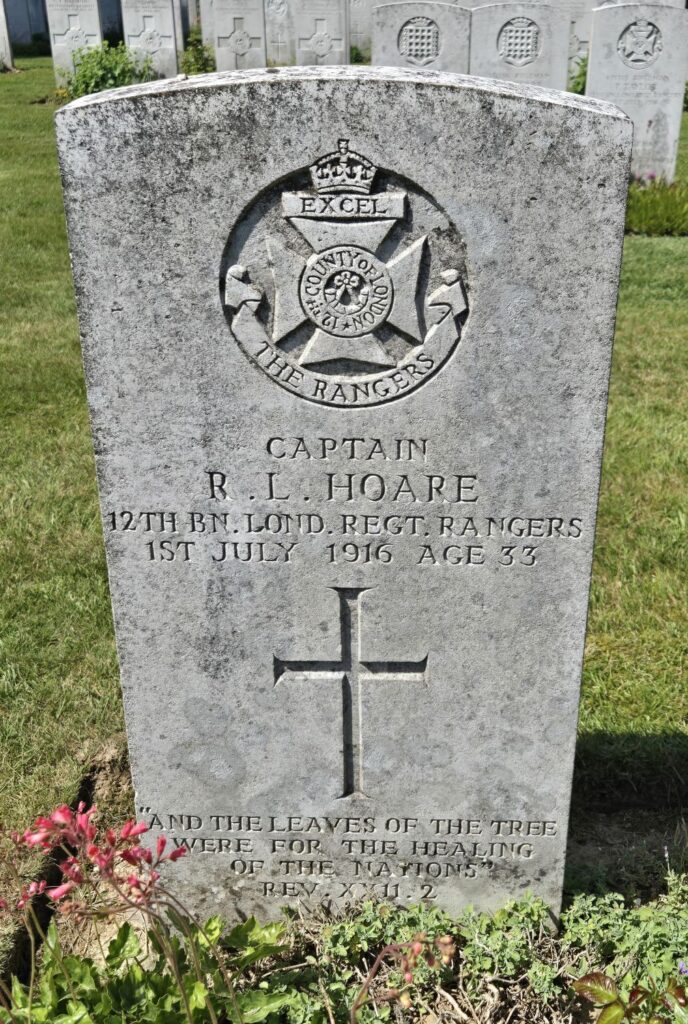
…were for the healing of the nations
Revelations XXII.2

Today we gather our thoughts before the day ahead. Tomorrow…what will we feel…what is to be…?

Still – this day, is a chance for gathering our thoughts before the morrow…it is a chance to pause previous to the emotions of the current ending. I often speak of regeneration in these places of conflict…finding peace in this former chaos, finding ourselves amongst those who have been…and remain. Knowing too that a bit more than twenty years after this peace, the chaos returns…Lucifer again amongst the tumult of all survivor’s memories and their children’s new war…a second world war, does not pass this day unrecognized.

In search of the Great War’s peace I have wondered what might be found to add to these clatterings of mine? Today the words were found…thanks to another….one soldier, one mother who chose her son’s inscription in search of peace from this chaos. Today one image was found…lest we forget…here at home.

Laura Hoare chose the biblical inscription that leads our day. It is the focus for our interests after the Great War…healing…rebuilding…memorialization…hope…closure. Laura’s son, Captain Richard Lennard Hoare (12th London Regiment “The Rangers”) died  on the first day of the Somme 1 July 1916 and is buried at Gommecourt British Cemetery No. 2, Hebuterne, France…and though I have not been…I will go…one day…not this day…soon…its about healing.

Previously published Pipes of War website, 10 November 2018

Kin and Kindling

A wooden poppy cross sits in front of a stain glass window. Partial lettering can be read on the window "And Men of the...the Western Front". A portion of a blue wreath sits beside the cross.
Poppy cross at St. George’s Memorial Church, Ieper (Ypres), Belgium.
P. Ferguson image, August 2018.

…each day

It’s about loss…a familiar theme to the tracks of war…along the fields, the woods, the towns. Too many memorials…nearly one per town…too many headstones…row on row… too many lives…so many /so few memories. Rust, blood and petals.

Repeatedly I remind myself that my visits to this peace were once the chaos of another’s every day. I walk alongside the landscapes once familiar to ancestors. They are gone now…the soldiers – their mothers, their fathers, from either side of many languages.

And though I will remember each day these paths of kin and kindling I understand that this generation, I speak, has provided notes to my letters to my words. I can never repay them other than to continue walking this crimson ground to find their souls, their place, their peace.

Rest now dear brother, dear sister…each day.

—————0—————

…and because loss means something different to each of us…

[Chris Cornell – Nothing Compares to You]

Previously published Pipes of War website, 23 September 2018

…and now we have been

A knitted woollen poppy flower with stem and message rests again a metal railing at the Menin Gate Memorial, Ypres. Names appear on panels in the background.
Woollen poppy upon the Menin Gate Memorial.
British Legion Great Pilgrimage 1928 – 2018.
P. Ferguson image, 8 August 2018.

Thread Fourteen

…and now we have been…and we have returned.

The landscapes of France and Flanders…London…have offered of themselves…their connections to us. We have rediscovered, found, observed and, above all, we have become connected. In finding the threads between the thimbles and needles we have bore witness the fabric of history…perhaps patchwork…but ours for all time.

There will be more visits, more patches to find. Some pieces will be easy paths of discovery – the information presented to us, others will only be revealed through our searching. In assembling these pieces each stitch becomes our own. The global quilt of history is there for all to see, but it is for you to discover how it is made.

…and now we have been… Words not lost upon us. We are well, we are safe, we are not hurt. Unlike so much of what we study…we have returned.

—–END OF SPOOL—–

Previously published Pipes of War website, 19 August 2018

Sound, light, colour…history

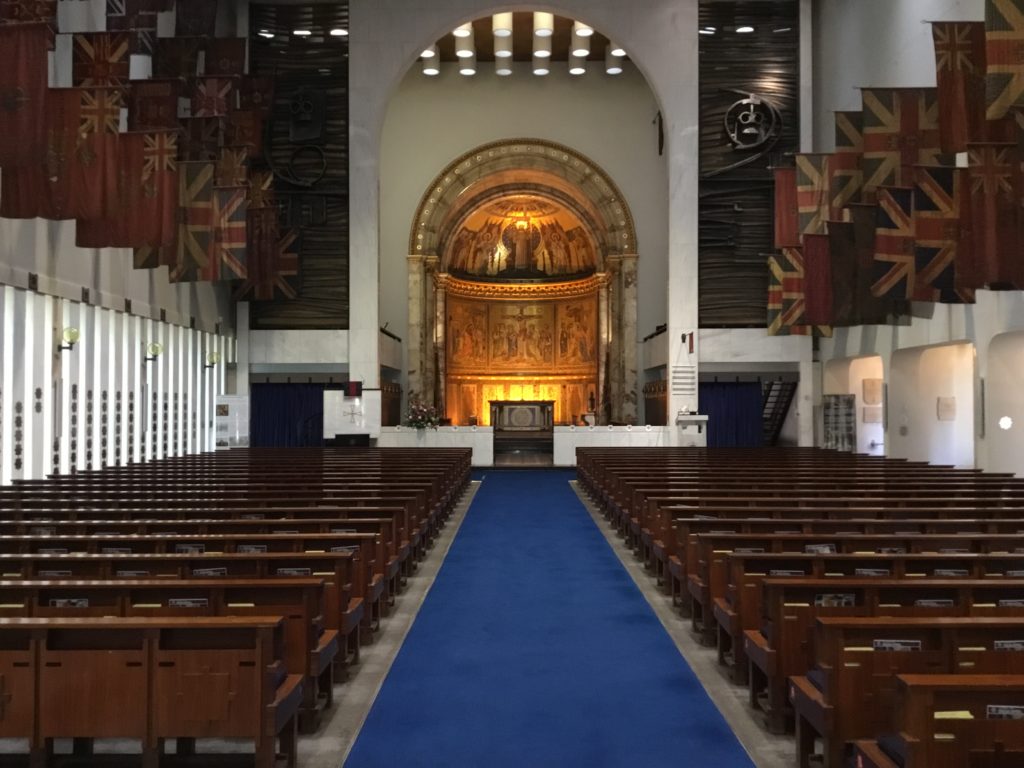
The Guards Chapel, London, England. Looking down the central aisle fitted with a deep blue carpet. Horizontal pews to wither side. Above the pews to the left and right, the Guard's colours hag from the wall. In the background the golden area of the chapel with altar.
The Guards Chapel, London was hit by a V-1 flying bomb in 1944.
P. Ferguson image, August 2018.

Thread Thirteen

From Buckingham Palace Road we turn onto Birdcage Walk, bypassing the tourists who have lined up along the gates to view the Guards. Instead of joining the onlookers we choose instead to visit the Guards Chapel, badly damaged by a V-1 flying bomb attack in 1944.

A cobalt blue, lit vase sits on a stone base.
Candlelight within a blue vase at the Guards Chapel, London.
P. Ferguson image, August 2018.

Smaller Chapels to the Guards Regiments line the one wall and two candlelights glow within blue vases informing us that a particular Guards Regiment is on active duty…a reminder that there is conflict somewhere in this world  that has taken these lads from home.

Along a brick wall a Victorian/Edwardian fountain near to a stone marker blocked by a black and red plastic recycle bin.
A black recycling bin blocks the view of a historical marker.
P. Ferguson image, August 2018.

A brisk walk across St. James’s Park follows and we then change course and head towards Piccadilly. All the while I search for a chance to find something new. This day is unusual, as we find the end words of a message on a wall about a garden commemorating a site hit by the destruction of an attack during the Blitz. I stand looking upon this part message and choose to move the large black plastic recycle bin blocking the view out of the way. In an instant all is revealed…we have discovered something new at a site I have walked by so many times.

The bin removed reveals a white tablet inscribed with details of a World War Two attack.
The bin set aside reveals the marker’s lettering informing those who pass by what this site has endured.
The bin was returned to its position.
P. Ferguson image, August 2018.

A few short steps later we walk amongst the vendors at Piccadilly Market. From leather belts, vinyl recordings, souvenirs to origami (one will feel there should be peace cranes here), and then open our eyes to Christopher Wren’s church, St. James’s Church, Piccadilly.

St. James's Church its steeple reaching skywards. Below and barely visible the tent covers of the market.
St. James’s Church, Piccadilly, London.
P. Ferguson image, August 2018.

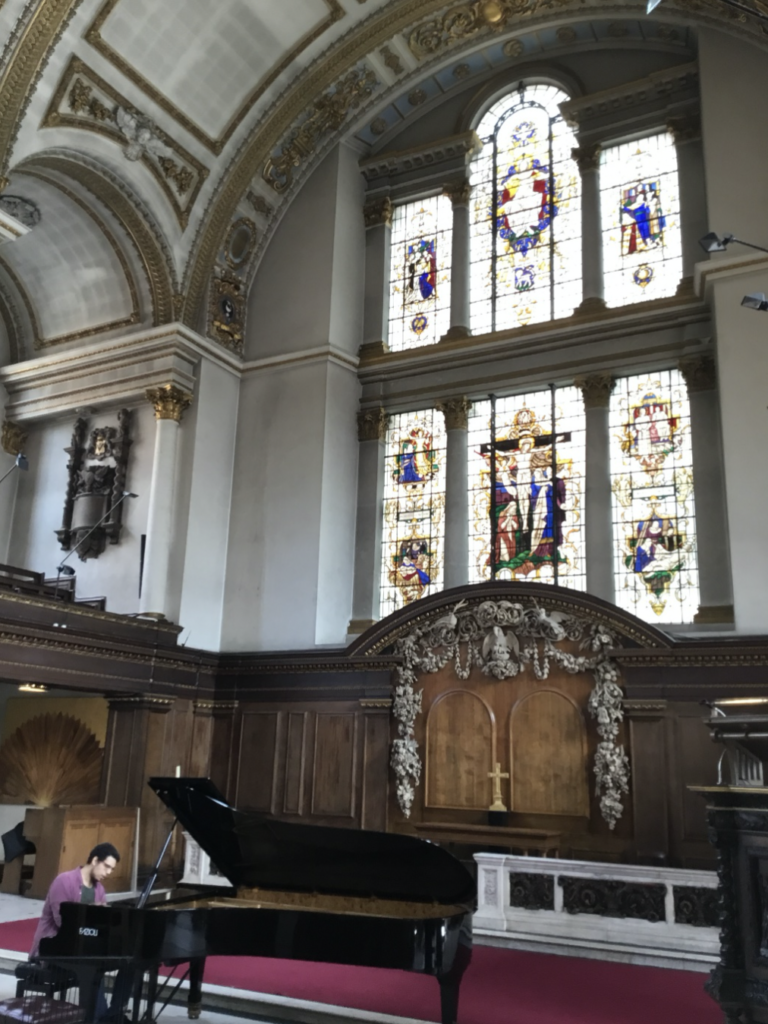
A sign tells us that this site was also hit in the Blitz and badly damaged. Within the church we find three Great War Memorials, as the notes from a fine piano sail through the building. The pianist keeps this journey’s soundtrack in motion. The dance across the keyboard, is thoughtful – classical – perfect…as movement after movement…leads us on our live documentary.

Inside St. James's Church a pianist plays at a Grand piano as light streams through the stained glass. The pianist plays in the altar area. It is a large area and one hopes that you can imagine the notes rising and falling within this space.
Light, colour and sound at St. James’s Church, London.
P. Ferguson image, August 2018.

All here today listen, the tourist, the resident, the unfortunate as the light passing through the coloured glass adds accent to the notes that rise and fall. We stand within the church’s history…a people’s history…as the palette changes with the sun’s movement and notes fade away to sleep…

——-SNIP——-

Previously published Pipes of War website, 17 August 2018

The Dust of Each Conflict

White roses in bloom at the tall pillared entrance to the Imperial War Museum, London.
The Imperial War Museum, Lambeth North, London.
The repository of collections that were first gathered during the Great War.
P. Ferguson image, August 2018.

Thread Twelve

The heat wave has relented and for much of the day we venture forward in the downpour. Rain-water bounces off the taut umbrella towards me managing to find those points at the neckline where it can scurry its chill down one’s back. Meanwhile, I attempt to skirt the roaring streams that run along the curbs in search of drains that attempt to gulp the waves as they come towards them. The drains and my improvised two-step are not successful.

Still one ought not to complain, soldiers and civilians endured much worse on active service and on the home front. Finding an overhang, I stand beneath hoping there may be an ebb to this tide, but not this tide. I carry on.

A shriveled leather glove affected by poison gas lies within a dome glass display case isolated from all other things.
Evidence of chemical warfare are illustrated at the Imperial War Museum with this shriveled glove having gone through such an attack. Damage to lung, eyes and skin was horrific.
P. Ferguson image, August 2018.

Arriving at the Imperial War Museum I seek out a few specific exhibits to snap, and then conduct a reconnaissance of the gift shops anticipating a volume or two to rest amongst others in a tall stack of reading to do. Though centenary titles continue to abound, we are starting to see interest in the immediate aftermath of this conflict that gave birth to the world as we know it today.

A sign from the Western Front. Brown with white letters it has much evidence of having been targeted hit with the aimed and hurtling debris of war.
A well fired upon Great War sign “Do Not Stand About Here”.
Imperial War Museum Collection.
P. Ferguson image, August 2018

Treaties, nations, political parties, demobilization, employment, veterans’ welfare, rehabilitation, prostheses, mental health, families, widows, memorialization and more. The Great War may have an end date with the armistice, 11 November 1918, but its after affects will continue…and then there will be another conflict…a Second World War with its own ramifications, its own openings and conclusions, but the dust of each conflict will never truly settle for years to come.

A soldier straddles the wall of the muddy tench. His boots within the mud he looks downward...we do not see his face but the top and rim of his helmet. He is wearing a trenchcoat.
A Great War soldier making his way through the wet and person clinging mud of the trenches.
P. Ferguson image, August 2018.

——-SNIP——-

Previously published Pipes of War website, 16 August 2018

When the World Stands Before Us

Exterior view of the Victoria and Albert Museum, London. Numerous visitors await entry as the familiar London taxis line-up to take visitors to other sites.
The Victoria and Albert Museum, Kensington, London.
P. Ferguson image, August 2018.

Thread Eleven

The entrance way of the Victoria and Albert Museum is crowded with visitors this August day, anxious to make their way towards their interests and expectations. Throughout the structure countless, precious items are exhibited. Cameras focus and snap on specific items, some objects hold visitors for lengthy terms while others are passed by in favour of something else.

The stunning stained glass windows of the Refreshments Rooms . The room is lavishly decorated with wonderful lights and ornamentation on the walls.
Detail of the Refreshment Rooms, Victoria and Albert Museum.
P. Ferguson image, August 2018.

We have returned here this day to enjoy tea and cakes in the Refreshments Rooms, part of the elder museum that I enjoy. It is here I can sit and imagine the visitors and staff, of former times, who have sat here to become refreshed. A chance to pause within the history. This day I have come here especially for the building’s ornamentations in situ, not within exhibition cases but part of the built structure itself.

A stairway at the Victoria and Albert lavishly decorated with bas-relief. The museum provides much for the eyes apart from the exhibitions.
The details we have come to see. The Victoria and Albert Museum.
P. Ferguson image, August 2018

We have returned to this entry way of world culture to a record of local names passed by in favour of the world alluring. Here amongst the seekers is the Great War Memorial to the staff of the Victoria and Albert Museum who did not return from that conflict. Set up by subscription of the whole staff in memory of their comrades 1920.

When the world stands before us…remember them well.

The Victoria and Albert Museum War Memorial records the names of their fallen with a laurel leaf at the top of the marble plaque. The plaque is installed near the entry and is near to a fine marble column.
The Great War Memorial to the staff of the Victoria an Albert Museum.
P. Ferguson image, August 2018.

The Victoria and Albert Museum Great War Memorial

J.P. Adams
H.F. Arnott
E. Biggs
A.A. Bunting
I. Callender
A. Clark
J. Fergusson
W. Ives
J.J. Lawes
A. McLean
C.G. Mills
W.F. Quickenden
G.C. Siordet
T.G. Stratford
W.T. Toomey
H. Wyer

——-SNIP——-

Previously published Pipes of War website, 15 August 2018

Paddington: A soldier and a bear

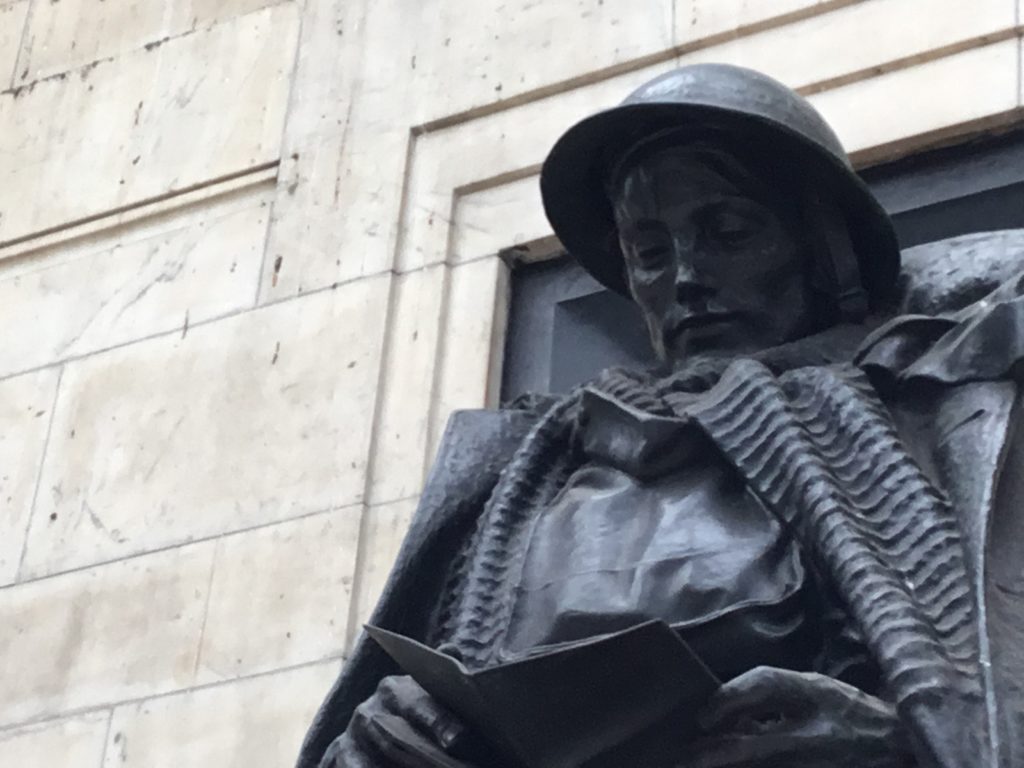
Statue of a soldier looking down at a letter. The soldier is wearing a helmet, heavy jacket known as a great coat and gas mask bag. The soldier's face appears thougthful.
Paddington Station’s soldier statue on Platform 1. Sculpture by Charles Sargeant Jagger MC.
P. Ferguson image, August 2018.

Thread Ten

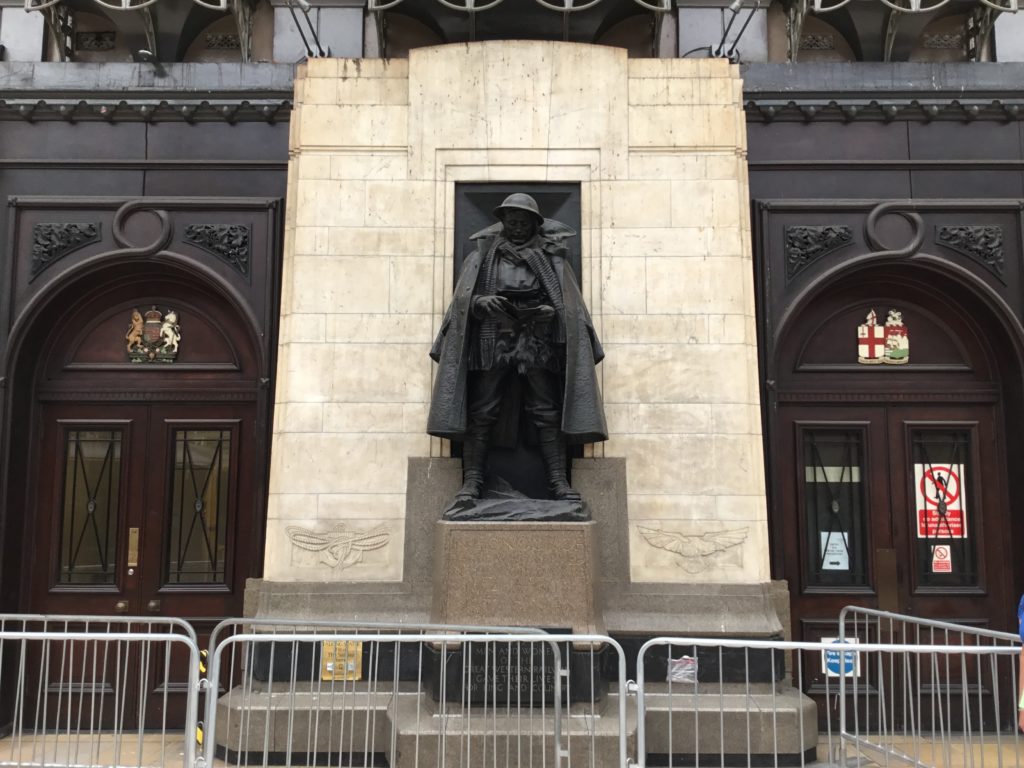
From London Victoria we walk to Paddington Station, to visit a well-known bear and to revisit with a soldier statue. The latter created by Charles Sargeant Jagger MC as the Great Western Railway War Memorial. Jagger was an experienced Great War officer with the Worcestershire Regiment and was wounded on three occasions and awarded the Military Cross.

The soldier statue stands on Platform 1 alongside a wall within Paddington Station, with a letter in his hands. He is reading. This statue was the subject of a recent and most successful letter campaign with 21,439 letters written about and inspired by this work in bronze. The soldier continues to stand, he continues to read. Please look after this soldier.

The Great Western Railway War Memorial at Paddington Station.  The soldier statue reading the letter framed by a white stone wall behind. He stands upon a plinth. There is a modern series of gates set up in front of the statue. Entry doors to either side of the memorial have the Royal Coats of Arms and another possibly relating to the City of London above the entries.
The Great Western Railway (GWR) War Memorial commemorates 3,312 men and women of the GWR who lost their lives in two world wars.
P. Ferguson image, August 2018.

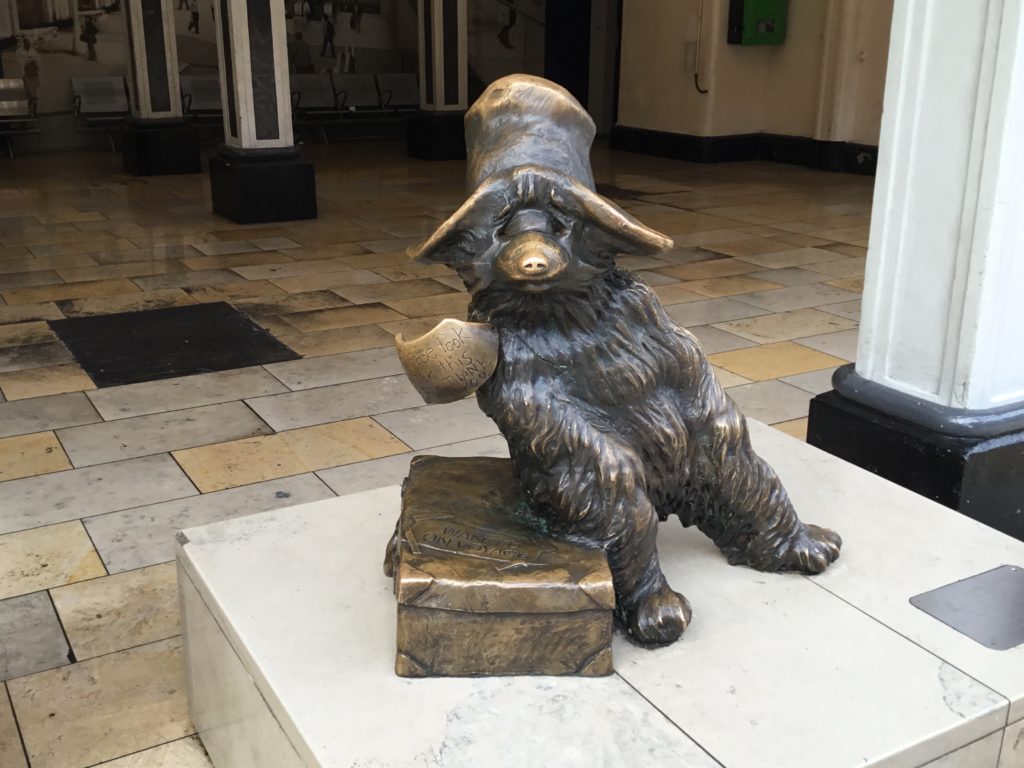
Near to the soldier is a bench and a statue of Paddington Bear, a character created by Michael Bond and inspired by World War Two child evacuees. Bond himself survived an air raid in February 1943 when the building he was in collapsed killing 41 and injuring many others. Bond soon applied to the Royal Air Force, aged 17, but subsequently served with the Middlesex Regiment. Paddington’s famous tag reads, Please Look After This Bear.

Bronze statue of Paddington Bear. Unlike the cartoon he does not wear a jacket or boots. He wears a large address label and large floppy hat. He sits on a suitcase.
Paddington Bear statue, please look after this bear (and this soldier). Platform 1, Paddington Station, London.
P. Ferguson image, August 2018.

——-SNIP——-

Previously published Pipes of War website, 14 August 2018

Beside a Prince and a Private

Conical hammer and chisels sit on a plinth at the Commonwealth War Graves Commission Visitor's Centre. An example of their engraving is shown  "BAR MM DCM" in reference to British honours.
Some tools of the trade. CWGC Information Centre, Ieper (Ypres).
Equipment used by headstone engravers of the Commonwealth War Graves Commission.
P. Ferguson image, August 2018.

Thread Nine

The considerable work of the Commonwealth War Graves Commission [CWGC] is evident across the globe. I have visited their work at many sites in Canada and North West Europe, Malta, and Turkey.

Headstones and memorials require continual maintenance and often I have been delighted to see their work in progress as gardeners and stone masons tend the myriad of plantings and built landscapes carefully thought out to preserve these places of commemoration.

Apart from gardeners and masons, there are landscapers, painters, metal workers, tree surgeons, and other tradesmen, as well as a large number of staff who maintain the records of these souls who reside in their care. Together their work is seen as one…a fine standard to uphold and cherish by those of us who visit perhaps once in their lifetime or for some of us – on several occasions.

Not all that long ago a CWGC information centre was opened near to Menin Gate. Here CWGC staff assist visitors in trying to find their family’s loved ones and ancestors. One only has to visit these places of commemoration to see evidence of those who have taken steps to reconnect their Great War to themselves. It is family, it is a shared heritage…family…community…region…nation.

In Ypres, this August 2018, we walked from Ypres Reservoir Cemetery to Ypres Town Cemetery…the Menin Gate Memorial…to Woods Military Cemetery. We have stood beside a Prince and a Private, read messages from across this globe and stopped to look a little closer. Long may it continue that we are able to share our interests with our readers thanks to the vision of the Commonwealth War Graves Commission.

——-SNIP——-

Previously published Pipes of War website, 13 August 2018

The Colour of Peace

The Cloth  at Ieper (Ypres), Belgium. A nearby midway features Mickey Mouse in his sorcerer's apprentice costume from Fantasia.
The Sorcerer’s Apprentice, from Fantasia, near to the Cloth Hall, Ypres (Ieper).
P. Ferguson image, August 2918.

Thread Eight

Despite those of us who have been drawn to Ypres because of the Great War there are other colours to this town. It is alive and filled with the voices of today and hopes for the future. Ypres – Ieper is filled with community – its own community – its own people. There is colour here – a kaleidoscope of vibrancy with fine shops and dining on the square and the in-between places to discover just around each corner.

Some are surprised to see that the Menin Gate Memorial is within the city, a short walk from the square where traffic is stopped for every evening’s Last Post by the buglers of the Fire Brigade. Since the 2018 Great Pilgrimage has returned home, a fair, midway, carnival has occupied the square offering all the rides and games that children and families enjoy. Guns crack at targets whilst bumper cars bounce into each other as glees of laughter rise up from the occupants. Plush toys are gathered by children as the sounds of music and bistros mix together.

And then there is myself finding joy in the happiness of families. I smile gently with this peace…but as always am on the watch for one more reminder of whence this peace came. It is then that I find myself with the Sorcerer’s Apprentice near to the Cloth Hall…we can only imagine what this town has endured…once the black and white world of conflict…now filled with the colour of peace.

Fantasia (Night on Bald Mountain 2/2)

—–SNIP—–

Previously published Pipes of War website, 12 August 2018

Mrs. Kate Palmer’s Walk

Two Commonwealth War Graves Commission headstones for Ptivates E.F. Gower and Roy Palmer, late of the 8th Canadian Infantry Battalion "The Little Black Devils". The markers are inscribed with a maple leaf representative of Canada and a Christian cross. The markers  are identical in style.
Standing in the footsteps of Kate Palmer. At her son’s grave, Private Roy Palmer,Woods Military Cemetery, Belgium.
P. Ferguson image, August 2018.

Thread Seven

1922 – Kate Palmer of Victoria, B.C. journeyed to Belgium to visit her son’s grave at Woods Military Cemetery, south of Ypres.

Today, 11 August 2018, we retrace Mrs. Palmer’s path and decide to walk from Ypres to the grave-site of Roy Palmer, located some five miles south of the city. It is a wooded area and a place I have visited before. Mrs. Palmer’s journey came to me when recently researching through the pages of Victoria’s Daily Colonist newspaper, “widow of Deputy-Chief of Police returns from Ypres, where she visited her son’s grave, which she found well cared for by Belgians…Woods Military Cemetery, Zillebeke, killed in action at Sanctuary Wood Jun 3, 1916.” (Daily Colonist, 1922-09-03, p.5)

As we find our way I re-visit a demarcation stone that I regularly photograph, and also return to both Spoilbank and Chester Farm Cemeteries. Nearby, horses tug at the grass across the road from a farmer’s field where, over the years, the fragments of war routinely appear. They are part of the crimson that lies and grows here – iron and poppies.

As I approach Roy Palmer’s grave I can only wonder of Mrs. Kate Palmer’s footsteps. Could she hear her own heartbeat? Was she alone? How did she get here and from where exactly did she come from? Have I passed by her place of stay in Ypres and, as I stand before the marker, have her tears graced this soil? I am here today standing within her footsteps, the moment is not lost upon me. Across the fields the towers of Ypres rise above the horizon.

I remain a while, standing alongside the graves of seven other members of the 8th Battalion CEF (Roy’s comrades), knowing too that another message, from Kate, appeared in the Daily Colonist, “In ever loving memory of Roy, eldest and dearly beloved son of Kate and late Thomas Palmer, Deputy Chief of Police, KIA Jun 3, 1916 at Ypres, also all his dear comrades.” (Daily Colonist 1923-06-03)

Side by Side

881 Sgt. J. Nicholas (3 June 1916)
622680 Pte. R.W. Reynolds (2 June 1916)
A/22682 Pte. P.M. Stevens (3 June 1916)
150128 Pte. T. Jackson (3 June 1916)
150093 Pte. E.F. Gower (2 June 1916)
17269 Pte. R. Palmer (3 June 1916)
A/22772 Pte. F.W. Ridley (4 June 1916)
460813 Lt. A.J. Hill (4 June 1916)

Published on the square, Ieper (Ypres), 11 August 2018

Nine Commonwealth War Graves Commission headstones at the back of Woods Cemetery, near to the wall. A van is in the field behind the wall. We are looking towards Ypres to a blue sky filled with puffy white clouds.
Side by side…comrades of Roy Palmer lie together at Woods Military Cemetery.
Together with one other from an English regiment.
P. Ferguson image, August 2018.

——-SNIP——-

Previously published Pipes of War website, 11 August 2018