The Highway to One Man of Passchendaele

Captain Oswald Howey Lunham, “…for now and all time”

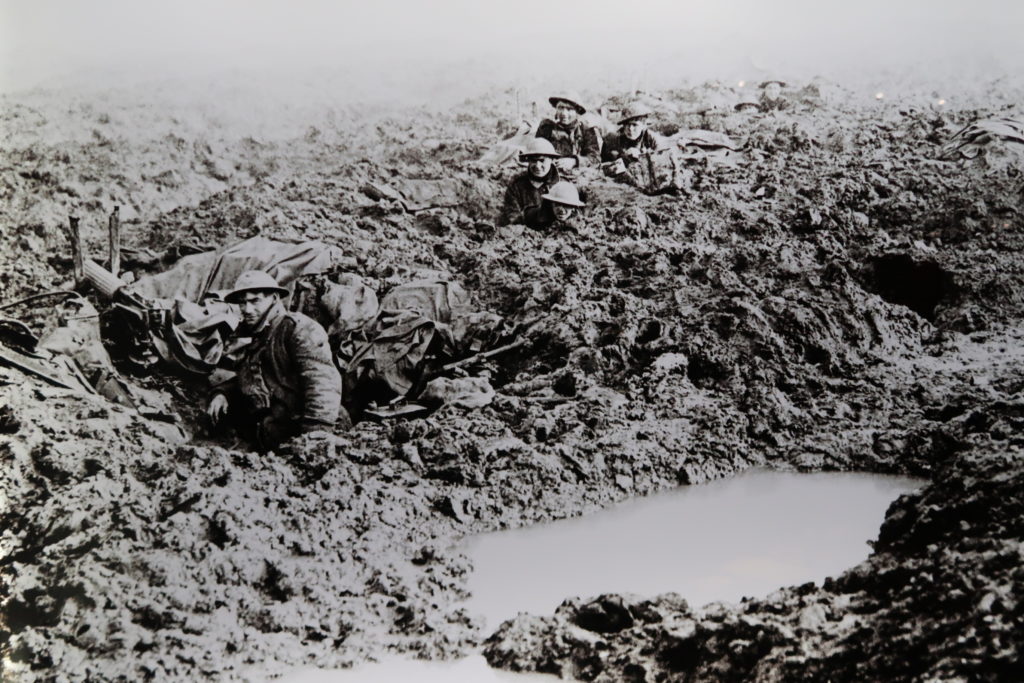
Soldiers amidst the mud and water-filled craters of Passchendaele. The waterfields are now pasture land for cattle below the ridge that was captured November 10, 1917.
Passchendaele (July 31 — November 10, 1917).
Imperial War Museum Exhibit Transparency.
P. Ferguson image, September 2017.

The Highway takes us up the island to our turn to the left…..to a solitary church…..near to a railway bridge…..near to a river.

Sitting at my desk some while back I wrote and re-wrote the words that have become this day’s Passchendaele. A battle whose centennial was recently marked July 31, 2017 – but the words of mine, for that time, did not meet my expectations and so I let them rest until this day when I have traded pen and paper for keyboard and screen. I can reminisce more easily this way winding my way visually and through the keys to our person of interest.

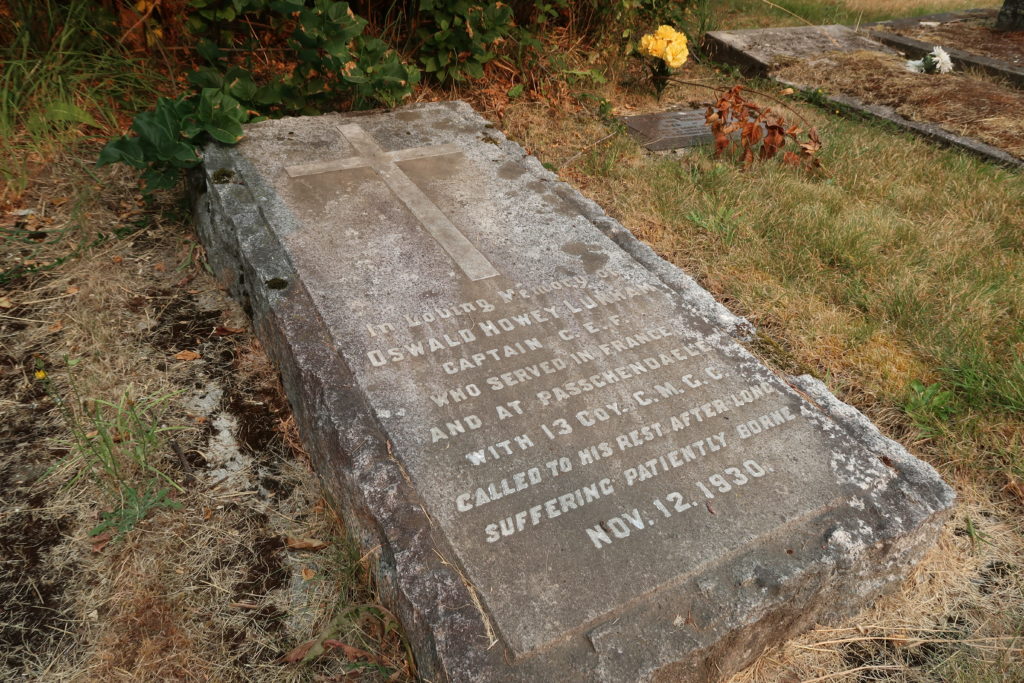
As we meander towards the church with its place of rest I contemplate the phrase we are to encounter. I know not much of our soldier but he is here with one line to remind us all of his Passchendaele. It is his story – a family story – captured for all – and for all time – by one mindful soul’s thought, “CALLED TO HIS REST AFTER LONG / SUFFERING PATIENTLY BORNE / NOV.12.1930.”

The lettered full length grave marker of Captain Lunham in the churchyard cemetery at Cowichan Station. The marker includes a large cross above the inscription.
Resting place of Captain O.H. Lunham, Passchendaele veteran,
St. Andrew’s Anglican Church, Cowichan Station, B.C.
P. Ferguson image, August 2017.

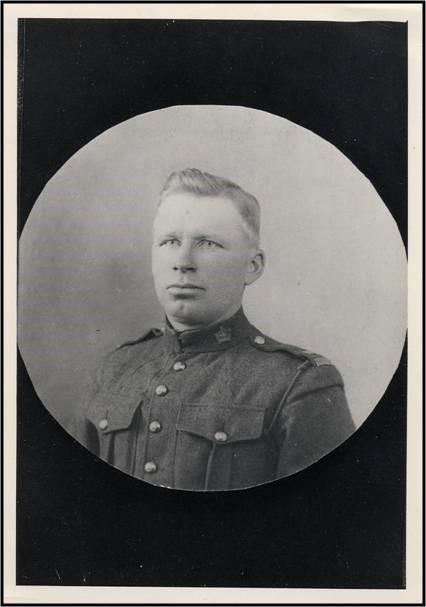
Captain Oswald Howey Lunham joined the 112th Battalion CEF at Windsor, Nova Scotia. A mine manager, Lunham served in France and Flanders commencing in July 1917 with the 13th Canadian Machine Gun Company. It was 10 November 1917, at Passchendaele, that Oswald Lunham suffered Shell Shock. Though his service record includes lengthy observations of his symptoms, some lines stand out from the others, “He has the appearance of a very neurotic person, and has a cast down expression as if some great sorrow was on his mind…He states he was always of a nervous temperament, but since this shell shock his nervous system seems completely shattered.”   (Assistant Director of Medical Service, Military District 6, April 13, 1918, pages 61 and 64)

Evidence of a previous breakdown, ca. 1914, are recorded in medical reports of 1918, however, Oswald Lunham chose to wear the uniform of his Canada. After seven months service in France, it was after two attacks at Passchendaele that Lunham’s system broke down leading to rheumatic fever, a complete nervous breakdown, difficulty in sleeping, difficulty in the company of others, afraid to be left alone in the dark, headaches and depression.

As I continue to read through these reports the repetition of his symptoms bounce again and again from the pages of 1918 to the face of 2017. Our goodly Mr. Lunham’s Passchendaele would remain with him for the rest of his days…and yet I take some comfort from the words of 1918 when I read “He can travel by transport as his wife can accompany him…” and it is perhaps from Myrtle Lunham, his dear wife that chose our thought for now and all time at a solitary church…..near to a railway bridge…..near to a river….

The Trews, Highway of Heroes.
Support the Canadian Hero Fund

Previously published Pipes of War website, 11 August 2017

In the morning, evening, at night…

Om morgonen, kvelden, natta*

Portrait of Private Ole Berget, in the uniform of the Canadian Expeditionary Force. The tunic includes maple leaf shaperd general service collar badges and Canada shoulder titles.
Private Ole Berget, 31st Canadian Infantry Battalion. Missing in Action, Fresnov, 3 May 1917.
Author’s Family.

In the darkness of the early morning the men of Alberta waited for the barrage to commence which would send them “over the top.” In spite of the heavy enemy bombardment, there were few casualties before the opening of the attack; but in front, swept by rifle and machine-gun fire and an open target for enemy shells, lay “No Man’s Land,” and beyond that – the enemy wire.

Promptly at 3:45 a.m. the barrage came down on the German positions, the whole terrain erupting suddenly into red flashes of bursting shells. In the darkness the men of the 31st Battalion climbed the parapet and went forward to the attack. Even as they did so the German counter-barrage fell on the leading companies and the deadly German machine-gun fire slashed through their ranks.

Onward and upward over the gently-sloping ground the attacking waves pressed at the double. In the darkness men stumbled over debris and pitched into shell holes, to rise and again push forward. Others fell, riddled with machine-gun bullets or disrupted by bursting shell, to rise no more.

(H.C. Singer, History of the Thirty-First Battalion C.E.F., pages 216-217)

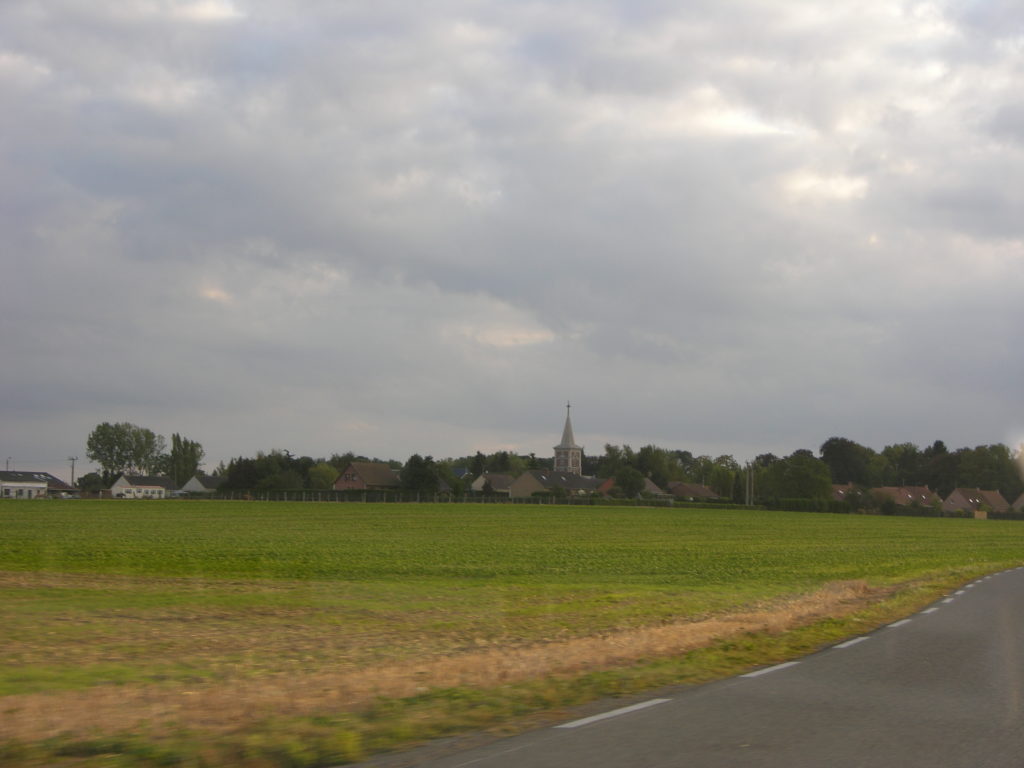
Looking towards the French village of Fresnoy. A green farmer's field in the foreground. On the horizon a church steeple rises above the town. It is a cloudy day.
The now peaceful and rebuilt French village of Fresnov En Gohelle (Fresnov).
P. Ferguson image, 2009

In 2009 I drove to Fresnoy, France with two friends for an exploration of the village of Fresnoy. It was here, to the north of the town, that my Great Grandfather was to lose his life…missing in action…commemorated on the Vimy Memorial. Today, near to a hundred years ago, I know it is time to return to this village. A time to wander this ground again and to include in my visit a nearby Commonwealth War Graves cemetery where there, amongst the markers, perhaps a Canadian soldier, Known Unto God.

*In the morning, evening, at night…we will remember them.

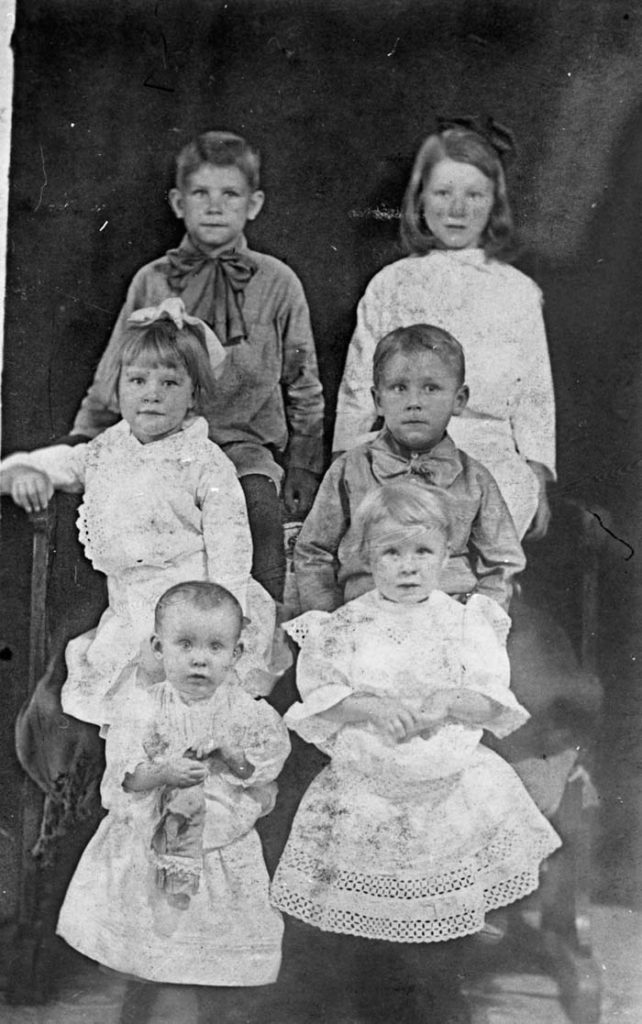
The first language of the Berget family who lived at Alderson, Alberta, near Medicine Hat was Norwegian*. Ole Berget left behind his dear wife Emma, and six children. Emma’s brother, Private Bernard Kyllo, 50th Canadian Infantry Battalion, was killed in action at Souchez, 1 February 1917 and is buried at Villers Station Cemetery, France.

Six children of the Berget family. Four posed upon a large chair. The two boys wear large bows at their necks. The two older girls with ribbons in the hair. The youngest girls in the foreground are standing, the youngest holding a doll.
The Berget Children
L-R back row; Willy and Myrtle, second row L-R; Florence “Flossie” and Edwin, front row L-R; Hazel and Mabel (undated). (Esplanade Arts and Heritage Centre, Medicine Hat, Alberta, Accession 0596.0004)

Previously published Pipes of War website, 1 May 2017

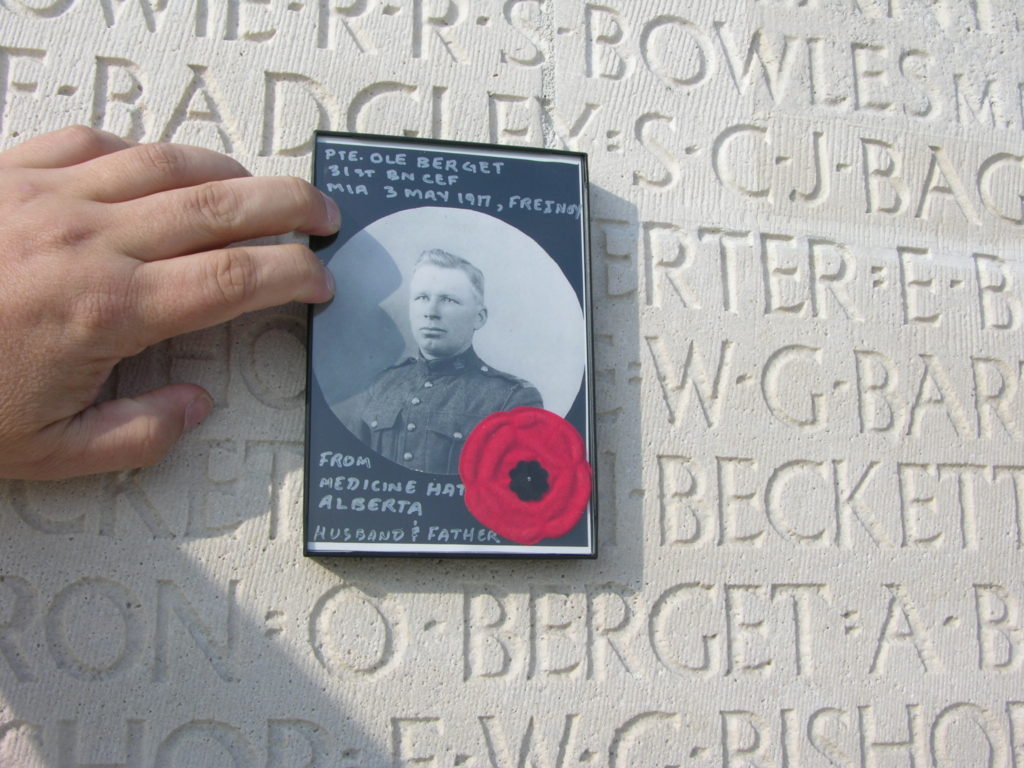
My Vimy

The writer's hand holds a framed portrait image of Private Ole Berget against the lettering of his name on the Vimy Memorial. There is a red poppy within the frame.
My Vimy. Ole Berget, 2007 Vimy Memorial Rededication
P. Ferguson image, April 2007

It is as if Vimy is the start of what I do

Vimy is connected to family. It’s personal.

This I learned many years ago from my grandmother who told me stories about her father…..which were…..upon reflection…..stories her mother had told. This was the man Grannie knew…..memories…..passed from one generation to another. Grannie was two years old or thereabouts when her Papa left this plain for another place, at another battle – known as Fresnoy – now so near to a 100 years ago.

Watching this past Sunday, I learned of many who followed this desire that rises in some of us to see for ourselves. I did not go this time but have been before and will go again. There is peace in what I do. I am at home here – walking, cycling, feeling these places as they ache into the heart and allow me to find connection through the space of years from conflict to calm. What noises, sites and smells were here then and what is here now? Patient, continuous observation without the chaos, within my own plain.

There can be no doubt that the consideration to remain at home was for a reason. I did not go. I did not speak – but found solace in words and thoughts from the wreckage of this past. My Vimy was 2007 at the rededication of the Vimy Memorial when I took my Great-Grandfather’s portrait with me and upon that ridge looked into this man who somehow brought me here. That day Private Ole Berget, late of the 31st Battalion CEF seemed to say, “I have been here before……………take me home”……….he just wanted to come home.

Somehow, I like to think that this is what many of us feel when we watch amongst this emotion and search for our peace. We find ourselves, our Vimys, our Fresnoys…….…it’s personal.

Previously published Pipes of War website, 11 April 2017

This Land of Crimson

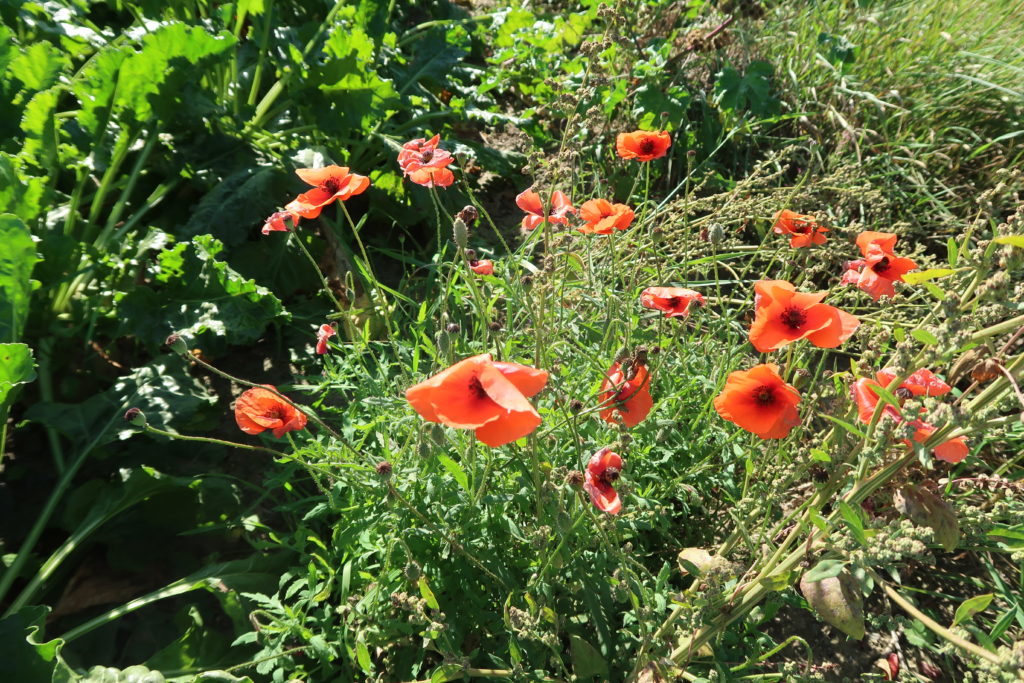
A stand of red poppies along the roadside. Crimson and black against the green foliage.
Flanders poppies along the roadside near Ouderdon, Belgium.
P. Ferguson image, September 2016.

Papaver rhoeas

On the advance to Reningelst I see them. A small stand, crimson with black centers grow near to another botanical family – corn stalks.

They are the only Papaver rhoeas (Corn Poppy) I have seen on this journey of discovery – their colour stands out amidst all this new growth from nature’s palette. Gentle in the breeze, catching the sun’s rays, their motion reminds me of a single moment when hurt is caught between the living and the fallen.

I cannot help but dismount, climb the slight rise to enjoy their life, their gentle sway as the shutter clicks. All the while…here in Flanders Fields, this land of crimson…we will remember them.

Previously published Pipes of War website, 11 November 2016

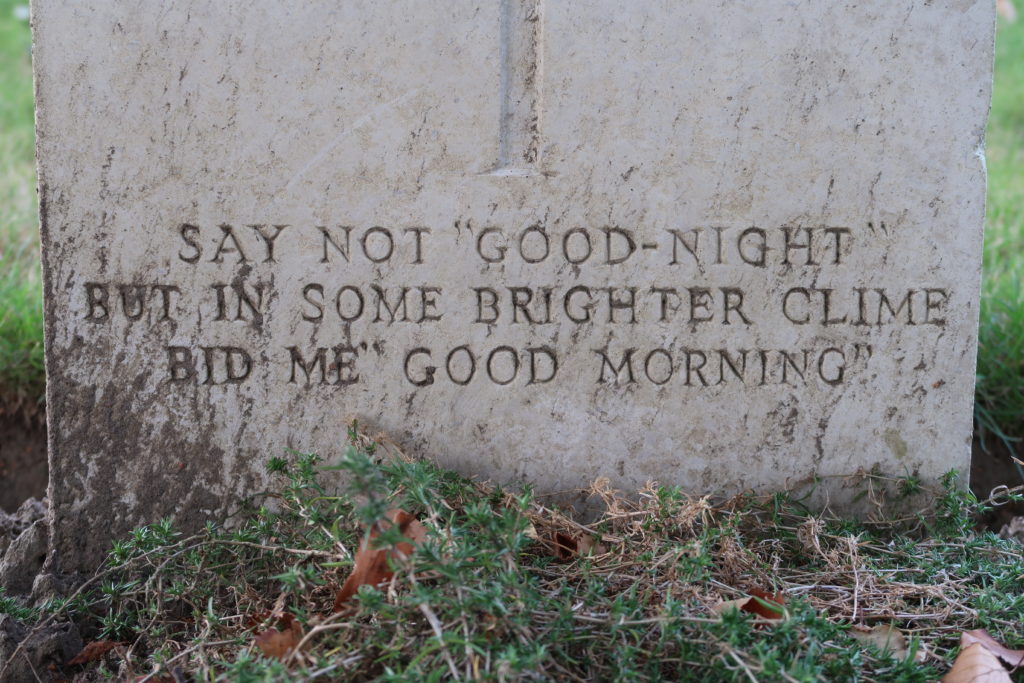
Say Not “Good-Night”

The inscription on the Commonwealth War Graves Commission headstone is at the base of the tablet.
Headstone inscription, Minty Farm Cemetery, Belgium.
P. Ferguson image, September 2016.

But in Some Brighter Clime

He was a soldier, unknown to me, but through my wanderings across Flanders I stumble upon his place. He is there with his fellow soldiers… who knew not what the day would bring. But this day, this time, this place, I stop a while and think upon his life and wonder who he was to others….We will remember them.

Bid Me “Good Morning”

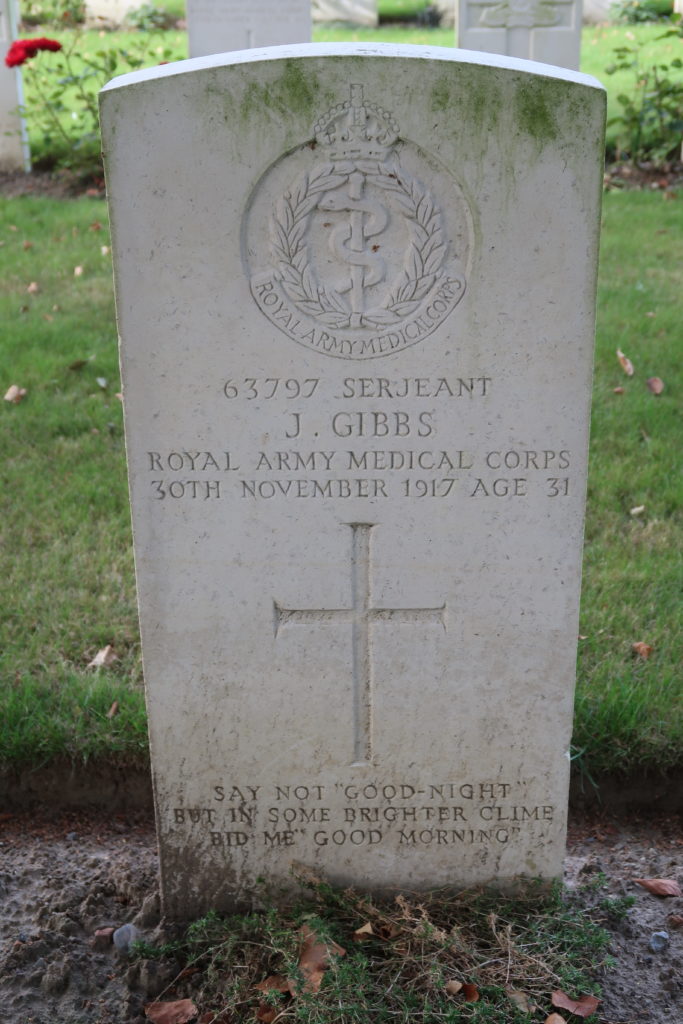
The full length headstone of Sergeant J. Gibbs includes the insignia of the Royal Army Medical Corps, a  Cadeuscus, (a snake wrapped aroundd a pole). Contained within a wreath with the King's Crown above.
Sergeant J. Gibbs, Royal Army Medical Corps, Age 31.
P. Ferguson image, September 2016.

Sergeant Gibbs’ headstone inscription is from the poem entitled “Life” by Anna Laetitia Barbauld (1743-1825). Son of Thomas and Maria Gibbs, of Burton-on-Trent; husband of Madeline Elizabeth Gibbs, of 199, Uxbridge St., Burton-on-Trent.

Previously published Pipes of War website, 9 November 2016

Remember Them Well

Mountains and Places – Any Day and Any Table

Many of us enjoy watching movies time and time again. Each year I promise myself to find a few others and as I sit with pencil and paper in hand, neatly levered into my chair – my place, I jot down a few titles or more. The latest list includes one film I had not thought on for many years until Cold Mountain comes to mind and especially for what I recall as the end theme. To my great pleasure I have forgotten much…..but not this day…..

My gosh where has my time gone? Jude Law, Nicole Kidman, Renée Zellwegger and the band, Brendan Gleeson, Jack White and Ethan Suplee. As I watch this story of the Civil War…and its hurt…I cannot help but drift with my thoughts to Ken Burns’ documentary and its wonderful reoccurring theme Ashokan Farewll. In Cold Mountain we have to wait to the ending for Alison Krausse and The Scarlet Tide to take up the story, and in her sweet voice paraphrase and melodically rekindle our 154 minute journey.

This film is an allegory, a reminder of hurt in war where pain is masterly crafted in simple words (but my how I wish I could write them). As you read upon Ada Munroe’s [Nicole Kidman] thoughts…think of all families…left with the same hurt…from any war…any where….any time…..

What we have lost will never be returned to us…..The land will not heal……too much blood…..the heart will not heal…..All we can do is make peace with the past…and try to learn from it….

And later

…..There are days now when I manage not to think of you…..When the needs of the farm call with more urgency than my heart…..This time of year there’s so much life everywhere…..I find you in all of it…..as if you were still walking home to me…..If you could see us now this Easter day, at Black Cove, you would know every step of your journey was worth it.

As you watch this clip I cannot help but think of families after the Great War (or any war) at special events or for that matter any day at any table. Know that every person gathered at this table has somehow suffered a loss related to war. Think too about Canada’s Great War families, America’s families, anyone’s family – they may have spoken Athabaskan, Norwegian, French, Russian, English, Chinese, Flemish, German…all nations hurt…all of us try to heal…

 I’m still climbing upwards and my journey’s almost ended. So friend if you’re thirsty climb this mountain with me….

Previously published Pipes of War website, 4 November 2016

There and Back Again

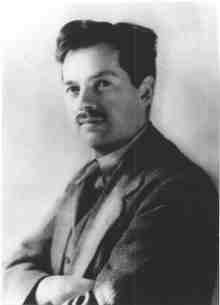
Eric Valentine Gordon

Portrait image of Eric Valentine Gordon wearing a jacket and tie.
British Columbia’s Eric Valentine Gordon, scholar, soldier and professor.

I can imagine them gathered around a table perhaps with a jug of ale, mead or warm cider. Finger foods, breads, meats and good conversation abound in tales of great imagination possibly anchored in some old tale of Norse or other. What brought them together…a common interest to share and then so many years later, so many tales, so many readings these stories released as films that I enjoy watching time and time again or the books I have returned to re-reading them with renewed imagination. What pray tell can these wanderings of tales of old could I be reckoning with?

I return again to Tolkien and his hobbits and rings, towers and kings, orcs and wizards. I have written before of Tolkien’s Great War and now I add his friend and Canadian soldier, Eric Valentine Gordon. Born in Salmon Arm, B.C. in 1896 Gordon was a student when he enlisted into the Canadian Field Artillery at Shorncliffe Camp, England, 11 August 1916. Gordon, service number 1260262 was, at the time of his enlistment, a student at University College, Oxford. I originally found Mr. Gordon’s name amongst those Rhodes Scholars that I had previously researched with Great War service and was pleased to find Gordon’s C.E.F. record there among his brethren. Although troubled since childhood with asthma the condition did not stop Gordon from enlisting into the C.E.F., though it was soon apparent that this malady would take its toll and he was discharged in November 1916. For the good Mr. Gordon there would be no trenches or dire landscapes as witnessed by Tolkien.

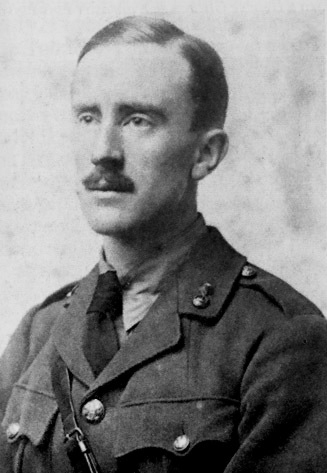
Portrait of soldier and author John Tolkien. He wears an officers tunic with Sam Browne belt.
J.R.R. Tolkien in 1916. A great friend of E.V. Gordon
Wiki image.

There are many stories of those who served in the trenches and saw action at the familiar place names of the Great War. There are fewer stories though about those who were discharged due to medical disabilities and other reasons. I think upon those who did all they could to serve and am reminded of what must have been a rather small group of brothers the H.R.V.C., (the Vancouver based Honorably Rejected Volunteers of Canada) who had tried to enlist and for whatever reason were unable to serve despite their great desire. The H.R.V.C. had insignia, a lapel pin similar to those issued by the Canadian Patriotic Fund, or similarly the Silver War Badge. There were many other insignias produced at this time and all were important distinguishing marks to be worn during these times of conflict.

It is true that there were antagonists who harassed those they thought should be in uniform, Why are you not serving your country? and who at times distributed white feathers, representative of cowardice, to those they deemed were not doing their bit. Having actually seen an original feather and accompanying note it is very much another astonishing symbol representative of a complex time.

These pins, many subject to punishment if worn unlawfully, marked the man as one who had served or attempted to serve and displayed to potential antagonists that they had attempted to serve the cause or had been discharged from active service.

Returning to the good Mr. Gordon, I was inspired to learn, that he had worked with Tolkien and the two became great friends, who perhaps shared stories that led to the creation of that famed series of books now further immortalized by Peter Jackson.

Gordon, “Being no longer physically fit for war service” returned to school. He had attended Victoria College and McGill University prior to the Great War and afterwards taught at Leeds University 1922 – 1931 and Manchester University until his death in 1938. Gordon worked with Tolkien on A Middle English Vocabulary and Sir Gawain and the Green Knight. Together they created the Viking Club where Icelandic sagas of old were read, and amongst friends and faculty beer was consumed. Together Gordon and Tolkien enjoyed the creation of Anglo-Saxon songs that were later privately published as Songs for Philologists.

Gordon’s wife Ida later became a visiting professor at the University of Victoria in 1970. Their daughter Bridget  MacKenzie, a lecturer in old Norse at the University of Glasgow, inherited several personal papers and books related to the friendship of her father and Tolkien. These documents were purchased by the Special Collections department of the University of Leeds. The University’s catalog description records, “The six letters, 11 manuscripts and two books include a copy of the extremely rare Songs for the Philologists, penned by Tolkien, Gordon and others, and a first edition of The Hobbit dedicated by its author to Gordon, his wife and young children.”

For me this research of friendship has taken me there and back again from re-reading The Hobbit and The Lord of the Rings series, re-watching Jackson’s interpretations of these journeys and to my Alma Mater, the University of Victoria. I see them all, the characters, Gandalf and Bilbo, Frodo and Sam of Tolkien and Gordon’s great imagination and creativity, those who are quite “little fellow[s] in a wide world after all” and see that indeed there really is no such thing as little fellows. All peoples are unique in their gifts of sharing knowledge for all. Thank goodness.

Previously published Pipes of War website, 22 August 2015

Thoughts of Home

I find inspiration in many places and sometime in the last year or two was told about Alfie Boe and the song Bring Him Home from Les Miserables. I have seen “Les Mis” at the Palace Theatre, London with good friends and my best friend Rosemary. I recall the event well, enthralled by the live performances from the stage and the power generated from the fine voices that empowered the audience. When our film director, Casey Williams suggested I re-listen to the song by Alfie Boe, it struck a deep connection for me, one that you can even feel with your eyes.

With my interest in military history on both the front lines and on the home front the thought of home is forever an enchanted message. As the notes first begin, I sense my eyes gently closing, head back slightly and wait for this magical voice to fill my heart, my soul, my person. Home…what does it mean to us, what does it mean to you? It can be a place of joy or sadness, but regardless home is always a place of hope. As the son of a soldier I know what it is like sitting beside a decorated tree with my mother by my side and with my father somewhere else. Now after all these years later thoughts of home become increasingly more powerful as our dear loved ones become more and more meaningful with each passing day.

The Palace Theatre, London, England at the time. A beautiful Victorian two tone brown building with tower like structures at the corners. Multiple windows can be seen along the sides.
The Palace Theatre, London. Thoughts of home and the magic of performance.
Wiki Image

Home is to the soldier what home is to all of us, a chance to be whole and to be part of something more than ourselves. As Bring Him Home delivers its message, regardless of the context, it reminds me that we find our own experience in anything that we relate to. It reminds me that everyone feels something differently and that is the beauty of the arts, taking any form, any amount of emotion, making it our own and sharing it with those we love. So as 2014 slips past, remember those who cannot be with us, remember absent family and friends, and provide a kind thought for them as you gently close your eyes, head back and listen to Bring Him Home.

All the best for a grand and fine 2015.

Bring Him Home

God on high
Hear my prayer
In my need
You have always been there

He is young
He's afraid
Let him rest
Heaven blessed.
Bring him home
Bring him home
Bring him home.

He's like the son I might have known
If God had granted me a son.
The summers die
One by one
How soon they fly
On and on
And I am old
And will be gone.

Bring him peace
Bring him joy
He is young
He is only a boy

You can take
You can give
Let him be
Let him live
If I die, let me die
Let him live
Bring him home
Bring him home
Bring him home

Previously published Pipes of War website, 31 December 2014

A Thousand Stars Away

Visiting Talbot House 2013 

Exterior view of Talbot House, in Poperinge, Belgium. The flags of Belgium and the United Kingdom out front and above a sign lettered Talbot House.
Talbot House, Poperinge, Belgium.
P. Ferguson image, September 2013

Sometimes it is worthwhile letting some time pass by. It’s an opportunity for better reflection and gathering those thoughts that have laced their way through our day until this moment when at long last it is time to sit down and put virtual type to virtual paper.

The most memorable visit on our recent sojourn to France and Flanders was a stop at Talbot House, Poperinge, Belgium. It was here that soldiers of the Great War were able to get away, even if momentarily, from the harsh realities of the frontlines in the Ypres Salient.

As I stand at the front of the building I look upwards to the sign dated 1915 – ? The last time I was here the building was covered with scaffolding but this time we are told of a side entrance whereby we gain entry into this wonderful site. It is filled, from the outset, with the hearts and souls of those who have passed through here from 1915 – 1918. It was here that soldiers gathered for a bit…and then returned to the scorched and twisted landscape…some never to pass this way again.

Lettering on the stairs leading to the loft at Talbot House, Poperinge, Belgium. The stairs are wooden and rather steep.
Lettering on the stairs:
EXCELSIOR, ONCE AGAIN! A COMPANION – LADDER THIS TIME, LEADING TO A LOFT. / PERHAPS 100,000 HAVE CLIMBED THESE STAIRS – BEFORE YOU, AND BEFORE / GOING UP THIS LINE. HERE YOU ARE ON HOLIER GROUND THAN ANY
P. Ferguson image, September 2013
Holier Ground Than Any. The loft at Talbot House.
P. Ferguson image, September 2013

I was immediately taken with the house and its furnishings and signs. It is here that the Great War is at peace today. I remember climbing about the stairs, looking at the rooms and then to the stairs leading to the loft. The stairs were rather pitched and narrow, but still we managed to climb into the loft where church services continue to be performed.  After having watched, in another part of the building, a short film on Talbot House troop entertainments, we settled onto some chairs and it was here that     our guide brought her words to us, creating an even greater sense of this place. “Twenty years ago there were veterans here. Their eyes, a thousand stars away. They don’t see you. They see other things”. (Annette, Camalou Tours) These words continue to remind me what Talbot House meant to those who visited during the Great War, and how their experiences have shaped some of us fortunate to have met a few of those witnesses to the war to end all wars.

Sometimes the Stars

—The Audreys (Adelaide, Australia, 2010)

Here I am confessing, you're lost to me now
I'm on a train telling strangers, about you
How you're still looking fine
How you ease my worried mind
Long, summers and wine
Yeah, you saved me
But sometimes the stars seem closer than they should
Like the more I knew, the less I understood
And the further that you got from me
The more I felt like I could see
The more I wondered if I should trust the stars
'Cause sometimes the stars
Here I am obsessing, that I lost you somehow
On a train full of strangers, and you
Every star look the same
All of those faces without names
They all drifted away
Is that when you left me?
'Cause sometimes the stars seem closer than they should
Like the more I knew, the less I understood
And the further that you got from me
The more I felt like I could see 
The more I wondered if I should trust the stars
'Cause sometimes the stars

Previously published Pipes of War website, 1 December 2013

It’s Best to be Dusty

From a Land so Torn and Muddy

For the ones that were there, for the ones we think about.

Music, soundtracks, the tonal qualities that bring resonance to the ear, that unfold in the mind and create depth, meaning and memories. Music has always reminded me of my journeys; recovering bits of forgotten time when that one note, that melody takes me back, returning me to places and events, the experiences of my past.

In this instance as I sit in the Secret Garden at the Crowded House Hotel in Eceabat, Gallipoli it seems that an Adele song will forever be etched into my being as a reminder of this trip. So too will I remember the people on our tour and the others I met along the way. Individuals such as Australian Peter Robb a regular visitor to Gallipoli, whose grandfather fought here, and who I told after a day of hiking and wandering across this peninsula, “Its best to be dusty”.

In an instant there is much laughter shared between us as we both understand the context…its essence…a homage to being here, getting out there, seeing the terrain, learning the hardships, the struggle…being in the heart of this place. Gallipoli is to the Australians as Vimy Ridge is to us Canadians and so two visitors, who have only just met, share stories, laughter, our heritage this evening, with a few other new friends while sipping upon cold beverages.

As I sit and think (as I sometimes do) seemingly wandering through the day’s events, I start thinking of home, perhaps just like one of the lads on this peninsula in 1915. Perhaps he is in a trench, scurrying across a ridge, seeking cover from the enfilade of fire and artillery? Maybe he thinks of an Emma or Katie, the ones at home…?

The cemetery at Lone Pine, Gallipoli. Amidst the markers and memorial a solitary tree, green against a blue sky with white clouds.
Lone Pine Cemetery, ANZAC, Gallipoli.
P. Ferguson image, May 2012

Somewhere along this journey, in preparation for visiting here, I discovered an Australian song by Mick Thomas entitled Gallipoli Rosemary. The song lingers with me, creeping up at times along the paths here and reminding me what this place means to others. The song tells us about a Rosemary bush that was pulled from this place, contained within a rucksack, taken to Australia and re-planted where it and cuttings from it continue to grow. Rosemary is a symbol of remembrance worn similar to poppies and seen on the lapels of visitors to the peninsula. The herb also has a reputation for improving memory, and as Mick Thomas sings it is now the only living link connecting Australia, their Gallipoli veterans and this peninsula of memory.

And so as I sit in the garden, listening to Adele, and talking with our host about our musical interests, Gallipoli Rosemary slips into my being, repeating itself time and time again. It’s not difficult, being connected to this peninsula, this trip into 1915. Tonight like that Great War soldier covered in dust wondering about the next day, Gallipoli Rosemary reminds me of my Emma or Katie, but in this instance, my girl Rosemary and once again I wander to the hotel’s internet and send a message home…

An Australian soldier in uniform wearing the familiar cap worn by soldiers of the Australian army. His sun shaped badges visible on his collar, a divisional patch on his upper sleeve and a wound badge at his cuff.
An Australian soldier’s message, “Best wishes for all times”.

Previously published Pipes of War website, 21 July 2012